 KnowThis
Key Takeaways
Key Takeaways
- 1Microwaves enter food from every exposed surface, penetrating only about 1-1.5 inches (2.5-4 cm) deep — they don't originate from, or specially target, the center of the food.
- 2In small or thin items, that penetration can reach the center from multiple directions almost at once, which is what creates the illusion of 'inside-out' heating.
- 3In a large or thick item, the deep center is actually heated last, by ordinary conduction from the already-hot outer layers — the literal opposite of inside-out.
The short answer
| Myth | What actually happens |
|---|---|
| "Microwaves heat from the inside out." | Waves enter from every surface and are absorbed within roughly 1 to 1.5 inches (2.5 to 4 cm). Deeper parts heat by conduction afterward. |
| "Microwaves make food radioactive." | The FDA describes microwaves as non-ionizing radiation, which does not have enough energy to knock electrons out of atoms. |
| "They cook food evenly." | The USDA notes microwaves leave cold spots, so food should be stirred or rotated and left to stand before eating. |
| "Heat is made by the oven's metal walls." | The magnetron produces the microwaves, and they make water molecules in the food vibrate, creating friction that produces heat. |
The concept
Understanding penetration depth as the real mechanism explains both why small items heat evenly and quickly, and why the exact food safety concern with microwaves is usually an underheated center, not an overheated one.
A microwaved potato comes out with a very hot exterior but a noticeably cooler, sometimes still-firm center. What does this actually demonstrate?
Worked examples
Example 1: Reheating a mug of water (baseline case)
A mug of water, only a couple of inches across, sits well within the roughly 1-1.5 inch penetration depth of microwaves from every side. The waves reach every part of the water almost simultaneously, and convection currents within the liquid mix it further, producing a genuinely even heat distribution throughout — this is the scenario where microwave heating looks closest to uniform, not because of any special inside-out mechanism, but simply because the whole volume falls within reach of the waves from multiple directions at once.
Why does a small mug of water heat almost evenly in a microwave, with no noticeably cold center?
Example 2: A large frozen roast (edge case / variation)
Why is it risky to assume a large frozen roast is fully cooked after microwaving, based only on how hot the outside feels?
Example 3: Why microwave-safe packaging recommends standing time (real-world / applied case)
Packaging for microwavable meals commonly instructs a 1-2 minute "standing time" after the timer ends, before eating. This isn't a formality — it gives thermal conduction time to continue moving heat from the microwave-heated outer portions toward the still-cooler center, evening out the temperature and, for food safety, helping ensure any harmful bacteria in the coolest part of the food actually reach a safe temperature. Skipping standing time on a dense meal can mean eating a product that measured "done" at the timer's end on the outside, while the center never actually reached a safe internal temperature.
Why does standing time after microwaving matter for food safety, especially in dense or thick foods?
How it works (visual)
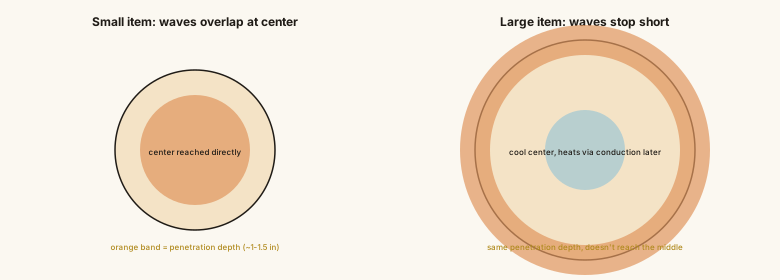
The waves behave identically in both cases — only the size of the food relative to the fixed penetration depth determines whether the center is reached directly or left to conduction.
Common mistakes
Common Mistakes
Assuming microwaves originate from, or specifically target, the center of food.
→ Remember waves enter from every exposed surface and lose most of their energy within a shallow penetration depth — there's no special interior targeting.
Judging a large or thick item as fully cooked based on how hot the outside feels.
→ Check internal temperature directly with a food thermometer for dense or thick foods, since the center heats last and most slowly.
Skipping standing time on dense microwaved meals to eat sooner.
→ Follow the packaging's standing time — it gives conduction time to bring the coolest part of the food up to a safe temperature.
Common misconception
“Microwaves heat food from the inside out, unlike a conventional oven which heats from the outside in.”
Microwaves enter food from every exposed surface and penetrate only about 1-1.5 inches (2.5-4 cm) before losing most of their energy — they don't originate from or specially target the interior. In small items, waves from multiple sides can overlap and reach the center directly, creating heating that looks fast and even. In large or thick items, the deep center is actually the last part to heat, reached only afterward by ordinary thermal conduction from the already-hot outer layers — the same slow process that heats the center of food in a conventional oven. If anything, the pattern in a large item is the opposite of "inside out."
Try it yourself
Uses the specific heat equation to estimate the energy a microwave must deliver to a given mass of water — the same mechanism (dielectric heating of water molecules) driving most microwave cooking.
What to do next
What to do next
- Use a food thermometer to check the center of large or dense microwaved foods rather than judging doneness by touch on the outside.
- Follow package standing-time instructions on microwavable meals — they exist to let conduction finish evening out the temperature.
- Cut large or thick items into smaller, more uniform pieces before microwaving to keep more of the food within the waves' penetration depth.
- Stop assuming 'inside out' as the mental model — think of microwaves as entering from every surface a short distance, with the deep center relying on conduction afterward.