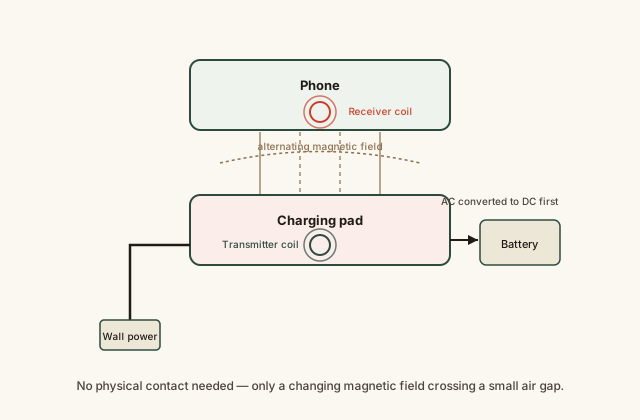
Wireless charging works through electromagnetic induction — a transmitter coil in the charging pad creates an alternating magnetic field, which induces an electric current in a matching receiver coil inside the device, and that current is converted to direct current to charge the battery.
Reading time
— 5 min
Updated
— Sep 24, 2026
Fact-reviewed
— Aug 28, 2026
Key Takeaways
Key Takeaways
1Wireless charging isn't power beamed through the air — it's electromagnetic induction between two coils held almost touching, the same basic physics used in electrical transformers.
2A transmitter coil in the pad creates a changing magnetic field, that field induces an alternating current in the receiver coil inside the device, and the device converts it to the direct current a battery actually needs.
3This method is inherently less efficient than a wired connection, since some energy is lost as heat during the induction process, and even small misalignment between the coils reduces efficiency further.
The concept
Picture two tuning forks. Strike one, and if you hold the second one close enough, it starts vibrating too — energy jumped from one to the other without them ever touching, just through the invisible vibrations passing through the air between them. Wireless charging works on a similar handoff principle, just with a magnetic field instead of sound: a coil of wire in the charging pad creates a changing magnetic field, and a matching coil inside your phone, sitting right on top of it, picks up that field and turns it back into electricity to charge the battery.
That coil-alignment sensitivity explains a set of very specific, very common wireless charging complaints — slower charging than a cable, a device that stops charging if bumped slightly, or noticeably more heat than expected — and each has a direct mechanical explanation below.
Quick check
Why does a phone often charge noticeably slower on a wireless pad than with a cable plugged directly into the same phone?
Worked examples
Example 1: Placing a phone on a wireless charging pad (baseline case)
A phone placed on a Qi-compatible pad first goes through a brief communication handshake — the pad sends a low-power signal, the phone's receiver coil detects it and responds confirming compatibility and requesting a specific power level, and only then does the pad ramp its transmitter coil up to full charging power. From that point, the transmitter coil's alternating current generates a changing magnetic field, the phone's receiver coil picks it up and induces its own current, onboard circuitry converts that to DC, and the battery begins charging — a process that continues as long as the phone stays reasonably well-aligned on the pad.
Quick check
Before a wireless charging pad ramps up to full power, it exchanges a brief signal with the phone placed on it. What is this initial exchange for?
Example 2: A phone case interfering with charging (edge case / variation)
A very thick phone case, or one containing metal components, can noticeably reduce wireless charging efficiency or stop it from working altogether. Metal is conductive and can itself pick up some of the transmitter's changing magnetic field, generating unwanted eddy currents that both waste energy as heat and can distort the field reaching the phone's actual receiver coil; simple added thickness (from a bulky but non-metal case) mainly increases the physical gap between the two coils, which weakens the induced field strength since magnetic field strength drops off with distance. Thin, non-metal cases generally have little to no meaningful effect.
Quick check
Why might a phone with a case containing metal decorative elements charge poorly or not at all on a wireless charging pad, even when properly aligned?
Example 3: Choosing between wired and wireless for a nightstand charging setup (real-world / applied case)
Someone setting up a bedside charging spot for overnight use, where slightly slower charging speed doesn't matter because the phone has hours to fully charge regardless, is a good practical fit for wireless charging — the convenience of simply setting the phone down, with no cable to plug in correctly in the dark, outweighs the modest efficiency loss. Someone who needs to charge as quickly as possible in a short window — topping up before heading out the door — is generally better served by a wired connection, since it avoids both the induction efficiency loss and any risk of slower charging from imperfect coil alignment.
Quick check
Why is a wireless charging pad often a better practical choice for overnight bedside charging, even though it's less efficient than a cable?
How it works (visual)
Electromagnetic induction between a charging pad and a phone
Everything in this diagram depends on that gap staying small and the two coils staying reasonably centered on each other — both distance and misalignment weaken the induced field, which is the direct physical reason wireless charging is more position-sensitive than plugging in a cable.
Common mistakes
Common Mistakes
✕
Assuming wireless charging works from any distance, the way WiFi or Bluetooth connects across a room.
→ Wireless charging via electromagnetic induction requires the two coils to be very close together — typically touching or nearly touching — not a genuinely long-range wireless power technology.
✕
Not noticing or troubleshooting poor coil alignment when charging seems slow.
→ Even a phone that looks 'on' the pad can be enough off-center to weaken the induced field — centering the device carefully on the pad's marked charging spot usually improves speed.
✕
Using a thick or metal-containing phone case without checking wireless charging compatibility.
→ Metal content in a case can meaningfully interfere with induction; check the case manufacturer's wireless-charging compatibility claims before assuming any case works fine.
Common misconception
“Wireless charging sends electrical power invisibly through the air over some real distance, similar to how WiFi sends data.”
Wireless charging via electromagnetic induction only works across a very small gap — essentially requiring the transmitter and receiver coils to be touching or nearly touching, since magnetic field strength drops off quickly with distance. It has nothing in common with genuinely long-range wireless power research (which remains largely experimental and inefficient at real distances); the "wireless" part refers only to the absence of a physical cable connection, not to any meaningful distance between charger and device.
Try it yourself
Estimate power delivered by a charger
Power delivered equals voltage multiplied by current — a simplified way to compare the rated power of different charging setups.
Power delivered (watts)5
Real-world wireless charging delivers somewhat less usable power to the battery than this figure, due to induction and conversion losses.
What to do next
What to do next
Center your device carefully on a wireless charging pad's marked charging spot rather than placing it anywhere on the pad's surface.
Check whether a phone case is labeled wireless-charging compatible before assuming a thick or metal-containing case will work fine.
Use a wired connection instead of wireless when charging speed genuinely matters, such as a short top-up before heading out.
Don't be alarmed by mild warmth from a wireless charger during use — some heat is a normal, expected side effect of induction losses, though a pad or phone that becomes uncomfortably hot is worth investigating.
FAQ
FAQ
Related terms
Related terms
Electromagnetic induction
The physical process by which a changing magnetic field creates (induces) an electric current in a nearby conductor, without any direct physical or electrical contact.
Transmitter coil
The coil of wire inside a wireless charging pad that an alternating current runs through to generate a changing magnetic field.
Receiver coil
The coil of wire inside a device (like a phone) that a nearby changing magnetic field induces a current in, which is then used to charge the battery.
Qi
An open wireless charging standard, maintained by the Wireless Power Consortium, that defines how compatible chargers and devices communicate and transfer power so products from different manufacturers work together.
Alternating current (AC)
Electric current that repeatedly reverses direction, which is what a wireless charger's transmitter coil uses to generate a continuously changing magnetic field.
Direct current (DC)
Electric current that flows in one constant direction, the form a battery actually stores and uses, requiring the induced AC current to be converted before charging can happen.
This entry was researched from public sources and drafted with AI-assisted tools, then edited — errors are still possible. Spot one, or want a topic covered? Read our disclaimer.
 KnowThis