How Lithium-Ion Batteries Work (And Why They Degrade)
A lithium-ion battery stores and releases energy by moving lithium ions back and forth between a graphite anode and a metal-oxide cathode through a liquid electrolyte, and it degrades over time because every charge cycle causes small, permanent chemical wear to those electrodes.
Reading time
— 5 min
Updated
— Sep 24, 2026
Fact-reviewed
— Aug 28, 2026
Key Takeaways
Key Takeaways
1A lithium-ion battery works by shuttling lithium ions between two electrodes through a liquid electrolyte — discharging sends ions one way and powers your device, charging sends them back.
2Degradation isn't a defect — every single charge cycle causes tiny, permanent chemical wear to the electrodes, so capacity loss over time is a predictable consequence of normal use, not a sign something is broken.
3Heat, full discharges, and constant 100% charging all accelerate this wear, which is why manufacturers commonly recommend keeping a battery in a moderate charge range and avoiding heat where practical.
The concept
Think of a lithium-ion battery as two parking garages connected by a one-lane road that only lithium ions are small enough to travel on. When you use your device, ions drive from one garage (the anode) to the other (the cathode), and that movement is what pushes electricity out through the wider road (the actual wires) to power your phone or laptop. Charging the battery just runs the whole process in reverse, driving the ions back to the first garage so they're ready to make the trip again.
This same chemistry explains a set of very common, very specific pieces of battery advice — and rather than take them on faith, it's worth walking through exactly why each one holds up mechanically.
Quick check
After a year of daily use, a phone's battery holds noticeably less charge than when it was new, even though nothing appears broken. What is the most accurate explanation?
Worked examples
Example 1: A normal charge-discharge cycle (baseline case)
A phone at 100% charge is used throughout the day until it reaches 0% and is plugged in overnight. During the day's discharge, lithium ions steadily move from anode to cathode, powering the phone via the electron flow through its circuitry, while the battery's voltage gradually drops as fewer easily-accessible ions remain at the anode. Overnight, the charger reverses the process, pushing ions back to the anode until the battery reports full again. This single day-and-night sequence counts as one full charge cycle — the SEI layer on the anode grows by a small, largely imperceptible amount, and the battery's underlying maximum capacity has dropped by a tiny, similarly imperceptible fraction.
Quick check
During a normal day-and-night charge cycle, why does the battery's underlying maximum capacity drop by a tiny amount, even though nothing appears wrong?
Example 2: Two identical phones, different charging habits (edge case / variation)
Two identical new phones are used for a year. One is regularly run all the way down to near 0% before being fully recharged to 100% and left plugged in overnight; the other is kept mostly between roughly 20% and 80% charge and rarely allowed to sit at either extreme for long. Deep discharges and prolonged time at 100% both place additional chemical stress on the electrodes compared to staying in a moderate charge range, so — all else being equal, including how much total energy each phone actually used over the year — the phone kept in the moderate range would be expected to retain more of its original capacity by the end of the year. This is the mechanical basis for the widely repeated advice to avoid habitually running a battery to 0% or leaving it plugged in at 100% for very long stretches.
Quick check
Why might a phone kept mostly between 20% and 80% charge retain more battery capacity after a year than an identical phone regularly run to 0% and then charged fully to 100%?
Example 3: Extending a laptop's battery lifespan in real use (real-world / applied case)
Someone who keeps a laptop plugged in and at 100% charge nearly all the time, in a warm environment (like near a sunny window or on a soft surface that blocks airflow), is combining two of the strongest accelerants of battery degradation: prolonged full charge and elevated temperature. Practical steps that meaningfully slow degradation include avoiding leaving the laptop plugged in and fully charged for very long uninterrupted stretches where avoidable, keeping the device cooler during heavy use, and not habitually discharging fully before every recharge. None of these steps stop degradation entirely — some capacity fade over years of use is unavoidable chemistry — but they measurably slow the rate at which it happens.
Quick check
A laptop is kept plugged in at 100% charge nearly all the time in a warm spot near a sunny window. What two factors are combining to accelerate its battery degradation?
How it works (visual)
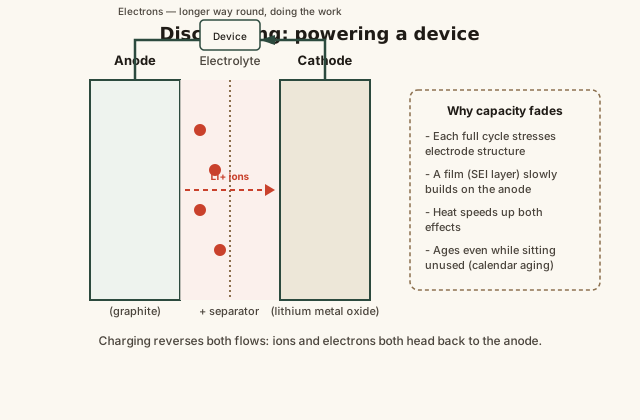
Lithium-ion discharge: ion and electron flow, and why capacity fades
Charging simply reverses both arrows in this diagram — but reversing the flow doesn't reverse the small amount of chemical wear each round trip leaves behind on the electrodes.
Common mistakes
Common Mistakes
✕
Believing a battery must be fully drained before recharging to keep it healthy.
→ This applied to older nickel-based battery chemistries with a 'memory effect,' not lithium-ion — for lithium-ion, partial charges are generally gentler on the battery than deep discharges.
✕
Leaving a device plugged in at 100% for extended periods without a second thought.
→ Prolonged time at full charge, especially combined with heat, accelerates capacity fade — unplugging once charged, where practical, reduces this stress.
✕
Assuming reduced battery capacity after a year or two means the battery (or device) is defective.
→ Gradual capacity fade is expected, predictable chemistry, not a defect — manufacturers typically define a normal capacity range after a given number of cycles rather than promising zero degradation.
✕
Ignoring heat as a factor in battery health.
→ Elevated temperature accelerates nearly every degradation mechanism in a lithium-ion cell — keeping a device cool during charging and heavy use meaningfully slows long-term capacity loss.
Common misconception
“A lithium-ion battery should always be run down to 0% before recharging, to keep it healthy.”
This rule applied to older nickel-cadmium batteries, which suffered from a real "memory effect" if repeatedly only partially discharged. Lithium-ion chemistry works differently and has no memory effect — repeated deep discharges to 0% actually place more chemical stress on the electrodes than a series of partial charges, which is why device manufacturers generally recommend keeping a lithium-ion battery in a moderate charge range rather than habitually draining it fully.
Try it yourself
Estimate charging time
A simplified estimate of how long a battery takes to charge at a given current — real chargers slow down near full charge (the constant-voltage phase), so actual time is often somewhat longer than this simple estimate.
Estimated charge time (hours)2
This simplified estimate ignores the slower constant-voltage taper phase most chargers use near full charge, so real charging time is typically somewhat longer, especially for the last 10-20%.
What to do next
What to do next
Where practical, avoid leaving a device plugged in at 100% for very long uninterrupted stretches, and avoid habitually letting it drain all the way to 0%.
Keep devices cool during charging and heavy use — heat is one of the strongest accelerants of long-term battery degradation.
Don't panic over normal, gradual capacity loss after a year or more of regular use — check your device's built-in battery health reporting (if available) before assuming a fault.
For long-term storage of a device you won't use for weeks or months, store it at a moderate charge level in a cool place rather than fully charged or fully drained.
FAQ
FAQ
Related terms
Related terms
Anode
The electrode a lithium-ion battery discharges lithium ions from — typically made of graphite — during use.
Cathode
The electrode a lithium-ion battery's lithium ions travel to during use, typically made of a lithium metal oxide compound.
Electrolyte
The liquid or gel medium inside a battery that lithium ions travel through between the anode and cathode, while blocking electrons from taking the same path.
Charge cycle
One full discharge-and-recharge sequence of a battery, whether that happens in one session or spread across several partial charges that add up to 100%.
Capacity fade
The gradual, permanent loss of a battery's maximum charge-holding capacity over time and use.
SEI layer
Solid electrolyte interphase — a thin film that forms on a lithium-ion battery's anode as a normal side effect of use, which slowly thickens and contributes to capacity fade over time.
Calendar aging
Battery degradation that happens gradually over time even when a battery isn't being actively used or cycled, simply from sitting at a given charge level and temperature.
This entry was researched from public sources and drafted with AI-assisted tools, then edited — errors are still possible. Spot one, or want a topic covered? Read our disclaimer.
 KnowThis