 KnowThis
Key Takeaways
Key Takeaways
- 1Your skin doesn't have a built-in thermometer — it has nerve endings that respond to how fast heat is leaving or entering your skin, not to an object's actual temperature.
- 2Metal conducts heat roughly 400-1,000 times faster than wood, so it pulls warmth out of your hand far more quickly, even when both are sitting at the exact same room temperature.
- 3This is exactly why a metal spoon feels cold in a drawer but scalding hot the moment it's left in a hot pan — the perceived temperature swing is about heat transfer rate, not the object's actual temperature changing more.
The concept
Once perceived temperature is understood as a heat-transfer-rate signal rather than a true reading, it becomes possible to predict which materials will "lie" to your hand and by how much, based purely on their thermal conductivity.
A metal railing and a wooden handrail sit next to each other outdoors, both having been in the shade all day. Why does the metal railing feel noticeably colder to the touch?
Worked examples
Example 1: A metal spoon vs. a wooden spoon in the same drawer (baseline case)
Both spoons have sat in the same kitchen drawer for days, reaching the exact same room temperature. Picking up the metal spoon produces an immediate, noticeable "cold" sensation, while the wooden spoon feels closer to neutral, barely registering as cold or warm at all. Since both objects are objectively the same temperature, the only variable at play is thermal conductivity — the metal spoon is pulling heat from the hand roughly 400-1,000 times faster than the wooden one would, at the same contact area and duration.
Two spoons, one metal and one wooden, have been in the same drawer for days at the same room temperature. Why does the metal one still feel colder when picked up?
Example 2: The same metal spoon left in a hot pan (edge case / variation)
Why does a metal spoon become dangerously hot when left in a heating pan, while a wooden spoon in the same pan stays safe to hold?
Example 3: Choosing flooring for a cold climate (real-world / applied case)
A homeowner comparing tile and carpet for a bedroom floor in a cold climate is really making a thermal-conductivity decision, whether or not they think of it that way. Tile has much higher thermal conductivity than carpet fiber and its padding, so bare feet on a tile floor lose heat rapidly and the floor feels cold, even if the room's air temperature is perfectly comfortable. Carpet, with far lower conductivity, removes heat from bare feet much more slowly, feeling noticeably warmer at the exact same air and floor temperature — which is why carpet and area rugs are commonly recommended for bedrooms in colder climates, independent of any actual heating difference.
A tile floor and a carpeted floor are both measured at the exact same temperature in the same room. Why does the tile still feel colder underfoot?
How it works (visual)
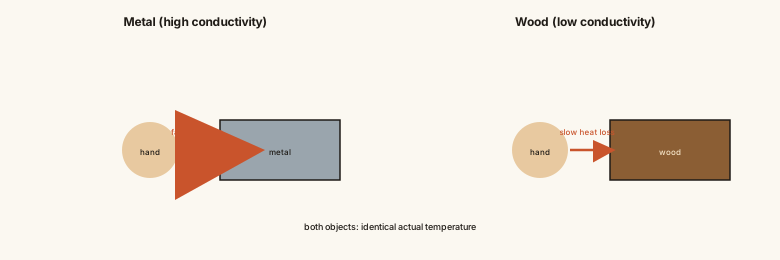
Both objects sit at the same temperature in this diagram — only the width of the heat-loss arrow, representing thermal conductivity, differs between them.
Common mistakes
Common Mistakes
Assuming a metal object that feels cold to the touch must be at a lower actual temperature than a nearby wood or fabric object.
→ Check with a thermometer if it matters — objects that have shared the same environment for a while are almost always the same actual temperature, regardless of how they feel.
Handling a metal utensil left in a hot pan the same way as a wooden one.
→ Remember that high thermal conductivity works both ways — the same property that makes metal feel cold at room temperature makes it deliver heat dangerously fast when it's the hot object.
Choosing flooring, countertops, or furniture based only on how they feel to the touch in a showroom, without accounting for conductivity effects.
→ Factor in that materials like stone and metal will always feel cooler than their actual temperature, and that this is a permanent property of the material, not a defect or a sign of poor insulation.
Common misconception
“If metal feels colder than wood in the same room, the metal must actually be at a lower temperature.”
Left in the same environment long enough, metal and wood settle to the exact same actual temperature — a thermometer would show identical readings for both. What differs is thermal conductivity: metal conducts heat roughly 400-1,000 times faster than wood, so it pulls warmth out of a touching hand far more rapidly. Human skin doesn't sense absolute temperature directly — its thermoreceptors respond to the rate of heat gain or loss at the skin's surface, and a fast rate of heat loss reads as "cold" regardless of the object's true temperature. The same mechanism works in reverse when the object is hotter than skin, which is exactly why a metal pan handle burns far faster than a wooden one at the same elevated temperature.
Try it yourself
Uses Fourier's law to estimate the rate of heat conduction through a material, given its thermal conductivity, contact area, thickness, and the temperature difference driving the flow.
What to do next
What to do next
- Next time a metal object feels cold, remind yourself it's almost certainly the same temperature as its surroundings — you're sensing conductivity, not temperature.
- Use wood, silicone, or plastic utensils for stirring hot food, since their low thermal conductivity keeps handles safe to hold.
- Consider adding a rug or carpet to a cold-feeling tile or stone floor if the room's actual air temperature is already comfortable.
- Be cautious with any metal object near a heat source — its high conductivity means it can become dangerously hot far faster than a wood or plastic equivalent nearby.