 KnowThis
Key Takeaways
Key Takeaways
- 1Chemically pure H2O has very few free-moving charged particles and is actually a poor conductor of electricity — the popular idea that 'water conducts electricity' isn't strictly about water itself.
- 2What actually carries current in water is dissolved ions from salts and minerals — tap water, rainwater, seawater, sweat, and the water in your body all contain more than enough of these to conduct readily.
- 3Because truly pure water essentially never occurs outside a controlled lab setting, every practical electrical safety warning about water remains fully correct — you're never really dealing with 'pure' water in daily life.
The short answer
| Water type | Dissolved ions | Conducts electricity? |
|---|---|---|
| Distilled or deionized | Almost none | Very poorly, but even this water can contain some ions |
| Tap, rain or bath water | Minerals and salts | Yes, enough to be dangerous |
| Salt water | Large amounts of sodium chloride | Very well, so current may bypass a body in the water |
| Human body | Salty fluids | Yes, the body is a good conductor because of how salty it is |
The concept
Once conductivity is understood as depending on dissolved ions rather than water itself, it becomes clear why "purity" and "conductivity" of water are almost inversely related in practice — the purer the water, the worse it conducts.
A lab technician tests two water samples: one is ordinary tap water, and one is freshly deionized (ion-free) water. Which conducts electricity better, and why?
Worked examples
Example 1: Deionized water barely conducting (baseline case)
Freshly deionized water, with nearly all its dissolved ions removed, is placed between two electrodes connected to a simple circuit with a lightbulb. The bulb glows extremely dimly or not at all, because so few free ions exist to carry current between the electrodes — the water's self-dissociation produces only a tiny concentration of hydrogen and hydroxide ions, nowhere near enough for meaningful conduction. This baseline demonstrates that water molecules themselves are poor conductors, contrary to the popular "water conducts electricity" framing.
Why does a circuit using freshly deionized water as the conductive medium fail to light a bulb, or light it only very dimly?
Example 2: The same setup with a pinch of table salt added (edge case / variation)
Adding a small pinch of table salt to deionized water causes a test-circuit bulb to glow noticeably brighter. What does this demonstrate?
Example 3: Why electrical safety guidance around water is still correct (real-world / applied case)
A homeowner might reasonably ask whether "pure water doesn't conduct electricity well" means safety warnings about mixing electricity and water are overstated. They aren't — tap water, bathwater, rainwater, sweat, and the water inside the human body are never chemically pure; all contain dissolved minerals and electrolytes more than sufficient to conduct a dangerous current. OSHA's electrical safety guidance around water treats any of these ordinary, real-world water sources as a conductive hazard, and that guidance is fully justified precisely because "pure water" is a laboratory condition, not something anyone actually encounters near a bathtub, pool, or wet floor.
If chemically pure water is a poor conductor, why does electrical safety guidance still strongly warn against mixing electricity with water in homes, bathrooms, and pools?
How it works (visual)
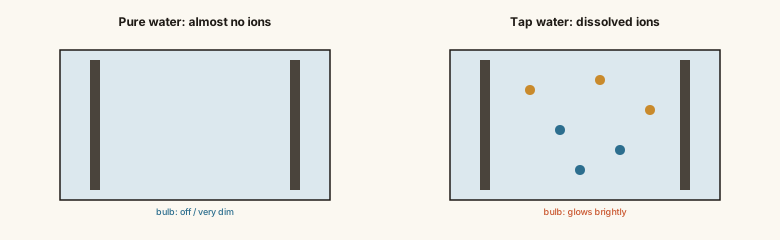
Only one variable changes between the two panels — the presence of dissolved ions — and that single difference is what actually determines conductivity.
Common mistakes
Common Mistakes
Assuming 'pure water doesn't conduct electricity well' means it's ever truly safe to mix electricity with real-world water.
→ Recognize that tap water, bathwater, and sweat are never chemically pure — they all contain dissolved ions that make them genuinely conductive and dangerous.
Believing water itself is the thing that conducts electricity.
→ Remember that dissolved ions are the actual charge carriers — water is simply the medium that allows those ions to dissociate and move freely.
Thinking distilled or deionized water at home is a safe substitute for standard electrical safety precautions.
→ Treat any household water source with the same caution, since it will already contain or quickly pick up enough dissolved minerals to conduct dangerously.
Common misconception
“Water conducts electricity because of some inherent property of water molecules themselves.”
Chemically pure H2O is actually a poor electrical conductor — it undergoes only a tiny amount of self-dissociation, producing far too few free ions to carry meaningful current. What actually conducts electricity in water is dissolved ionic material: minerals, salts, and other electrolytes that separate into free-moving charged particles once dissolved. Ordinary tap water, rainwater, seawater, sweat, and the water inside the human body all contain more than enough dissolved ions to conduct electricity readily, which is exactly why real-world electrical safety warnings around water remain fully valid — truly pure water is a laboratory condition that essentially never occurs in daily life.
Try it yourself
Ohm's law: current equals voltage divided by resistance. Try a very high resistance (like deionized water) versus a much lower one (like mineral-rich tap water).
What to do next
What to do next
- Treat every real-world water source near electricity as conductive and hazardous — tap water, bathwater, pool water, and rain all contain dissolved ions.
- Never use the 'pure water doesn't conduct well' fact to justify relaxed caution around electrical devices and standing water.
- Ensure GFCI outlets are installed in kitchens, bathrooms, and other areas where water and electricity might meet — they're designed for exactly this real-world conductivity.
- If curious, try the salt-and-water conductivity experiment yourself with a simple low-voltage circuit and lightbulb, using adult supervision and low-voltage components only.