 KnowThis
Key Takeaways
Key Takeaways
- 1A single central thermostat only guarantees the temperature at its own location — every other room has its own combination of factors that can make it run hotter or colder.
- 2The most common culprits are duct length and restriction, direct sun exposure, closed or blocked vents, uneven insulation, and rooms sitting above or beside unconditioned spaces like a garage.
- 3Fixing a persistently uneven room usually means addressing its specific cause — balancing dampers, added insulation, window treatments, or zoning — rather than turning the whole-house thermostat up or down.
The concept
Because each of these causes is physical and local to the specific room, the fix that actually works is almost always specific too — which is why simply adjusting the thermostat rarely solves a persistently uneven room and can end up overcooling or overheating every other room in the process.
A house has one thermostat in the hallway, and a back bedroom consistently runs several degrees colder. What is the most accurate way to think about this?
Worked examples
Example 1: A room at the end of a long duct run (baseline case)
A bedroom sits at the far end of the house from the air handler, with a duct run roughly three times longer than the run feeding the living room near the thermostat. Even with the same size register and a fully open vent, the bedroom reliably gets weaker airflow and a smaller temperature swing than rooms closer to the equipment, because the air has farther to travel and more surface area to lose pressure and exchange heat along the way before it arrives. This is a purely physical, structural cause — no equipment is malfunctioning, and the thermostat is reading its own location correctly the entire time.
Example 2: A sun-facing room that overheats even with cooling running (edge case / variation)
A west-facing home office overheats every afternoon even though the central AC is running and the hallway thermostat is at its setpoint. What is the most likely primary cause?
Example 3: Balancing airflow to fix a chronically cold room (real-world / applied case)
A homeowner with a consistently cold upstairs bedroom, in a house with no formal zoning, has a technician partially close balancing dampers on ducts feeding rooms that run warmer than average, redirecting more of the system's total airflow toward the cold bedroom's duct run. After adjustment, the previously cold room holds a temperature much closer to the rest of the house, at the cost of the previously warm rooms losing a small amount of their airflow. This kind of manual balancing works because the total air the blower moves is roughly fixed — redirecting more of it toward one room genuinely takes some away from others, which is why balancing is a deliberate, whole-system adjustment rather than something that can be done room by room in isolation.
A technician partially closes balancing dampers on ducts feeding warmer rooms to send more airflow to a chronically cold bedroom. Why does this work?
How it works (visual)
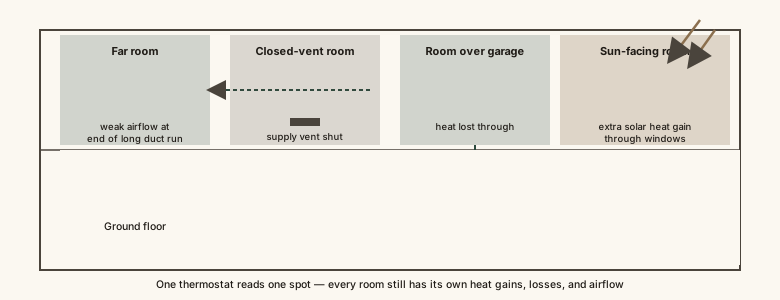
None of the four causes shown in the diagram involve the thermostat itself malfunctioning — each is a separate physical factor local to that specific room, which is exactly why they call for different, targeted fixes rather than one whole-house adjustment.
Common mistakes
Common Mistakes
Repeatedly adjusting the whole-house thermostat to try to fix one persistently uneven room.
→ Diagnose the specific room's cause — duct length, sun exposure, closed vents, or insulation — since a whole-house setpoint change usually overcorrects every other room instead.
Assuming a closed vent in an unused room saves energy with no downside elsewhere.
→ Leave supply vents open throughout the house, since closing several can raise system pressure and actually push more air toward whichever rooms remain open, unbalancing the whole system further.
Blaming a persistently hot or cold room entirely on the HVAC equipment without checking sun exposure, insulation, or duct routing.
→ Rule out non-equipment causes first — solar heat gain and duct length are common, inexpensive-to-diagnose culprits before assuming a costly HVAC repair is needed.
Common misconception
“If one room is too cold or too hot, the HVAC system itself must be broken or undersized.”
A persistently uneven room is very often a distribution and building-envelope issue rather than an equipment problem — the system can be correctly sized and functioning perfectly while still failing to make every room identical, simply because rooms differ in duct length, sun exposure, and insulation. A properly functioning single-thermostat system is only ever designed to control the temperature at its own sensor's location; expecting it to autonomously equalize every other room in the house misunderstands what the thermostat is actually capable of sensing and correcting for.
What to do next
What to do next
- Check whether a persistently uneven room has a longer or more restricted duct run than the rest of the house before assuming an equipment problem.
- Look at window exposure and consider shading or window treatments for rooms that run hot specifically during sunny afternoons.
- Keep supply vents open throughout the house rather than closing them in unused rooms, since closed vents can unbalance airflow elsewhere.
- Consider having balancing dampers adjusted, or ask an HVAC contractor about zoning, if one or two rooms remain chronically uncomfortable despite the rest of the house holding the setpoint.