 KnowThis
Key Takeaways
Key Takeaways
- 1A clogged filter's main problem isn't that it stops filtering well — it's that it restricts airflow, forcing the blower motor to work harder while less conditioned air actually reaches the house.
- 2A higher MERV rating traps finer particles but also resists airflow more, so pairing an overly restrictive filter with a system not designed for it can cause the same strain a clogged filter does.
- 3Replacement interval depends on filter type, household dust load, pets, and system usage — a fixed "every 90 days" rule is a reasonable default, not a guarantee, and should be checked visually.
The concept
Because the cost of a clogged filter shows up as reduced airflow and motor strain rather than an obvious visible failure, it's easy to run a system on an overdue filter for months without noticing anything beyond a vaguely less comfortable house and a higher energy bill.
What is the main practical problem caused by a heavily clogged HVAC filter?
Worked examples
Example 1: A filter left in place well past its replacement interval (baseline case)
A standard fiberglass furnace filter, typically replaced every 60 to 90 days, is left in place for nearly a year. Held up to the light, it's visibly gray and matted rather than showing the open weave it had when new. The homeowner notices the system running longer than it used to and the house feeling less consistently comfortable, without any single dramatic failure. Both symptoms trace back to the same cause: airflow has been gradually restricted for months, making the blower work harder to deliver less air, room by room, throughout the house.
Example 2: A too-high MERV filter installed in a system not rated for it (edge case / variation)
A brand-new, clean high-MERV filter causes airflow to drop noticeably right after installation. What does this most likely indicate?
Example 3: Diagnosing weak airflow from vents during a heat wave (real-world / applied case)
During a stretch of hot weather, a homeowner notices the air conditioning is running almost constantly but the house still isn't reaching the thermostat's setpoint, and air from the vents feels weaker than usual. Before assuming the refrigerant or compressor has failed, checking the filter is the standard first step — a clogged filter restricting airflow across the indoor coil can produce exactly this pattern: long run times, weak airflow, and a house that struggles to cool. In many real cases like this, replacing an overdue filter restores normal airflow and cooling performance without any repair to the refrigeration system at all.
An air conditioner runs almost constantly during hot weather, vent airflow feels weak, and the house still doesn't reach the setpoint. What is the standard first thing to check?
How it works (visual)
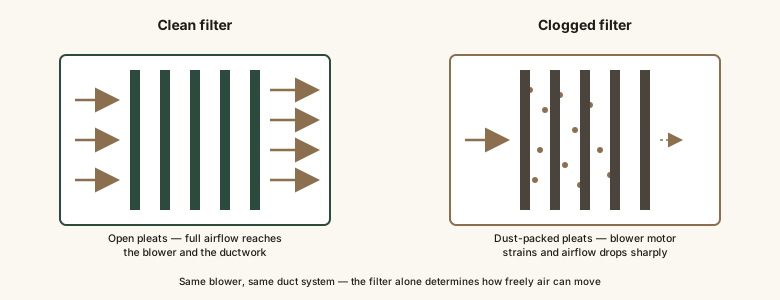
Both filters shown are doing their job of trapping particles — the difference the diagram highlights is how much open space is left for air itself to pass through once that trapping has happened many times over. A restricted filter forces the system to run longer to hold a set temperature, which compounds with poor insulation in the same house — both problems separately increase how hard the equipment has to work to keep up.
Common mistakes
Common Mistakes
Replacing the filter on a fixed calendar schedule without ever checking it visually.
→ Check the filter monthly by holding it up to light — households with pets, more dust, or heavier system use often need replacement sooner than a generic 90-day rule.
Assuming a higher MERV rating is always a straightforward upgrade with no downside.
→ Confirm the system's or filter manufacturer's airflow compatibility before installing a much higher-MERV filter than the one the system originally shipped with.
Ignoring weak airflow or long system run times as unrelated background annoyances.
→ Treat weak vent airflow and unusually long run times as a prompt to check the filter first, since restricted airflow is one of the most common and easiest-to-fix causes.
Common misconception
“A dirty filter is mainly an indoor air quality problem — it doesn't really affect how the system runs.”
A clogged filter's biggest practical impact is on airflow, not filtration quality. As it fills with debris it increasingly restricts how much air the blower can move, which makes the motor strain, can reduce cooling and heating performance throughout the house, and in central air conditioning can let the indoor coil get cold enough to freeze over — a problem that then blocks airflow even further. The energy and equipment-wear cost of a badly overdue filter is often larger than most homeowners expect, well beyond its effect on dust in the air.
What to do next
What to do next
- Check the filter visually every month by holding it up to a light source, rather than relying on a fixed replacement date alone.
- Replace a standard filter roughly every 60 to 90 days as a baseline, adjusting sooner for pets, heavy dust, or near-constant system use.
- Confirm airflow compatibility before installing a filter with a MERV rating notably higher than the one the system originally came with.
- If airflow feels weak or the system runs unusually long during hot or cold weather, check the filter before assuming a more serious mechanical problem.