 KnowThis
Key Takeaways
Key Takeaways
- 1Central air conditioning doesn't create cold air — it moves heat out of the house using a refrigerant that absorbs heat indoors and releases it outdoors in a closed loop.
- 2The cycle has four core stages: an indoor coil absorbs heat, a compressor pressurizes the refrigerant, an outdoor coil releases that heat, and an expansion valve drops the pressure again before the loop repeats.
- 3Cooling capacity is commonly measured in tons, where one ton equals 12,000 BTU per hour — a rating of the system's heat-removal rate, not a literal weight of anything inside it.
The concept
Because the whole system is fundamentally about relocating heat rather than generating cold, several everyday AC behaviors that seem odd at first — why the outdoor unit blows warm air, why airflow matters so much, why a system has a rated capacity in tons rather than just horsepower — start making sense once the cycle itself is clear.
What is a central air conditioner actually doing when it cools a house?
Worked examples
Example 1: Tracing one full refrigeration cycle (baseline case)
On a warm afternoon, a thermostat calls for cooling. Indoors, the blower pushes 78°F room air across the evaporator coil; the refrigerant inside absorbs that heat and evaporates, and the air leaving the coil drops to around 58°F before it's mixed with room air and sent through the ducts. The now-warmed refrigerant gas travels to the outdoor compressor, gets pressurized and hot, releases that heat at the condenser coil — which is why the outdoor unit's exhaust air always feels warm, even on a cooling cycle — and returns as a cooled liquid to start the loop again. This sequence repeats continuously as long as the thermostat keeps calling for cooling.
Example 2: Why blocked outdoor airflow hurts cooling performance indoors (edge case / variation)
Overgrown shrubs are blocking airflow around the outdoor condenser unit. Why does this reduce indoor cooling performance?
Example 3: Matching cooling capacity to a house's size (real-world / applied case)
A homeowner is told a replacement air conditioner is rated at 3 tons of cooling capacity. Converting that to a more familiar unit, 3 tons × 12,000 BTU per hour per ton equals 36,000 BTU per hour — the rate at which the system can remove heat from the house. An undersized system for the home's square footage and insulation would run nearly nonstop without ever quite catching up on a hot day, while an oversized one can cool the air quickly without running long enough to also remove enough humidity, leaving the house feeling clammy even at the right temperature. Sizing cooling capacity to the specific house, not just picking the biggest available unit, is standard professional practice for exactly this reason.
A 3-ton air conditioner has a cooling capacity, in BTU per hour, of approximately:
How it works (visual)
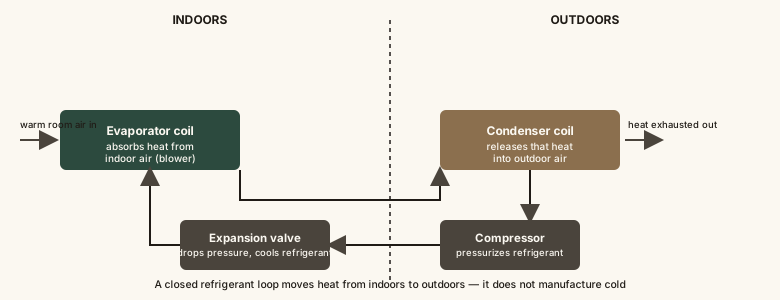
Following the loop clockwise in the diagram is really following one unit of heat energy on its journey from inside the house to outside — the refrigerant itself never leaves the sealed system, only the heat it carries does.
Common mistakes
Common Mistakes
Letting shrubs, mulch, or debris crowd the outdoor condenser unit.
→ Keep at least a couple of feet of clearance around the outdoor unit so the condenser coil can release heat freely.
Assuming a bigger air conditioner is always a better, safer choice for a given house.
→ Match cooling capacity to the home's actual size and insulation — an oversized unit can cool too fast to properly remove humidity, leaving the house feeling damp.
Ignoring a dirty filter or blocked vents when cooling performance drops, and assuming the refrigerant must be low.
→ Check airflow-related causes like the filter first, since restricted indoor airflow across the evaporator coil produces very similar symptoms to a refrigerant problem.
Common misconception
“Air conditioning works by creating cold air, similar to how a furnace creates hot air.”
An air conditioner doesn't generate cold in any chemical or electrical sense — it moves existing heat from inside the house to outside using a refrigerant that absorbs heat at one coil and releases it at another. That's why the outdoor unit's exhaust always feels warm even while the system is actively cooling the house: it's literally exhausting the heat pulled from indoors. A furnace, by contrast, genuinely does generate new heat, by burning fuel or running an electric element — the two systems work on fundamentally different principles even though people often describe them as mirror images of each other.
Try it yourself
Enter a system's rated cooling capacity in tons to see the equivalent heat-removal rate in BTU per hour (1 ton = 12,000 BTU/hr).
What to do next
What to do next
- Keep at least a couple of feet of clearance around the outdoor condenser unit so it can release heat efficiently.
- Check the indoor air filter first if cooling performance drops, since restricted airflow can mimic a refrigerant problem.
- When replacing a system, have cooling capacity sized to the home's square footage and insulation rather than defaulting to the largest available unit.
- Read What R-Value Actually Measures in Insulation to see how the house's own insulation affects how hard the AC has to work to hold a setpoint.