 KnowThis
Key Takeaways
Key Takeaways
- 1A screw driven into bare drywall concentrates all of the load onto one small point of gypsum, which tears out under a surprisingly light pull.
- 2A wall anchor's real job is spreading that same load over a wider area of material — by expanding into a cone or ring, or by opening a toggle behind the wall — so it can't tear out as easily.
- 3Toggle-style anchors spread load over the widest area and generally hold the most weight; light plastic anchors spread it the least and hold the least.
The concept
This same soft, brittle nature of gypsum board is also why drywall cracks appear around openings and corners under stress the material was never meant to absorb — an anchor that spreads load well keeps that same weakness from showing up as a torn-out mounting point.
Once you see an anchor as simply a load-spreading device, the weight ratings printed on anchor packaging stop being arbitrary numbers and start making sense as a direct consequence of how much drywall area that particular anchor design actually engages.
What is the core mechanism that lets a wall anchor hold more weight than a bare screw in drywall?
Worked examples
Example 1: A light picture frame with a plastic anchor (baseline case)
A small picture frame weighing a couple of pounds needs a mounting point away from any stud. A basic plastic expansion anchor, sized to the hole and screw, spreads that light and steady load over a modest ring of gypsum — comfortably more surface area than the screw threads alone would touch, and more than sufficient for the weight involved. This is the anchor type most commonly included with light home decor for exactly this reason.
Example 2: A wall-mounted shelf under real shear load (edge case / variation)
Why might an anchor rated for more weight than a shelf's load still fail once books are placed on that shelf?
Example 3: Mounting a heavy mirror away from a stud (real-world / applied case)
A heavy mirror needs to hang at a spot where a stud finder confirms no framing is available. Rather than trusting a single anchor near its maximum rating, a toggle-style anchor is chosen for its wide load-spreading area, and two anchors are used instead of one to split the weight and add a margin of safety in case the load isn't distributed perfectly evenly between the two mounting points. This layered approach — best available anchor type, plus multiple points, plus a safety margin below the rated maximum — is standard practice for anything heavy or breakable. A toggle-style anchor also depends on the fastener threaded through it — typically a machine screw rather than a wood screw, since it's tightening into the toggle's own pre-threaded metal, not biting into wood fiber.
Why would someone use two toggle anchors for a heavy mirror instead of one anchor rated for the full weight?
How it works (visual)
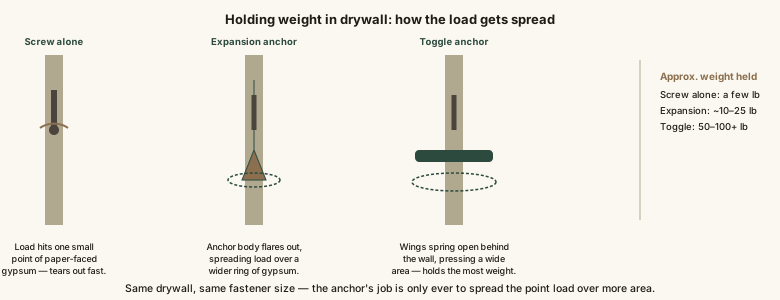
Same wall, same fastener size — the anchor's only job is turning a small point of contact into a much larger one.
Common mistakes
Common Mistakes
Driving a screw straight into bare drywall with no anchor for anything beyond the lightest, smallest item.
→ Use an anchor sized to the fastener whenever a stud isn't available, even for items that seem light — drywall alone tears out easily under a concentrated point load.
Trusting an anchor's printed weight rating at face value for a shelf, rod, or bracket that applies a shear or rotating load, not a straight pull.
→ Treat printed straight pull-out ratings as an upper limit, not a target, and choose an anchor rated well above the expected real-world load for anything under shear or leverage.
Skipping a stud finder check and defaulting straight to an anchor, even when solid framing is available right at the mounting point.
→ Always check for a stud first — a fastener driven into solid framing outperforms even the best hollow-wall anchor and should be used whenever it's an option.
Common misconception
“Any wall anchor is basically as good as any other, as long as it fits the hole.”
Anchor designs differ enormously in how much drywall area they actually engage, and that area is what determines holding capacity — not just whether the anchor physically fits the drilled hole. A light plastic expansion anchor might hold a picture frame comfortably but fail under a shelf's load, while a toggle anchor sized for the same hole spreads that load across a much wider area behind the wall and holds several times more weight. Matching the anchor type (not just the hole size) to the actual weight and load type is the part that's easy to skip and genuinely matters.
What to do next
What to do next
- Check for a stud at the mounting point first — solid framing outperforms every hollow-wall anchor and should be preferred whenever available.
- Match anchor type to load: light plastic anchors for small decor, toggle-style anchors for shelves, rods, and anything heavier.
- Treat printed weight ratings as a conservative ceiling, especially for fixtures that apply shear or rotating loads rather than a straight pull.
- Split heavy or breakable loads across two or more anchors rather than relying on a single anchor near its rated maximum.