 KnowThis
Key Takeaways
Key Takeaways
- 1A nail holds entirely through friction — compressed wood fibers spring back against its smooth shank, with no physical interlock involved.
- 2A screw's thread is a wedge wrapped helically around a cylinder, so turning it cuts a matching groove into the material and locks the fastener in place along its entire length.
- 3Because a screw resists pull-out through both friction and mechanical interlock, it typically takes several times more force to pull a screw straight out than a same-size nail.
The concept
Nails and screws also differ in a second, often-overlooked way: a nail is genuinely strong against being sheared sideways (bent across its length), while a screw's threads can make it slightly more brittle under that same kind of side load. That's a large part of why framing carpentry — where lumber is mostly held against sideways racking forces — still leans heavily on nails, while cabinetry, hardware, and anything expected to resist being pulled straight apart leans on screws. This is also the same reasoning behind how a wall anchor actually holds weight in hollow drywall — an anchor is really just a way of giving a screw's thread something wider to interlock with once solid stud framing isn't available at the mounting point.
What is the main mechanism that lets a screw resist being pulled straight back out of wood?
Worked examples
Example 1: Hanging a light picture frame (baseline case)
A small picture frame needs a fastener in solid wood trim to hold a couple of pounds indefinitely, with a slow, steady pull-out load from gravity rather than any sudden jolt. A short wood screw driven into a pilot hole grips through its full thread engagement and easily outlasts a nail of the same length, which would rely on friction alone against a fairly light, steady pull. Either would likely work for such a light load, but the screw has a large safety margin the nail doesn't.
Example 2: A screw in a stripped or reused hole (edge case / variation)
Why might a screw feel loose almost immediately after being reinstalled several times in the exact same hole?
Example 3: Framing lumber vs. cabinet hardware (real-world / applied case)
A framing crew nailing wall studs together is mostly resisting sideways, shearing forces as the frame is handled and loaded — nails are fast to drive, strong across their length, and inexpensive at the volume framing requires, so nails remain the standard there even though screws would resist pull-out better. A cabinetmaker attaching hinges or shelf brackets, by contrast, cares most about resisting a slow, steady pull-out force (a heavy shelf, a door swinging on its hinge) — exactly the load screws are built to resist, which is why cabinetry and hardware default to screws almost universally.
Why do framing carpenters still commonly use nails, even though screws generally resist pull-out better?
How it works (visual)
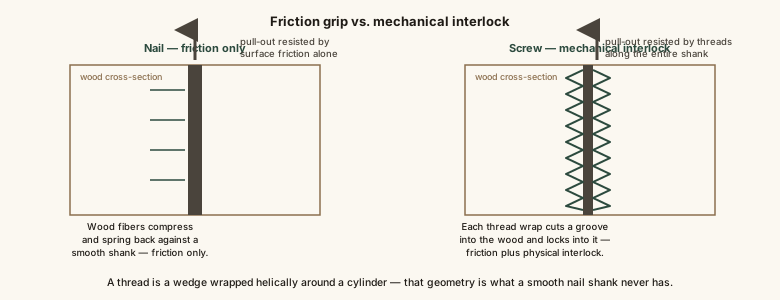
Same wood, same fastener diameter — the entire difference in holding power comes down to whether the shank is smooth or threaded.
Common mistakes
Common Mistakes
Skipping a pilot hole on hardwood or near the edge of a board, splitting the wood and destroying the thread's grip before it can even engage.
→ Drill a pilot hole slightly smaller than the screw's shank, especially in hardwood or near edges, so threads cut a clean groove instead of splitting the material.
Reusing the exact same screw hole repeatedly (common with hinges and hardware) without addressing the worn-out threads.
→ Fill a stripped hole with a wood plug or toothpicks and wood glue, let it cure, then redrive the screw into fresh material for a real thread bite.
Choosing a nail for a joint that will experience a steady pull-out load, purely out of habit or speed.
→ Match the fastener to the load direction — screws for pull-out-heavy joints like shelving and hardware, nails for shear-heavy joints like framing.
Common misconception
“A thicker or longer nail is basically just as strong as a screw of similar size.”
Length and thickness affect how much friction surface a nail has, but they don't change the underlying mechanism — a longer nail is still gripping purely through friction against a smooth shank, with no mechanical interlock at all. A screw of the same length adds threads that cut and lock into the material along that entire length, which is a fundamentally different (and generally stronger) way of resisting pull-out. Making a nail longer narrows the gap somewhat, but it doesn't close it, because the two fasteners are relying on different physical mechanisms, not just different amounts of the same one.
Try it yourself
A screw's thread converts rotation into a large linear force. This shows how many times a handle's turning circle exceeds the distance the screw advances per turn.
What to do next
What to do next
- Choose screws over nails for any joint that will mainly experience a steady pull-out load, like shelving, hardware, or hangers.
- Drill a pilot hole before driving screws into hardwood or near an edge, so the threads cut a clean groove instead of splitting the material.
- Avoid repeatedly reusing the exact same screw hole — patch it and redrive into fresh material once it feels loose.
- Keep nails for joints dominated by sideways, shearing loads, where speed and shear strength matter more than pull-out resistance.