 KnowThis
Key Takeaways
Key Takeaways
- 1A wood screw has coarse, self-cutting threads and a sharp point built to carve its own groove into wood, which then acts as the 'nut.'
- 2A machine screw has fine, standardized threads meant to mate with a pre-tapped hole or a separate nut, not to cut its own path.
- 3A bolt usually shares a machine screw's thread profile, but is formally defined by installation method: tightened by turning a nut while the head stays still, rather than by turning the head itself.
The concept
Once thread geometry and installation method are the actual dividing lines, picking the right fastener stops being about matching size and starts being about matching what the joint actually needs — cutting into wood, mating with a tapped hole, or clamping two parts together under real load.
What's the core functional difference between a wood screw's thread and a machine screw's thread?
Worked examples
Example 1: Mounting a wooden shelf bracket (baseline case)
A shelf bracket needs to attach directly to solid wood framing. A wood screw is the natural choice here — its coarse, self-tapping thread cuts directly into the wood fiber, creating a mechanical interlock with no separate nut or pre-tapped hole required. Driven with a pilot hole to avoid splitting the wood, it's both the simplest and the strongest option for this exact joint.
Example 2: Attaching a metal hinge into a pre-tapped hole (edge case / variation)
Why would a wood screw be the wrong choice for a hole that's already been machine-tapped with internal threads?
Example 3: Assembling a heavy-duty structural bracket (real-world / applied case)
Two metal brackets need to be clamped tightly together under a real, ongoing structural load — the kind of joint where the parts must be squeezed together with a specific, reliable force rather than just held from separating. A bolt paired with a nut and washer is the standard choice: the nut is turned against the held-still bolt head, developing real clamping force between the two brackets, and that clamping force (not just the fastener's raw strength) is what keeps the joint tight and resistant to loosening under vibration or repeated load — the exact reason a torque wrench is often specified for this kind of joint rather than tightening by feel.
Why is a bolt-and-nut combination typically chosen over a simple screw for a heavy structural joint?
How it works (visual)
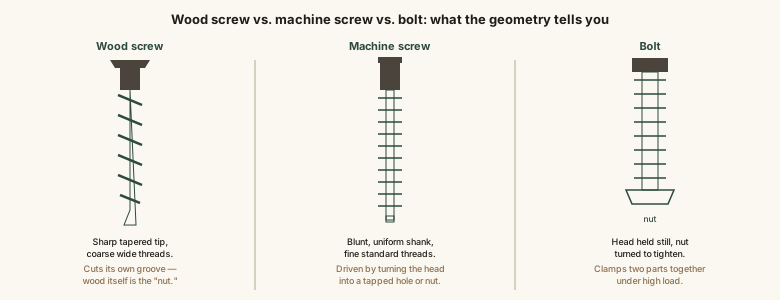
The point, the thread spacing, and what turns during installation — those three details tell you almost everything about which fastener you're actually holding.
Common mistakes
Common Mistakes
Driving a self-tapping wood screw into a pre-tapped machine-threaded hole, stripping the existing internal thread.
→ Match thread type to the hole — use a machine screw or bolt sized to the exact thread pitch for any pre-tapped hole, never a self-tapping wood screw.
Using a machine screw directly into solid wood, expecting it to grip the way a wood screw would.
→ Choose a wood screw with a self-tapping thread and sharp point for wood, reserving machine screws for tapped holes or nutted joints.
Tightening a structural bolted joint 'by feel' instead of to a specified clamping force.
→ Use a torque wrench and the joint's specified torque value for bolted connections where clamping force actually matters, rather than guessing at tightness.
Common misconception
“'Screw' and 'bolt' are just two different names for the same kind of fastener.”
They often look nearly identical and the terms get used loosely in everyday speech, but the meaningful distinction (recognized in fastener industry standards) is installation method: a screw is generally turned by its head into material or a nut stays put, while a bolt is generally turned by a nut (or into a tapped hole) while its head is held still, producing clamping force between two parts. The same physical piece of hardware can sometimes be used either way depending on the joint, which is exactly why the line between the two terms feels blurry in practice — the geometry doesn't always tell you which one it is; how it's installed does.
What to do next
What to do next
- Choose a wood screw with a self-tapping thread and sharp point for driving directly into solid wood.
- Choose a machine screw sized to the exact thread pitch when working with a pre-tapped hole or a separate nut.
- Choose a bolt-and-nut combination for structural or high-load joints that need real, reliable clamping force.
- Use a torque wrench and the joint's specified value for any bolted connection where clamping force genuinely matters, rather than tightening by feel.