 KnowThis
Key Takeaways
Key Takeaways
- 1A wall's weight capacity is really set by what's directly behind the surface at the mounting point — solid framing holds far more than hollow drywall alone.
- 2The fastener or anchor used matters as much as the wall itself, since it's usually the weakest link in the chain between the item and the framing.
- 3Whether a load pulls straight out or applies a sideways, rotating force changes how much a given fastener or anchor can actually support in practice.
The concept
Treating wall capacity as three separate checks — what's behind the surface, what fastener is used, and which direction the load actually pulls — turns a vague question into a concrete decision almost every time. Once you understand how a wall anchor actually holds weight in hollow drywall, matching an anchor to a load stops being guesswork.
What actually determines how much weight a given spot on a wall can hold?
Worked examples
Example 1: Hanging a small shelf where a stud is available (baseline case)
A stud finder locates solid framing exactly where a small shelf needs to mount. Driving a properly sized wood screw directly into that stud gives the shelf a capacity limited mainly by the screw's own strength and how well it's seated — comfortably enough for books, small decor, or similar steady household loads, with a wide safety margin over what a hollow-wall anchor in the same spot could support.
Example 2: The same shelf, but the stud is a few inches off (edge case / variation)
When a stud isn't available at the ideal mounting spot, what's the right way to choose an anchor for a loaded shelf?
Example 3: Mounting a bathroom grab bar (real-world / applied case)
A grab bar needs to support a person's full body weight suddenly and unpredictably — a genuine live load with real safety consequences if it fails. This case calls for mounting directly into solid stud framing wherever possible, confirmed with a stud finder rather than assumed; where framing doesn't line up with the ideal bar location, only anchors specifically rated for structural or safety-critical loads (not general-purpose light-duty anchors) are appropriate, often combined with added blocking behind the wall for a permanent, reliable mounting point.
Why does a bathroom grab bar require a different mounting approach than a light picture frame or small shelf?
How it works (visual)
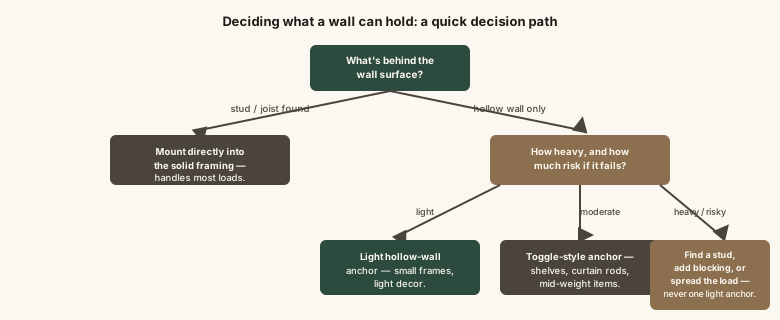
The same three questions — what's behind the wall, which fastener fits that situation, and how heavy or risky is the load — cover nearly every real mounting decision.
Common mistakes
Common Mistakes
Judging a wall's capacity by tapping or pressing on the drywall surface, without checking what's actually behind it.
→ Use a stud finder to locate solid framing before mounting anything of real weight, rather than relying on a surface-level guess.
Treating every anchor as interchangeable as long as it fits the drilled hole size.
→ Match anchor type and rated capacity to the actual expected weight and load type, not just physical fit in the hole.
Mounting safety-critical items like grab bars or heavy furniture with general-purpose light-duty anchors because the item 'doesn't look that heavy.'
→ Reserve solid framing or safety-rated anchors specifically for anything a person might lean, pull, or climb on, regardless of the item's apparent weight.
Common misconception
“If an anchor's weight rating is higher than the item's weight, the mounting is automatically safe.”
A rated capacity is usually tested under a specific, controlled load direction — often a slow, straight pull. Many real fixtures instead apply a rotating, sideways, or sudden force that stresses the anchor differently than its rating reflects, which is exactly why a shelf, grab bar, or piece of furniture can fail well below its anchor's printed number. The item's weight matters, but so does how that weight is actually applied — treating the rating as a comfortable ceiling with real margin, not a number to approach closely, is what keeps the difference between the two from becoming a problem.
What to do next
What to do next
- Use a stud finder to check for solid framing before mounting anything, and prefer it over any hollow-wall anchor when it's available.
- Match anchor type and rated capacity to the item's real weight and how the load will actually be applied, not just the size of the hole it fits.
- Reserve solid framing or safety-rated hardware for anything a person might lean, pull, or climb on, regardless of how light it looks.
- Treat printed weight ratings as a ceiling with margin built in, especially for loads that shift, rotate, or apply force suddenly.