 KnowThis
Key Takeaways
Key Takeaways
- 1Super glue doesn't cure by evaporating a solvent like most glues — it cures through a chemical chain reaction that starts almost instantly.
- 2Trace moisture naturally present on most surfaces (even ones that feel bone-dry) is what triggers that chain reaction, linking monomer molecules into rigid polymer chains.
- 3Because the reaction needs only a thin film of glue and a trace of moisture, it works best in a very thin layer between two closely fitting surfaces — not as a gap-filler.
The concept
Once bonding is understood as a fast chemical chain reaction rather than a drying process, several familiar quirks of super glue — the near-instant set time, the preference for thin bond lines, the way it bonds skin so readily, and its sensitivity to humidity — all trace back to the same underlying mechanism. It's also a genuinely different holding mechanism than a mechanical fastener: a threaded screw grips by physically interlocking with a material it cuts into, while cyanoacrylate grips by chemically fusing two surfaces together at a molecular level — which is why adhesive and mechanical fastening are often combined rather than treated as interchangeable.
What actually triggers cyanoacrylate super glue to harden so quickly?
Worked examples
Example 1: Repairing a small ceramic figurine (baseline case)
Two broken ceramic pieces fit together cleanly, with a very thin gap between them. A small drop of cyanoacrylate spread thin and held firmly in place sets within seconds, as the trace moisture on the ceramic surface triggers the reaction quickly and evenly through the thin glue film. Holding the pieces still during that brief window matters, since the joint is gaining real strength almost immediately, not gradually over minutes.
Example 2: Gluing a wider, uneven gap (edge case / variation)
Why does standard cyanoacrylate glue perform poorly when used to fill a wide, uneven gap between two parts?
Example 3: Working in a very dry room vs. a humid bathroom (real-world / applied case)
The same cyanoacrylate glue behaves noticeably differently in a very dry, low-humidity room compared to a steamy bathroom. In the dry room, there's less ambient and surface moisture available, so the reaction starts more slowly, giving a bit more working time to align parts before the bond sets. In the humid bathroom, extra moisture can trigger the reaction very fast — sometimes too fast to get pieces perfectly aligned before the glue starts setting, and occasionally leaving the telltale white haze of a bond that partially cured before full contact was made.
Why might the same super glue set noticeably faster in a humid bathroom than in a very dry room?
How it works (visual)
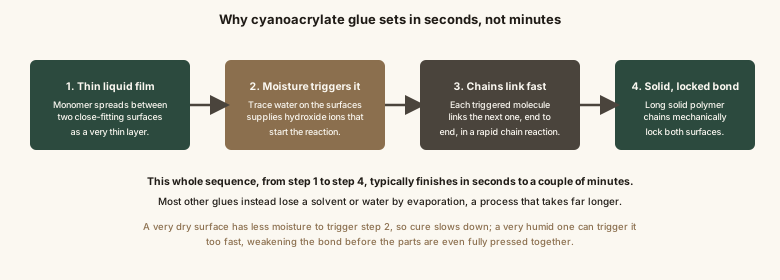
Every step in that sequence depends on the glue layer staying thin enough for surface moisture to reach essentially all of it at once.
Common mistakes
Common Mistakes
Applying a thick pool of standard cyanoacrylate to fill a wide gap, expecting it to cure as solidly as a thin bond line.
→ Use a gap-filling cyanoacrylate formula for wider gaps, or reshape the joint so the standard thin-bonding formula can be used as intended.
Holding pieces together loosely while waiting for the glue to 'dry,' as if it were an evaporative adhesive.
→ Hold parts firmly and precisely aligned from the moment of contact, since cyanoacrylate begins gaining real strength within seconds, not after a drying period.
Assuming humidity has no effect on super glue's performance and using it the same way in any environment.
→ Expect faster set times and a narrower alignment window in humid conditions, and slightly slower set times in very dry conditions — plan working time accordingly.
Common misconception
“Super glue works by drying out, the same basic process as white glue or wood glue, just faster.”
Ordinary white glue and wood glue cure by losing water or solvent to evaporation, which is a physical process that takes real time. Cyanoacrylate super glue cures through a chemical reaction — trace surface moisture triggers monomer molecules to link into solid polymer chains — which is a fundamentally different process, not just a faster version of the same one. That distinction explains why super glue sets in seconds rather than minutes or hours, why it prefers thin bond lines over thick gap-filling, and why humidity (which barely affects evaporative glues' set time in a comparable way) changes cyanoacrylate's behavior noticeably. It's a useful contrast to keep in mind alongside other household patch materials, like how spackle and caulk actually differ from each other — different jobs entirely, but the same lesson that the specific chemistry behind a product determines what it's actually good for.
What to do next
What to do next
- Apply cyanoacrylate as a thin film between closely fitting surfaces rather than a thick pool, since the reaction cures more completely and evenly that way.
- Hold pieces in their final, aligned position from first contact — real bonding strength begins within seconds, not after a drying period.
- Choose a gap-filling cyanoacrylate formula for wider or uneven gaps, rather than relying on standard thin-bonding glue to fill space.
- Keep cyanoacrylate away from skin and eyes and store it out of reach of children, since it bonds tissue about as readily as it bonds most materials.