 KnowThis
Key Takeaways
Key Takeaways
- 1Spackle is formulated to dry hard and sandable — it's for filling still, non-moving gaps like nail holes and small drywall dents.
- 2Caulk is formulated to stay flexible and elastic indefinitely — it's for sealing joints, like where trim meets a wall, that continue to expand, contract, or shift.
- 3The deciding question is always whether the gap moves: use spackle where nothing will move again, and caulk where movement is ongoing and expected.
The concept
Once the choice is framed around movement — does this gap stay still, or does it keep shifting — picking between spackle and caulk stops being a guessing game and becomes a straightforward read of the joint itself.
What's the core functional difference between spackle and caulk that determines where each one should be used?
Worked examples
Example 1: Filling a nail hole after taking down a picture (baseline case)
A small nail hole left behind in a wall, after a wall anchor or nail is removed, gets filled with a dab of spackle, left to dry, then lightly sanded flush and painted over. Because this hole is in the middle of a flat, still section of drywall that will never move relative to itself, spackle's rigidity is exactly the right property — it hardens into essentially the same solid, sandable material the surrounding wall is made of, disappearing invisibly once painted. How invisible that patch actually looks also depends on the topcoat's sheen — a glossier finish tends to make even a well-sanded patch more visible than a flatter one would.
Why is spackle the correct choice for filling a small nail hole in the middle of a flat wall, rather than caulk?
Example 2: Sealing a baseboard-to-wall gap (edge case / variation)
Why does spackle applied along a baseboard-to-wall joint tend to crack within a season or two, where caulk in the same spot would hold up?
Example 3: Patching a medium-sized drywall hole near a doorway (real-world / applied case)
A fist-sized hole in drywall near a doorway needs repair, and the area is close enough to the door frame's corner that it's also near where stress-concentration cracks commonly form. The hole itself still gets a rigid repair — a patch and spackle or joint compound over it, sanded flush, since the hole itself doesn't move — but the adjacent corner seam, if it's prone to reopening due to nearby framing movement, is a better candidate for a flexible caulk-based crack-repair product or a properly re-taped, flexible-mesh seam rather than a purely rigid fill, precisely because that specific spot experiences real, recurring movement that a flat hole nearby does not.
In this scenario, why might the drywall hole itself get a rigid spackle patch while the nearby corner seam gets a more flexible repair approach?
How it works (visual)
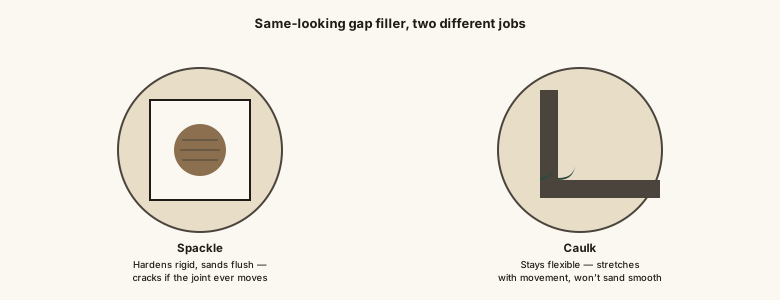
Both products fill a gap and both can be painted, but one is chosen for staying rigid forever and the other for staying flexible forever — reversing them is what causes most repeat repairs.
Common mistakes
Common Mistakes
Using rigid spackle to seal a joint that experiences ongoing movement, like a baseboard-to-wall gap or a window frame perimeter, then watching it crack within a season.
→ Use a flexible caulk at any joint where two materials meet and move independently, saving spackle for still, non-moving gaps like nail holes.
Using caulk to fill a still nail hole or drywall dent, expecting it to sand flush and disappear the way spackle would.
→ Use spackle for still holes and dents that need a hard, sandable, flush finish — caulk stays too flexible to sand smooth.
Assuming any gap filler will work anywhere as long as it's paintable, without considering whether the gap actually moves.
→ Ask whether the gap experiences ongoing movement before choosing a product — that single question determines whether spackle or caulk is the right fit.
Common misconception
“Spackle and caulk are basically interchangeable — whichever one is on hand will work fine for a small gap.”
They're formulated for opposite mechanical behavior on purpose. Spackle is engineered to harden into a rigid, sandable solid, which makes it excellent for a still gap but guarantees eventual cracking at a joint that moves. Caulk is engineered to stay elastic indefinitely, which makes it excellent at a moving joint but means it will never sand flush or hold a crisp edge the way a still hole often needs. The right choice isn't about which one is more convenient to grab — it's about whether the specific gap being filled ever changes size.
What to do next
What to do next
- Ask whether the gap you're filling ever moves — if not, use spackle; if it experiences ongoing expansion, contraction, or shifting, use caulk.
- Use spackle for nail holes, small drywall dents, and similar still, non-moving repairs that need to sand flush.
- Use caulk at baseboard-to-wall joints, window and door frame perimeters, and tub-to-tile seams, where materials expand and contract independently.
- Check a caulk product's label for 'paintable' and allow its full cure time before painting, since it stays more flexible than spackle even after curing.