 KnowThis
Key Takeaways
Key Takeaways
- 1Gloss and matte paint differ mainly in the amount of flattening agent mixed in, which controls the microscopic roughness of the dried film's surface.
- 2A smooth glossy film reflects light in one direction (specular reflection), while a rougher matte film scatters it in many directions (diffuse reflection) — that's why gloss looks shiny and matte looks flat.
- 3The same surface texture that controls shine also controls durability: a smoother gloss film sheds dirt and wipes clean more easily, while a rougher matte film traps grime and shows scrub marks more visibly.
The concept
Once sheen is understood as a byproduct of microscopic surface texture rather than a different paint chemistry, the practical tradeoffs — gloss shows wall imperfections but wipes clean, matte hides imperfections but shows wear — stop looking arbitrary and start following directly from the same physical cause.
What is the main physical reason a glossy paint film looks shinier than a matte paint film?
Worked examples
Example 1: Choosing a finish for a kitchen wall (baseline case)
A kitchen wall near a stove and sink gets frequent grease splatter and needs regular wiping down. A satin or semi-gloss finish is typically chosen for exactly this reason: its smoother surface, closer to the gloss end of the sheen range, sheds grease and wipes clean with far less effort and residue than a flatter matte finish would, whose rougher texture holds onto grime and shows visible marks after repeated scrubbing. Whichever sheen is chosen, a properly primed surface underneath still matters just as much for how evenly that topcoat's sheen reads once it's dry.
Why is a satin or semi-gloss finish typically recommended for a kitchen wall that gets frequent grease splatter, rather than a flat matte finish?
Example 2: A matte ceiling with an uneven texture (edge case / variation)
Why does a flat matte finish tend to hide minor surface imperfections on a ceiling better than a glossier finish would?
Example 3: Touching up a scuffed matte hallway wall (real-world / applied case)
A hallway painted in a flat matte finish gets scuffed and scrubbed clean in one spot to remove a scuff mark, and afterward that spot appears slightly shinier than the surrounding wall — a phenomenon called burnishing. Scrubbing compresses and smooths the matte film's microscopically rough surface in that one location, shifting it locally toward more specular, gloss-like reflection even though no gloss paint was ever applied there. This is a predictable consequence of matte's surface texture being physically alterable by friction, and it's one reason higher-traffic areas often use a slightly higher sheen than flat matte in the first place.
Why might a scrubbed spot on a flat matte wall end up looking noticeably shinier than the rest of the wall, even though no glossier paint was used there?
How it works (visual)
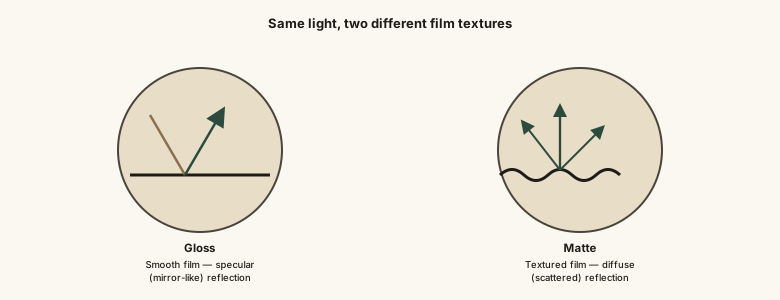
The incoming light is identical in both cases — the only difference between a shiny wall and a flat one is the microscopic texture the light bounces off.
Common mistakes
Common Mistakes
Choosing a flat matte finish for a high-grease or high-traffic area like a kitchen wall or hallway, then being surprised it's hard to keep clean.
→ Choose a satin or semi-gloss finish for areas that need frequent wiping or scrubbing, since a smoother surface resists staining and cleans more easily.
Using a high-gloss finish on a wall with visible surface imperfections, expecting it to look smoother than a matte finish would.
→ Use a flatter, matte finish on walls or ceilings with texture irregularities, since diffuse reflection visually minimizes small bumps and dips better than a glossier, more reflective surface.
Scrubbing a matte wall hard to remove a mark and being confused when the spot ends up looking shinier than the rest of the wall.
→ Clean matte walls with a soft touch and minimal pressure where possible, since hard scrubbing can burnish the surface and locally shift it toward a glossier appearance.
Common misconception
“Gloss and matte are fundamentally different types of paint, chosen mainly for how shiny you want the wall to look.”
Sheen is largely a cosmetic-seeming choice with real physical consequences beyond appearance. The same surface roughness that makes matte paint look flat instead of shiny also makes it more prone to visibly showing scrubbing marks (burnishing) and holding onto stains, while the smoothness that makes gloss shiny is exactly what makes it wipe cleaner and resist staining better. Choosing a sheen is really choosing a surface texture with real durability tradeoffs, not just picking a look.
What to do next
What to do next
- Choose satin or semi-gloss for kitchens, bathrooms, and other frequently wiped surfaces, since their smoother texture resists staining and cleans more easily.
- Choose flat or matte for ceilings and walls with visible texture imperfections, since diffuse reflection minimizes how noticeable those bumps and dips are.
- Clean matte-finished walls gently rather than scrubbing hard, to avoid burnishing a locally shinier patch into the surface.
- Consider a slightly higher sheen than flat matte for high-traffic hallways and children's rooms, where frequent cleaning is likely.