 KnowThis
Key Takeaways
Key Takeaways
- 1Drying is solvent or water evaporating out of the paint film, which usually takes just a few hours — it only makes the surface feel dry, not fully hardened.
- 2Curing is a separate, much slower chemical process where the remaining resin cross-links or oxidizes into a hard, durable film, typically taking two to four weeks.
- 3A paint film can be dry to the touch and safe to handle gently within a day, while still being soft enough underneath to dent, scuff, or block for weeks.
The concept
Once drying and curing are separated as two different processes on two different timelines, a lot of paint-related waiting-time advice — recoat times, cure times before washing a wall, cure times before hanging pictures — stops looking arbitrary and starts making sense as guidance tied to a specific, real chemical stage. It's the same reason super glue can feel set within seconds while still needing hours to reach its full bond strength — a fast surface-level change and a slower underlying one, running on separate clocks.
Why can a wall be dry to the touch just a few hours after painting, while manufacturers still recommend waiting weeks before washing it?
Worked examples
Example 1: Recoating a wall the same afternoon (baseline case)
A latex/acrylic wall paint is typically dry to the touch within one to two hours and safe to apply a second coat over within about four hours, under normal room temperature and humidity. This recoat window relies only on the drying stage being far enough along that the second coat won't disturb or trap moisture in the first — it doesn't require the first coat to be fully cured, which is why same-day second coats are standard practice rather than something that has to wait weeks. The same logic applies to a first coat of primer under a topcoat: primer only needs to be dry, not cured, before the finish coat goes on.
Why is it normally fine to apply a second coat of wall paint the same afternoon, without waiting for full curing first?
Example 2: Painting in a cold garage (edge case / variation)
Painting in a cold garage produces a wall that feels dry to the touch on a normal timeline, but the paint stays soft and easily damaged for much longer than usual. What best explains this?
Example 3: Hanging a picture on a freshly painted wall (real-world / applied case)
Someone paints a bedroom wall and, three days later, presses a picture-hanging hook firmly into it and leans a piece of furniture against the same wall. Even though the paint has been dry to the touch for days, the film hasn't finished curing, so it's still soft enough to dent, scuff, or take a lasting mark from firm pressure — the same wall would resist that same pressure far better after the typical two-to-four-week full cure window has passed. This is why manufacturers commonly recommend waiting several weeks before scrubbing a wall, hanging heavy items against it, or pushing furniture back flush to it, even though the paint has felt dry for most of that time.
Why might a wall painted three days ago still dent or scuff easily from firm pressure, even though it's been dry to the touch for days?
How it works (visual)
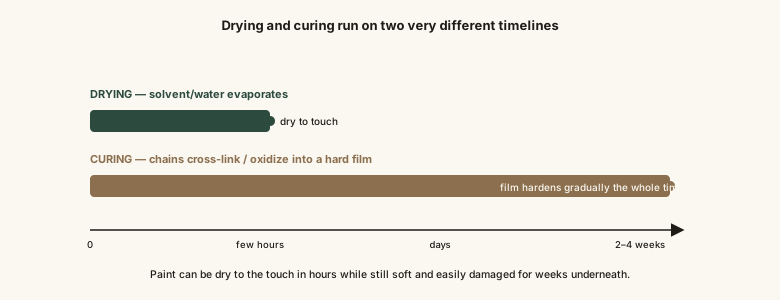
Both processes start at the same moment the paint is applied, but drying is essentially finished in hours while curing keeps working, unseen, for weeks afterward.
Common mistakes
Common Mistakes
Treating a freshly dry-to-the-touch wall as fully durable and immediately scrubbing it, hanging heavy items on it, or pushing furniture against it.
→ Wait for the manufacturer's full cure time — typically two to four weeks — before subjecting a freshly painted surface to scrubbing, firm pressure, or heavy contact.
Applying a second coat too soon in cold or humid conditions, before the first coat has dried enough, trapping moisture and causing a cloudy or uneven finish.
→ Check the manufacturer's recoat window and extend it in cold or humid conditions, since evaporation slows in both, delaying the point at which the surface is ready for another coat.
Painting in a cold space and assuming a normal-feeling dry time means the film has also cured normally.
→ Remember that curing is a temperature-sensitive chemical reaction — a cold room can leave paint dry to the touch on schedule while curing far more slowly underneath, so extend the wait before hard use.
Common misconception
“Once paint feels dry to the touch, it's fully hardened and can be treated normally.”
Feeling dry only means the water or solvent carrier has evaporated out of the surface layer — a physical process that's often finished within hours. The film's actual hardness, scuff resistance, and resistance to sticking (blocking) come from curing, a separate chemical process — cross-linking in latex/acrylic paints, oxidation in oil-based paints — that continues for two to four weeks after application. A wall can look and feel completely finished days before it's actually able to withstand scrubbing, firm pressure, or heavy furniture contact without marking.
What to do next
What to do next
- Check the paint can's label for both the recoat time and the full cure time — they're usually listed separately and mean different things.
- Wait for the full cure window, typically two to four weeks, before scrubbing a freshly painted wall or subjecting it to firm pressure.
- Extend both drying and curing time estimates in cold or humid conditions, since evaporation slows in humidity and the curing reaction slows in cold.
- Avoid pushing furniture flush against a freshly painted wall or closing a freshly painted door against its frame until the paint has had time to cure, to prevent it sticking (blocking).