 KnowThis
Key Takeaways
Key Takeaways
- 1Adhesive (thinset mortar or mastic), applied first and hidden under the tile, is what actually structurally bonds each tile to the floor or wall beneath it.
- 2Grout, applied afterward into the joints between tiles, has no structural bonding role at all — its job is filling gaps, managing minor surface water, and appearance.
- 3A cracked or missing section of grout is a cosmetic and minor water-protection issue; tiles staying firmly attached to the floor depends entirely on the adhesive layer underneath, not the grout.
The concept
Understanding this division also explains why tile problems get misdiagnosed: a homeowner who notices cracking grout often assumes tiles are "coming loose," when the two symptoms usually have separate, unrelated causes.
If a section of grout between two tiles cracks and falls out, what does this most directly affect?
Worked examples
Example 1: A standard tile floor installation (baseline case)
A kitchen floor is tiled using thinset mortar spread with a notched trowel, tiles set and leveled, and grout applied into the joints the next day once the mortar has cured. In this baseline sequence, each material does exactly its intended job: the thinset bears the structural load of the tile under foot traffic, and the grout, applied afterward, simply fills and finishes the joints. Neither material could substitute for the other's role — thinset alone with no grout would leave open, debris-collecting gaps, while grout alone with no adhesive underneath would provide no structural support at all.
In a standard tile floor installation, why is thinset mortar applied before the tiles are set, while grout is applied after?
Example 2: A shower wall using mastic instead of thinset (edge case / variation)
Why might mastic be acceptable on an upper bathroom wall but not recommended for a shower floor?
Example 3: Misdiagnosing loose tile as a grout problem (real-world / applied case)
A homeowner notices a tile that rocks slightly underfoot and, seeing cracked grout nearby, assumes re-grouting will fix it. In reality, a rocking or hollow-sounding tile (often checked by gently tapping it and listening for a hollow sound compared to surrounding tiles) indicates the adhesive bond underneath has failed, not the grout — re-grouting around a loose tile does nothing to restore its structural attachment and can even trap moisture against a compromised bond. The correct fix is removing the loose tile, cleaning off old adhesive, and resetting it in fresh thinset, entirely separate from any grout work.
Why would re-grouting around a rocking, loose tile fail to actually fix the problem?
How it works (visual)
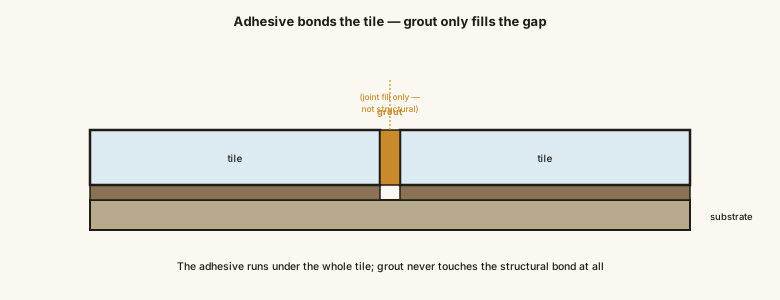
The adhesive layer runs under the whole tile and carries the structural bond; the grout only occupies the narrow joint between tiles and touches nothing structural at all.
Common mistakes
Common Mistakes
Re-grouting around a loose or rocking tile expecting it to fix the attachment.
→ Check for hollow sound/rocking first — that indicates a failed adhesive bond, which requires removing and resetting the tile in fresh thinset, not re-grouting.
Using mastic in a high-moisture floor or direct-spray shower area.
→ Use thinset mortar for wet floor areas and direct water-exposure zones; reserve mastic for drier wall applications per the manufacturer's rated use.
Assuming cracked or missing grout is a serious structural problem.
→ Treat it as a cosmetic and minor water-protection repair — remove and re-apply grout in the affected joints, without assuming the tiles themselves are at risk of coming loose.
Common misconception
“Grout is what holds tile down and keeps it from coming loose.”
Grout has no structural bonding role at all. The material that actually holds each tile in place is a separate adhesive — thinset mortar or, in some lower-moisture wall applications, mastic — applied to the substrate before the tile is even set. Grout is applied afterward, once the adhesive has cured, purely to fill the narrow joints between already-bonded tiles for appearance, debris resistance, and minor surface water management. A tile that rocks or sounds hollow when tapped has an adhesive bond problem underneath it, which no amount of re-grouting can fix — the two materials are structurally and functionally independent of each other.
Try it yourself
A rough way to estimate how much floor area one bag of thinset mortar will cover, based on the manufacturer's stated coverage rate per pound at your chosen trowel notch size.
What to do next
What to do next
- Diagnose a suspect tile by gently tapping it and comparing the sound to a neighboring tile — a hollow sound means an adhesive problem, not a grout problem.
- Match adhesive type to moisture exposure: thinset for wet floors and direct-spray shower areas, mastic reserved for appropriate drier wall applications per its rating.
- Repair cracked or missing grout promptly to maintain its minor water-protection role, even though it isn't a structural repair.
- For a loose or hollow-sounding tile, plan to remove it, clean off old adhesive, and reset it in fresh thinset rather than attempting a grout-only fix.