 KnowThis
Key Takeaways
Key Takeaways
- 1A drip means a seal — a rubber washer, an O-ring, or a ceramic disc, depending on the faucet type — no longer closes fully against its matching valve seat, even with the handle turned all the way off.
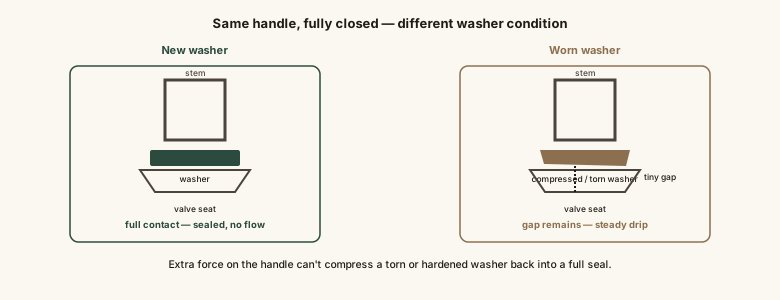
- 2Tightening the handle harder doesn't fix a worn seal — it just compresses already-degraded material against the seat, which is a temporary illusion of a fix at best.
- 3A slow, easy-to-ignore drip adds up fast: even a modest drip rate can waste well over a thousand gallons of water in a year.
The concept
Because the failing part is always a soft or precisely fitted seal rather than the handle's grip strength, diagnosing a drip really means figuring out which specific seal has failed inside a particular faucet, not how hard to close it. It's the same underlying pattern as a toilet's worn flapper letting tank water trickle into the bowl — a different fixture, but the same story of a rubber seal that no longer fully closes.
Why does a compression faucet eventually start to drip, even when the handle is turned fully off?
Worked examples
Example 1: A classic two-handle compression faucet develops a steady drip (baseline case)
A kitchen faucet with separate hot and cold handles starts dripping from the spout even when both handles are fully closed. Years of screwing the stem down onto the valve seat have compressed the rubber washer past the point where it springs back into a full seal. A thin gap remains at the seat's edge, and water under supply-line pressure finds it, forming a slow, steady drip. Replacing the worn washer with a new one of the correct size and shape typically restores a complete seal, since the valve seat itself is usually still in good condition.
Example 2: A single-handle bathroom faucet drips with no washer to replace (edge case / variation)
A single-handle faucet is dripping, but there's no simple rubber washer to find or replace inside it. What does this most likely mean?
Example 3: A new washer doesn't fully stop the drip (real-world / applied case)
Someone replaces a worn washer in a compression faucet, expecting the drip to stop completely — but a slower drip persists. In areas with hard, mineral-rich water, dissolved minerals can gradually pit and roughen the valve seat's surface itself, not just the washer pressed against it. A brand-new, perfectly shaped washer still can't form a complete seal against a scored or uneven seat. The fix in that case usually involves resurfacing the valve seat with a seat-dressing tool or replacing the seat entirely, rather than assuming the new washer was defective.
A faucet still drips slowly after its washer has been replaced with a new one. What is a likely explanation?
How it works (visual)
What a drip actually costs
A drip rate that feels trivial in the moment adds up over a full year. The estimate below scales from a commonly cited EPA WaterSense reference point: a faucet dripping at roughly one drip per second can waste more than 3,000 gallons of water annually.
Enter an approximate drip rate to see how much water it could waste over a full year, scaled from the EPA WaterSense one-drip-per-second reference point.
A rough estimate, scaled linearly from the commonly cited EPA WaterSense reference of roughly 3,000 gallons wasted per year at one drip per second (60 drips per minute). Actual waste varies with drop size and water pressure.
Common mistakes
Common Mistakes
Assuming tightening the handle harder permanently stops a drip.
→ Recognize extra force just compresses already-degraded rubber temporarily — the real fix is replacing the worn washer, O-ring, or cartridge.
Replacing the washer but never checking the valve seat's condition.
→ Inspect the seat for pitting or roughness, and resurface or replace it if a new washer still doesn't fully stop the drip.
Ignoring a slow drip as too minor to bother fixing.
→ Use a rough gallons-per-year estimate to see how quickly a small, steady drip adds up, and address persistent drips before they compound.
Common misconception
“A dripping faucet just needs to be shut off tighter, and it isn't really wasting much water anyway.”
Worn rubber, a torn O-ring, or a pitted valve seat can't be compressed back into a full seal by extra handle force — the material or surface damage is physical, not a matter of how hard the handle is turned. And the volume isn't trivial: even a modest, easy-to-ignore drip rate can waste well over a thousand gallons of water over the course of a year, according to commonly cited EPA WaterSense estimates. A persistent drip is a worn-part problem with a specific fix, not a tightening problem.
What to do next
What to do next
- Identify your faucet type — compression (two handles, a washer) versus cartridge, ball, or ceramic disc (usually single-handle) — before buying any replacement parts.
- Shut off the fixture's dedicated supply valve, if it has one, before attempting any faucet repair.
- If a drip persists after replacing the washer or cartridge, inspect the valve seat itself for pitting or damage rather than assuming the new part was faulty.
- Call a licensed plumber for a persistent drip, a corroded valve seat, or any faucet you're not comfortable disassembling yourself.
When reassembling the packing nut or handle, snug it down firmly and stop — cranking it further doesn't improve the seal and risks cracking a fitting. See what torque actually means for a wrench for why more force past the point of resistance tends to damage hardware rather than help it.