 KnowThis
Key Takeaways
Key Takeaways
- 1Water pressure measures force pushing on a fixed area, expressed in pounds per square inch (psi) — a real physical quantity, not just a vague sense of how "strong" the water feels.
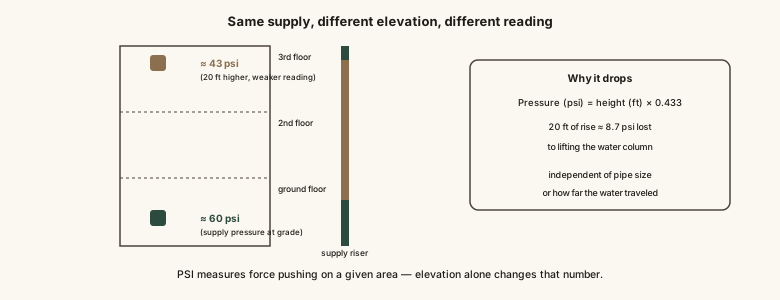
- 2Elevation alone changes pressure by a fixed, predictable amount: roughly 0.433 psi for every foot of height difference, independent of pipe size or how far the water traveled to get there.
- 3A pressure-reducing valve, where installed, actively regulates incoming supply pressure down to a safer target range through a continuous feedback loop, not a one-time adjustment.
The concept
Because pressure and flow are measuring two different things, a home can have plenty of one and not enough of the other — which is exactly why diagnosing "weak water" correctly means figuring out which of the two is actually the problem. Supply pressure isn't just background trivia, either — a toilet's fill valve depends on it to refill the tank at a reasonable pace after every flush. It's a related but distinct kind of pressure that a plunger relies on downstream of a fixture — creating a short-lived pressure differential in the trap rather than tapping into the supply system's steady static pressure at all.
What does a water pressure reading, in psi, actually measure?
Worked examples
Example 1: Testing static pressure at an outdoor hose bib (baseline case)
A homeowner screws a simple pressure gauge onto an outdoor hose bib and reads the static pressure with no other fixtures running in the house. The gauge shows a number in psi — commonly somewhere in a range plumbing codes generally consider safe for household fixtures and appliances. That single number reflects the municipal supply pressure at that specific point, adjusted for that fixture's elevation relative to where the supply line enters the property.
Example 2: The same supply reads differently on different floors (edge case / variation)
A home's ground-floor faucet and third-floor faucet are fed by the same supply line, but the third-floor faucet consistently reads lower pressure. What best explains this?
Example 3: A pressure-reducing valve quietly protects a home's plumbing (real-world / applied case)
A home sits close to a municipal pumping station, where incoming supply pressure runs well above what most household fixtures and appliances are rated for. Rather than letting that full pressure reach every fixture, a pressure-reducing valve installed at the main shutoff continuously senses the pressure downstream and throttles the flow through it, holding the home's internal plumbing to a lower, safer, more stable range. The valve isn't a one-time adjustment — it's actively regulating in real time, the same way a thermostat continuously compares a sensed value against a target rather than setting it once and walking away.
Why might a home have a pressure-reducing valve installed even though its municipal water supply is well above the minimum needed for normal use?
How it works (visual)
Estimate pressure from elevation
Because pressure from a water column depends purely on height, the relationship can be calculated directly: pressure in psi equals the height of the column in feet, multiplied by roughly 0.433.
Enter a height difference to see how many psi it adds or subtracts, based on the standard hydrostatic pressure relationship for water.
Based on the standard hydrostatic pressure relationship for water (about 0.433 psi per foot of height). A positive height means a supply point below a fixture; the same relationship applies in reverse for a fixture below its supply source.
Common mistakes
Common Mistakes
Treating water pressure and water flow rate as the same measurement.
→ Understand pressure (force per area) and flow (volume over time) as related but distinct — a fixture can have solid pressure but weak flow due to a clog or partially closed valve.
Adjusting or removing a pressure-reducing valve because pressure feels low, without understanding its protective role.
→ Have a licensed plumber diagnose and adjust a PRV rather than bypassing or removing it, since it's typically protecting the home's plumbing from unsafe incoming pressure.
Assuming persistently high pressure readings are simply a bonus with no downside.
→ Recognize that sustained pressure above the range recommended by plumbing codes accelerates wear on pipes, fittings, and appliances, and increases water hammer risk.
Common misconception
“Higher water pressure is always better, with no real downside as long as the pipes don't leak.”
Pressure above the range most plumbing codes and appliance manufacturers recommend puts sustained extra stress on pipe joints, fixture seals, and appliance components, accelerating wear and increasing the odds of a sudden failure or a leak developing over time. It also makes water hammer more forceful when a valve does close quickly. A pressure-reducing valve exists specifically because more pressure isn't simply better past a certain point — it's a tradeoff that plumbing codes and appliance ratings are built around, not unlike the way central air conditioning relies on controlling refrigerant pressure precisely rather than simply maximizing it.
What to do next
What to do next
- Test your home's static water pressure with a simple hose-bib pressure gauge from a hardware store.
- Compare your reading against the safe range typically referenced in local plumbing code.
- Remember that a reading taken on an upper floor will read lower than the same supply measured at ground level, purely from elevation.
- Have a licensed plumber inspect or adjust a pressure-reducing valve rather than adjusting it yourself if pressure seems unusually high or low.