 KnowThis
Key Takeaways
Key Takeaways
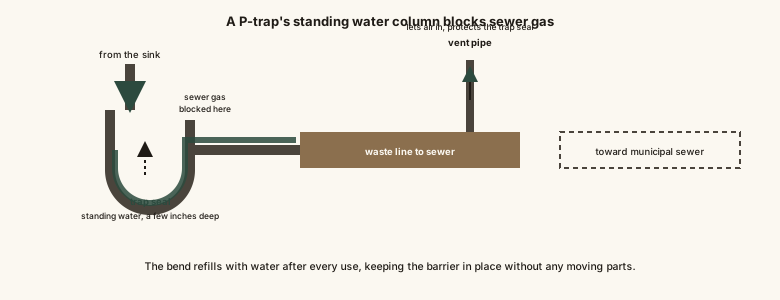
- 1A P-trap blocks sewer gas using nothing more than a standing column of water held in a curved pipe — a purely physical barrier, with no moving parts or seals to wear out.
- 2That water barrier, called the trap seal, has to stay full to keep working — it can fail simply by evaporating in a rarely used drain, with no plumbing damage involved at all.
- 3A sewer smell in a room usually points to one nearby fixture's dry or siphoned trap, not a broken main sewer line — a much smaller and more common problem than it sounds like.
The concept
Because the barrier is just standing water rather than a mechanical valve, a P-trap can fail in ways that have nothing to do with damage — it can simply run dry, which is exactly what happens to fixtures that don't get used often. The same trapway shape and siphon physics also happen to be central to how a toilet flushes — one uses a siphon deliberately for a moment, the other quietly avoids losing one by accident.
What physically blocks sewer gas from entering a room through a sink's drain?
Worked examples
Example 1: A regularly used kitchen sink (baseline case)
A kitchen sink gets used several times a day. Every time it drains, fresh water refills the trap's low point, maintaining a consistent trap seal. Sewer gas rising from the drain line below hits that water column and simply can't pass through it, so no odor reaches the kitchen. The trap needs nothing from the homeowner beyond ordinary, regular use to keep working.
Example 2: A guest bathroom's floor drain sits unused for weeks (edge case / variation)
A rarely used floor drain starts smelling like sewer gas, even though nothing was ever installed incorrectly. What's the most likely cause?
Example 3: A poorly vented sink loses its seal every time a nearby fixture drains (real-world / applied case)
A bathroom sink's trap keeps losing its seal shortly after the toilet in the same bathroom is flushed, even though the sink itself is used regularly. If the drain line lacks adequate venting, the fast rush of water from the toilet's flush can create a temporary vacuum strong enough to siphon the water right out of the sink's trap through the shared drain line. The sink's trap isn't evaporating slowly here — it's being actively pulled dry by pressure changes elsewhere in the system, a sign that the venting itself needs to be corrected rather than the trap.
A sink's trap repeatedly loses its water seal shortly after a nearby toilet is flushed. What does this suggest?
How it works (visual)
Common mistakes
Common Mistakes
Pouring chemical drain cleaner repeatedly down a drain that just smells bad from disuse.
→ For a rarely used drain, simply run water through it for a few seconds first — an evaporated trap seal is a far more common cause than a smell than a clog.
Using or leaving an outdated S-trap in place during a DIY sink or fixture install because it seems to drain fine at first.
→ Install only code-compliant P-traps with proper venting, and have a licensed plumber correct an S-trap if one turns up during other work.
Assuming any sewer smell in the house means the main sewer line is broken.
→ Check nearby fixtures for dry or siphoned traps first — floor drains, guest bathrooms, and rarely used sinks are the most common source of a localized sewer smell.
Common misconception
“A sewer smell in a room always means the home's main sewer line is broken or backed up.”
In most cases, the far more likely explanation is a single nearby fixture's trap seal that has evaporated from disuse or been siphoned out by poor venting — not a failure anywhere in the buried sewer line itself. Because a trap seal is just standing water rather than a mechanical part, it can fail quietly and locally without any sign of a larger plumbing problem. According to the CDC, sewer gas exposure at typical household levels is generally more of an odor nuisance than an acute health hazard, though sustained exposure in an enclosed, poorly ventilated space should still be addressed rather than ignored, and a persistent or strong smell is worth having a licensed plumber investigate. A slow drain near the smelly fixture is also worth ruling out on its own terms — see how a plunger actually clears a clog before reaching for a chemical drain cleaner.
What to do next
What to do next
- Run water briefly through rarely used sinks, tubs, and floor drains every few weeks to keep their trap seals full.
- Recognize an S-trap as an outdated, non-compliant design that a licensed plumber should correct if you find one during other work.
- If a sewer smell appears, check uncovered or rarely used drains for dryness before assuming a larger sewer line issue.
- Have a licensed plumber inspect the venting if a trap keeps losing its seal shortly after another fixture is used nearby.