 KnowThis
Key Takeaways
Key Takeaways
- 1A toilet flush works through a self-contained siphon inside its own trapway — not through suction pulling from the municipal sewer line.
- 2The flush and the refill are two separate mechanisms: gravity and siphon physics empty the bowl, while a float-and-valve feedback loop quietly refills the tank and bowl afterward.
- 3A toilet that runs on its own without being flushed usually means the feedback loop is stuck slightly open — a worn flapper or a float set too high — not a mysterious malfunction.
The concept
Once flush and refill are understood as two separate mechanisms, most common toilet problems sort themselves neatly into one bucket or the other — a weak or incomplete flush points to the siphon side, while a toilet that keeps running or randomly gurgles points to the float-and-valve side. That refill-side failure mode has a close cousin at the sink, too: see why a faucet drips for how a worn rubber seal produces the same kind of slow, unintended leak in a completely different fixture.
What actually pulls waste and water through a toilet's trapway during a flush?
Worked examples
Example 1: A normal, full flush (baseline case)
Someone pushes the handle down fully and holds it until the flapper lifts completely out of the way. The full volume of stored tank water rushes into the bowl at once, more than enough to fill the trapway and displace the air inside it. The siphon forms cleanly, pulls the bowl's contents over the trap and into the drain line, and only breaks once the bowl's water level has dropped enough to let air back in. The flapper reseats, and the float-driven refill begins.
Example 2: A quick tap of the handle produces a weak flush (edge case / variation)
Why does barely tapping the flush handle often produce a weak, incomplete flush?
Example 3: A toilet that runs briefly on its own every so often (real-world / applied case)
A toilet no one has touched in hours suddenly runs for a few seconds, then stops — often called a "phantom flush." The usual cause is a flapper that no longer seals perfectly, letting a slow trickle of tank water leak into the bowl over time. That trickle slowly drops the tank's water level until the float finally senses it's low enough to open the fill valve, which briefly refills the tank and sounds just like the tail end of a normal flush. Nothing was actually flushed — the feedback loop simply reacted to a slow leak, the same way it reacts to a real flush, just on a much smaller and slower scale.
A toilet occasionally runs for a few seconds on its own, with no one having used it. What does this most likely indicate?
How it works (visual)
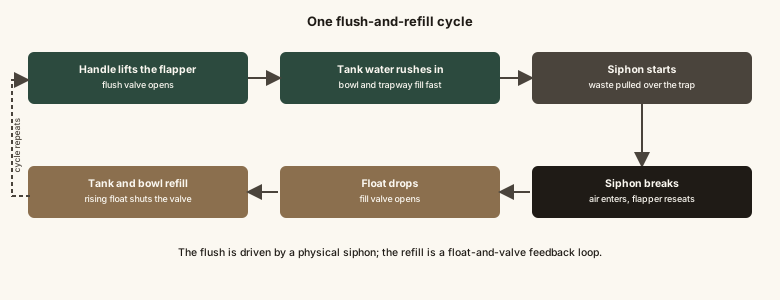
The two halves of the loop never really interact — the siphon doesn't know or care how the tank got full again, and the float-and-valve system doesn't know or care what triggered the water level to drop in the first place.
Common mistakes
Common Mistakes
Treating a toilet that runs occasionally as harmless background noise.
→ Check for a slow flapper leak with a simple dye test — food coloring in the tank that shows up in the bowl without flushing confirms a leak worth fixing.
Jiggling the handle every time as a permanent fix for a toilet that won't stop running.
→ Replace the worn flapper or adjust the float to its correct level, or have a licensed plumber address the underlying cause instead of repeating a temporary workaround.
Assuming a bigger tank or more water always means a stronger flush.
→ Recognize that flush strength depends on trapway geometry and how fast the water pulse arrives, not just total volume — set the float to the fill valve's marked level rather than overfilling the tank.
Common misconception
“A toilet flushes because the sewer line sucks the waste away.”
The pull a flush relies on is generated entirely inside the toilet itself, by the siphon that forms in its own trapway once enough water rushes through fast enough to displace the trapped air. The municipal sewer line downstream isn't creating any suction on the toilet — it's simply the destination the siphon-driven water and waste travel toward. This is also why a toilet can still fail to flush properly even with a perfectly clear sewer line: the problem is almost always upstream, in whether the trapway ever got enough water fast enough to start the siphon in the first place.
What to do next
What to do next
- Run a simple food-coloring dye test in the tank periodically to check for a silent flapper leak before it shows up on a water bill.
- Check that the float is set close to the fill valve's marked water level, not overfilled, which can waste water without improving flush strength.
- Hold the handle down for a full press rather than a quick tap, to make sure the trapway gets enough water to start a complete siphon.
- Call a licensed plumber for a toilet that runs constantly, rocks on the floor, or leaks at its base, rather than treating any of those as routine.
When reinstalling a tank or a supply line yourself, resist the urge to crank fittings as tight as possible — porcelain and plastic thread fittings can crack under excess force the same way an over-torqued bolt can strip; see what torque actually means for a wrench for why "snug plus a bit more" beats brute force on most plumbing hardware.