 KnowThis
Key Takeaways
Key Takeaways
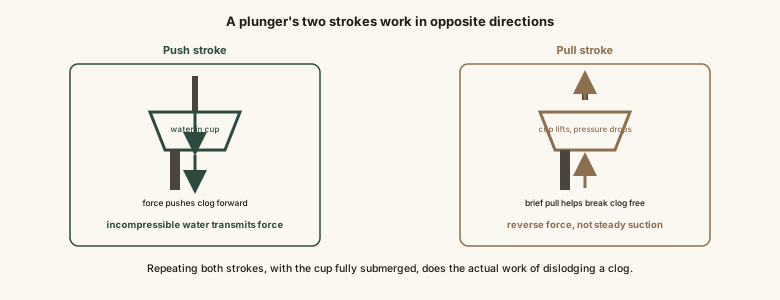
- 1A plunger's main working force is its push stroke, which transmits force through trapped water — nearly incompressible — straight down against a clog, not a sucking-out action.
- 2The pull stroke that follows adds a second, weaker force in the opposite direction, helping loosen a clog rather than being the primary mechanism.
- 3A plunger only works properly when its cup is fully submerged in water and sealed against the drain opening — without both, force gets absorbed by trapped air or lost through an unsealed gap instead of reaching the clog.
The concept
Once the push-stroke mechanism is clear, the usual advice around plunging — add water first, get a good seal, use the right plunger shape — stops being folklore and starts making direct physical sense. It also explains why a toilet doesn't need any of this at all during a normal flush — its own built-in siphon already moves a full column of water through the trapway on its own.
What is a plunger's push stroke actually doing when it clears a clog?
Worked examples
Example 1: Clearing a slow kitchen sink drain (baseline case)
A kitchen sink is draining slowly, suggesting a partial clog of grease or debris nearby in the trap. Before plunging, the sink's overflow opening — a small hole near the top of the basin — is blocked with a wet rag, since it's an alternate path pressure could otherwise escape through instead of reaching the clog. Enough water is added to fully submerge the plunger's cup, and repeated firm push-and-pull strokes are applied. The push strokes drive water directly against the clog while the pull strokes help work it loose, and the drain clears after several cycles.
Example 2: Plunging a nearly dry toilet bowl fails to work (edge case / variation)
Why does plunging a toilet with very little water in the bowl often fail to clear the clog?
Example 3: Plunging one side of a double kitchen sink does nothing (real-world / applied case)
A double-basin kitchen sink is clogged somewhere in the shared drain line, and plunging the clogged side repeatedly produces no result at all. Because both basins connect to the same drain line, pressure generated by the plunger can simply escape backward up through the second, open basin instead of being forced toward the clog — water and force both tend to follow the path of least resistance. Sealing the second basin's drain, typically with a wet rag pressed firmly into it or a sink stopper, before plunging again directs the full force of each stroke at the actual clog instead of letting it dissipate elsewhere.
Plunging one side of a double kitchen sink isn't clearing a shared drain clog. What is the most likely fix?
How it works (visual)
Understood this way, plunging near a fixture's P-trap makes intuitive sense too — the clog is very often sitting right at or just past that same curved bend the trap seal depends on.
Common mistakes
Common Mistakes
Believing a plunger's main job is suction, pulling a clog out toward you.
→ Think of the push stroke as the primary force, transmitting pressure through trapped water directly against the clog, with the pull stroke adding a secondary, weaker assist.
Plunging a toilet or sink without enough water covering the cup.
→ Add water first so the plunger has a full column of water to work with instead of mostly compressing trapped air.
Reaching straight for chemical drain cleaner, or mixing different chemical drain cleaners together, before trying a plunger.
→ Try a plunger first for a simple clog, and handle any chemical drain cleaner cautiously per its label and general CPSC household chemical safety guidance — never mix products.
Common misconception
“A plunger works mainly by suction, pulling the clog out toward you.”
The more significant force in most plunging is the push stroke, which compresses the water trapped under the cup and transmits that pressure through the nearly incompressible water column, straight down against the clog. The pull stroke that follows does create a mild reverse pressure, which can help loosen a clog further, but it's a secondary effect layered on top of the push, not the main mechanism doing the work.
What to do next
What to do next
- Choose a flange plunger for toilets and a flat cup plunger for sinks, tubs, and showers — the seal geometry is built for different drain shapes.
- Add enough water to fully submerge the plunger's cup before starting, rather than plunging with the cup mostly exposed to air.
- Seal any nearby drain openings that could let pressure escape instead of reaching the clog, such as a double sink's second basin or a tub's overflow hole.
- Call a licensed plumber if plunging doesn't clear a clog after a reasonable number of attempts, rather than escalating to repeated or mixed chemical drain cleaners.