 KnowThis
Key Takeaways
Key Takeaways
- 1Tire pressure is the same physical quantity — force per unit area — regardless of which unit labels it: psi in the US, bar or kPa in most of the rest of the world.
- 2The fixed conversion factors are 1 psi ≈ 0.0689 bar and 1 psi ≈ 6.895 kPa, so a US car's typical '32 psi' recommendation converts to about 2.21 bar or 220.6 kPa.
- 3Bar and kPa are directly related by a clean factor of 100 (1 bar = 100 kPa exactly) because both are metric, while psi's relationship to either requires an externally defined conversion factor, the same pattern seen throughout this topic whenever a US customary unit meets a metric one.
The concept
Because vehicles built for different regions display pressure recommendations in whichever unit is standard locally, converting correctly matters most when using a gauge from one region on a vehicle labeled in another.
A car's door-jamb sticker (made for the European market) recommends 2.3 bar. A driver in the US has only a psi-reading gauge. Roughly what psi reading should they inflate to?
Worked examples
Example 1: Converting a standard US tire pressure to bar (baseline case)
Example 2: Converting between bar and kPa, the easy metric-to-metric case (edge case / variation)
Why does converting bar to kPa require only multiplying by 100, while converting psi to bar requires the less clean factor 0.0689476?
Example 3: Why a small pressure conversion error matters for tires specifically (real-world / applied case)
How it works (visual)
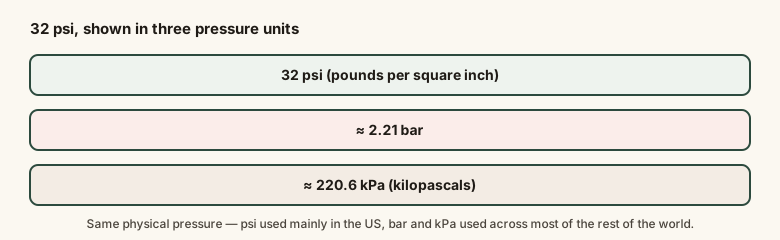
All three bars represent the identical physical air pressure inside the tire — the unit changes, the tire's actual firmness does not.
Common mistakes
Common Mistakes
Reading a pressure value in one unit (e.g. bar) and inflating a tire to that same numeric value on a gauge calibrated in a different unit (e.g. psi).
→ Always confirm which unit both the recommendation and the gauge are using before inflating — the numeric values are not interchangeable between psi and bar/kPa.
Assuming bar and kPa need a complicated conversion factor, when they're actually a clean factor of 100 apart.
→ Remember bar and kPa are both metric — multiply bar by 100 to get kPa, or divide kPa by 100 to get bar, no lookup needed.
Trusting a tire pressure sticker meant for a different regional market without converting its units to match your gauge.
→ Check the unit label on both the sticker and the gauge, and convert using the fixed psi/bar/kPa factors before inflating.
Common misconception
“A tire pressure number like '2.2' means roughly the same thing whether it's labeled psi, bar, or kPa — close enough not to worry about.”
Psi, bar, and kPa differ from each other by large factors — roughly 14.5x between psi and bar, and exactly 100x between bar and kPa — so the same numeric value means drastically different actual pressures depending on the unit. A tire inflated to '2.2' read as psi instead of the intended bar would be dangerously underinflated, at roughly 7% of the target pressure.
A performance car's manual specifies front tire pressure as '2.5 bar' for track use. The car's built-in tire pressure monitoring system displays readings in psi. What psi value corresponds to the manual's recommendation?
Try it yourself
What to do next
What to do next
- Check which pressure unit your tire gauge reads in before comparing it to a manufacturer recommendation in a different unit.
- Remember bar-to-kPa is a clean x100 (or ÷100 the other way); psi to either requires the fixed 0.0689/6.895 factors.
- Never treat the same number as 'close enough' across psi, bar, and kPa — the gap between them is large enough to meaningfully under- or over-inflate a tire.
- Use the calculator above whenever converting a specific tire recommendation between units.