 KnowThis
Key Takeaways
Key Takeaways
- 1A4 (210 x 297 mm) belongs to the ISO A-series, a system built around a single rule: every size has the same aspect ratio, so folding any sheet exactly in half produces the next size down with the identical proportions.
- 2US Letter (8.5 x 11 in) and Legal (8.5 x 14 in) sizes were set by historical printing and paper-manufacturing convention in the US, with no underlying scaling rule connecting them to each other or to any other standard size.
- 3Because the two systems are built on fundamentally different logic — a mathematical ratio versus a historical convention — converting between A4 and Letter isn't a single clean multiplication the way most conversions in this topic are; the two rectangles simply have different proportions.
The concept
Because A4 and Letter are different shapes rather than the same shape at different scales, printing an A4 document on Letter paper (or vice versa) always requires either cropping content or leaving margin — not just a simple percentage resize.
Why can't A4 and US Letter be converted into each other with a single multiplication, the way miles convert to kilometers?
Worked examples
Example 1: Calculating A4's area (baseline case)
Example 2: Verifying the halving property from A4 to A5 (edge case / variation)
If A3 paper is 297mm × 420mm, what should A2 paper's dimensions be, following the ISO 216 doubling pattern?
Example 3: Printing an A4 document on US Letter paper (real-world / applied case)
How it works (visual)
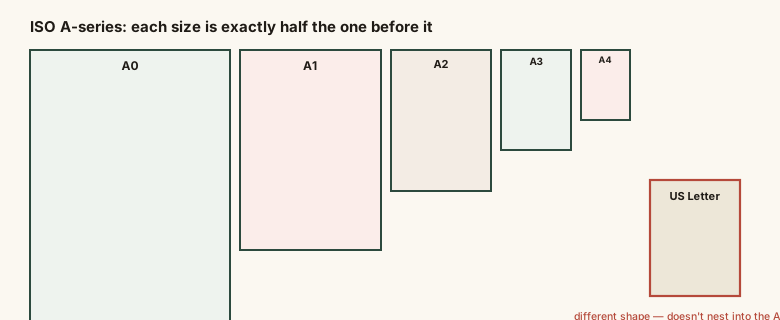
Every A-series rectangle is a scaled copy of every other one — you could lay a smaller A-size directly over a corner of a larger one and the edges would line up proportionally. US Letter, drawn separately, doesn't share that relationship with any A-size.
Common mistakes
Common Mistakes
Assuming A4 and US Letter are 'basically the same size' and can be used interchangeably without adjustment.
→ Treat them as different shapes, not just different sizes — check your document or printer's paper-size setting explicitly rather than assuming compatibility.
Expecting a single conversion factor to translate A4 dimensions into Letter dimensions the way a length unit converts.
→ Recognize this as a different-shape problem, not a unit-conversion problem — there's no multiplication that turns one aspect ratio into another.
Forgetting that scaling up the A-series (A4 to A3, A3 to A2) doubles the area, not just a linear dimension.
→ Remember each full A-series step doubles the area (and roughly multiplies each side length by √2 ≈ 1.414), not by exactly 2x on both sides.
Common misconception
“A4 and US Letter are close enough in size that documents will print identically on either without any adjustment.”
A4 (210 x 297mm, ratio 1:1.414) and US Letter (8.5 x 11in, ratio roughly 1:1.294) are meaningfully different shapes, not just slightly different sizes of the same shape. A4 is narrower and taller relative to its width than Letter is. Printing one format directly onto the other paper size without adjusting layout settings will crop content, leave uneven margins, or require scaling — never a perfect, lossless fit.
US Legal paper (8.5 x 14 in) and US Letter (8.5 x 11 in) share the same width. Does this mean Legal is part of a scaling system the way A4 relates to A3?
Try it yourself
What to do next
What to do next
- Check your document editor or printer's paper-size setting explicitly rather than assuming A4 and Letter are interchangeable.
- When designing a template meant for international use, test it against both A4 and Letter rather than just one.
- Remember that scaling up an A-series size (A4 to A3, for example) doubles the area, roughly multiplying each side by about 1.414, not exactly doubling each side.
- Use the calculator above to compare the actual area of any two paper sizes you're choosing between.