 KnowThis
Key Takeaways
Key Takeaways
- 1Unlike length, weight, or temperature, shoe and clothing sizes have no single fixed physical definition behind them — 'US size 9' doesn't correspond to one exact foot length the way '1 mile' corresponds to one exact number of kilometers.
- 2Size charts converting between US, UK, EU, and other systems are approximations built from typical measurements, and can shift by half a size or more depending on the specific brand and even the specific shoe or garment style.
- 3The most reliable way to compare sizes across countries is to measure the actual foot length (or body measurement) in centimeters or inches and compare that against a specific brand's own chart — not to trust a generic size-to-size conversion number as if it were a fixed unit conversion factor.
The concept
Because no fixed factor exists, the practical approach to cross-border sizing is the opposite of most of this topic: instead of trusting a formula, measure the actual foot or body dimension and cross-check it against the specific brand's own published chart.
Why is converting shoe sizes across countries fundamentally different from converting miles to kilometers?
Worked examples
Example 1: Applying the rough US-to-EU approximation (baseline case)
Example 2: Why the same nominal size varies by brand (edge case / variation)
A shopper wants the most reliable way to buy shoes from an unfamiliar international brand online, without trying them on first. What should they prioritize?
Example 3: Vanity sizing shifting a clothing size chart over time (real-world / applied case)
How it works (visual)
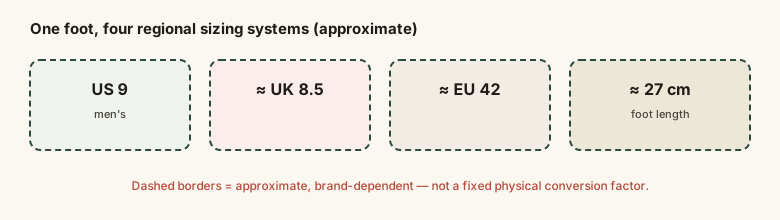
The dashed borders are deliberate — every other diagram in this topic uses solid borders for values connected by an exact, fixed conversion factor. Sizing conversions genuinely don't have that same certainty behind them.
Common mistakes
Common Mistakes
Treating a generic US-to-EU (or any cross-country) size conversion chart as an exact, guaranteed-fit number.
→ Use generic charts only as a rough starting estimate, and check the specific brand's own size chart, ideally based on an actual foot or body measurement, before buying.
Assuming a size label means the same thing across different brands, or even across different shoe/garment styles from the same brand.
→ Measure the actual foot length or body dimension and compare it against a specific product's chart, rather than relying purely on a familiar size number.
Not accounting for vanity sizing when comparing an old garment's size label to a new one.
→ Compare actual measurements (waist in inches, foot length in cm) rather than size labels when the garments are from different eras or brands.
Common misconception
“Shoe and clothing sizes work like any other unit — a 'US size 9' means the exact same physical foot length no matter which brand or country made the shoe.”
Unlike a mile, a kilogram, or a liter, shoe and clothing size labels have no single internationally fixed physical definition behind them. Each brand assigns its own size labels to its own last (for shoes) or pattern (for clothing), meaning the same nominal size can correspond to measurably different physical dimensions across brands. Size conversion charts are useful approximations, not exact unit conversions.
ISO 9407 (Mondopoint) shoe sizing is based directly on what physical measurement?
Try it yourself
What to do next
What to do next
- Before buying shoes or clothing from an unfamiliar brand, measure the actual foot length or body dimension rather than trusting a generic size conversion.
- Check the specific brand's own size chart whenever one is available, rather than a generic cross-brand chart.
- Treat any US-to-EU (or similar) conversion calculator, including the one above, as a rough starting estimate, not a guarantee.
- Remember that even a familiar brand's own size chart can drift over time due to vanity sizing — don't assume an old garment's size label still matches current sizing from the same brand.