 KnowThis
Key Takeaways
Key Takeaways
- 1A foundation's real job is spreading a house's entire weight over a wide enough area of soil that the resulting pressure stays under that soil's safe bearing capacity.
- 2Most real-world foundation problems come from uneven settling — different parts of the foundation experiencing different soil pressure or soil conditions — not from the concrete itself failing or being too weak.
- 3Soil type matters as much as the foundation design itself; the same foundation performs very differently on stable soil versus expansive clay that swells and shrinks with moisture.
The concept
This is also why soil testing happens before a foundation is designed, not as an afterthought: the correct footing size and depth genuinely can't be determined without knowing what the actual soil beneath the house can support.
Why does a foundation footing spread out wider at its base rather than just being a straight, narrow wall going into the ground?
Worked examples
Example 1: A standard footing on stable soil (baseline case)
A typical single-family home is built on dense, stable soil with a well-established, code-compliant footing width. The load from the house spreads evenly across that footing area, resulting in a bearing pressure comfortably under the soil's safe capacity. Over decades, the foundation experiences only the small, uniform settling expected on stable ground, with no meaningful cracking or shifting. This is the scenario standard residential footing sizing tables are built around.
Why does a foundation built to standard specifications on stable, dense soil typically avoid significant cracking over decades?
Example 2: A foundation on expansive clay soil (edge case / variation)
Why might a correctly sized foundation still develop problems on expansive clay soil?
Example 3: Diagnosing a stairstep crack in a foundation wall (real-world / applied case)
A homeowner notices a diagonal, stairstep-pattern crack running through the mortar joints of a block foundation wall, concentrated on one corner of the house. This pattern is a classic sign of differential (uneven) settling — that corner of the foundation has settled slightly more than the rest of the house, often due to soil conditions specific to that spot (a downspout draining nearby, saturating the soil, or a section of fill soil that compresses differently than undisturbed soil elsewhere). The diagnosis and fix target the localized soil-and-drainage cause, not the wall material itself, which is functioning as expected under an uneven load it wasn't designed to accommodate evenly.
Why does a stairstep crack concentrated at one corner of a foundation typically point to a localized soil issue rather than a general concrete-strength problem?
How it works (visual)
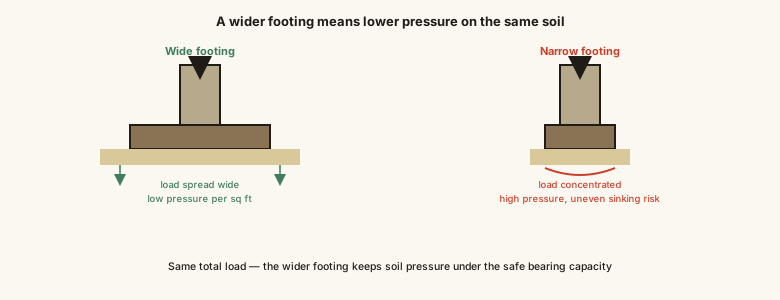
The footing's width is the entire point — the same total load, spread wider, produces lower pressure per square foot on the soil beneath it.
Common mistakes
Common Mistakes
Assuming all foundation cracking indicates a serious structural failure of the concrete itself.
→ Distinguish uniform, minor settling cracks (often cosmetic) from directional, widening stairstep cracks concentrated in one area (often a sign of uneven settling worth investigating).
Ignoring drainage and grading around a foundation as unrelated to structural health.
→ Recognize that water pooling near a foundation changes local soil moisture and bearing behavior, directly affecting settling risk in that specific area.
Assuming the same footing design works identically on any soil type.
→ Have soil conditions assessed before foundation work, since bearing capacity and moisture-driven soil behavior vary significantly and directly affect what footing design is actually adequate.
Common misconception
“A foundation holds a house up mainly because the concrete itself is extremely strong.”
Concrete strength matters, but it isn't the main variable determining whether a foundation performs well over decades. The foundation's core function is spreading the house's entire load over a wide enough footing area that the resulting pressure on the soil beneath stays under that soil's safe bearing capacity. The overwhelming majority of real-world foundation problems — cracking, settling, doors and windows sticking — trace back to uneven pressure or unstable/expansive soil conditions beneath different parts of the foundation, not to the concrete itself being structurally weak. This is exactly why soil testing precedes foundation design, and why drainage and grading around a house are treated as foundation-health issues, not separate concerns.
Try it yourself
A simplified illustration of the core relationship: dividing a load by the footing area it rests on gives the pressure the soil actually experiences, which engineers compare against the soil's safe bearing capacity.
What to do next
What to do next
- Have soil conditions professionally assessed before any new foundation work, since bearing capacity varies significantly by soil type and location.
- Maintain proper grading and drainage around the entire foundation perimeter to avoid localized soil moisture changes that can cause uneven settling.
- Distinguish minor, uniform hairline cracking (often normal) from widening, directional, or stairstep cracking (worth a professional inspection).
- If expansive clay soil is present in your area, ask a foundation professional about moisture-management or design measures specific to that soil type.