 KnowThis
Key Takeaways
Key Takeaways
- 1Pressure treatment doesn't change the wood species or make it structurally stronger — it forces a chemical preservative deep into ordinary wood's cells to resist rot and insects.
- 2The preservative is driven in using a vacuum-pressure cycle, not just surface-brushed or dipped on, which is why the protection extends through the wood rather than sitting only on its outer surface.
- 3Modern copper-based preservatives are corrosive to standard steel fasteners, which is why pressure-treated wood construction requires hot-dip galvanized or stainless steel screws and connectors, not standard hardware.
The concept
This is also why treated wood is rated by exposure category (ground contact versus above-ground use) — the required preservative retention level is higher for lumber that will sit in direct contact with soil, since that exposure creates the highest decay risk.
Why is pressure-treated wood not considered structurally stronger than the same species of untreated wood?
Worked examples
Example 1: An above-ground deck frame (baseline case)
A deck frame built with pressure-treated lumber rated for above-ground use is exposed to rain and humidity but never sits in direct contact with soil. The preservative treatment level appropriate for this exposure category protects the wood from decay driven by repeated wetting and drying, and the frame lasts for decades under normal outdoor conditions — provided it's assembled with hot-dip galvanized or stainless steel fasteners rather than standard uncoated screws.
Why does an above-ground deck frame use a different treatment rating than lumber intended for direct ground contact?
Example 2: A fence post set directly in soil (edge case / variation)
Why would using above-ground-rated treated lumber for a fence post set in soil likely lead to premature decay?
Example 3: A deck built with standard steel screws (real-world / applied case)
A homeowner builds a deck using correctly rated pressure-treated lumber but fastens it with ordinary steel screws left over from an indoor project, unaware of the corrosion risk. Within a few years, the screw heads show significant rust and corrosion, some snapping under load, well before the treated lumber itself shows any decay. The wood treatment did its job protecting against rot; the actual point of failure was the mismatched hardware, which the copper-based preservative accelerated the corrosion of — a completely avoidable outcome with the correct fastener choice from the start.
In this deck example, why did the fasteners fail years before the pressure-treated wood itself showed decay?
How it works (visual)
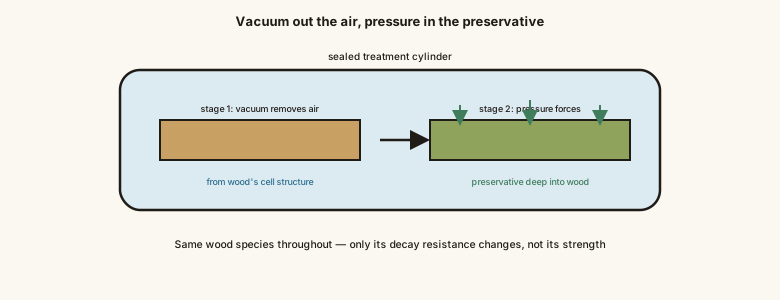
The vacuum stage clears space inside the wood's own cells; the pressure stage is what actually forces the preservative into that space, rather than leaving it sitting on the surface.
Common mistakes
Common Mistakes
Fastening pressure-treated wood with standard, uncoated steel screws or nails.
→ Use hot-dip galvanized or stainless steel fasteners and connectors rated for use with modern copper-based pressure-treated lumber.
Using above-ground-rated treated lumber for a post or structure set in direct soil contact.
→ Match the lumber's rated exposure category (ground contact versus above-ground) to the actual application before purchasing.
Assuming pressure-treated wood is structurally stronger and can span farther or hold more weight than the same untreated species.
→ Use the same span and load tables for the wood species regardless of treatment — pressure treatment addresses decay resistance, not structural capacity.
Common misconception
“Pressure-treated wood is a special, stronger type of lumber, not just regular wood that's been chemically treated.”
Pressure-treated lumber typically starts as the same common softwood species used in plenty of untreated products — the difference is entirely a chemical process, not a different or reinforced wood material. A vacuum-pressure cycle forces a preservative, commonly a copper-based compound in modern residential lumber, deep into the wood's cell structure to resist fungal decay and insect damage. It does not add structural strength, density, or load-bearing capacity beyond what the same untreated species would have. The real, practical difference to plan around isn't strength — it's that the preservative's copper content is corrosive to standard steel fasteners, requiring hot-dip galvanized or stainless steel hardware instead.
What to do next
What to do next
- Match the lumber's rated exposure category (above-ground versus ground contact) to your actual application before buying.
- Use only hot-dip galvanized or stainless steel fasteners and structural connectors with modern pressure-treated wood.
- Apply a compatible end-cut sealant to any freshly cut end of pressure-treated lumber, since cutting exposes untreated inner wood at that spot.
- Use standard structural span and load tables for the wood's species and grade — don't assume pressure treatment allows for a longer span or heavier load than the same untreated species could support.