 KnowThis
Key Takeaways
Key Takeaways
- 1Grading is the deliberate slope of the ground next to a foundation — building codes commonly call for a minimum drop of about 1/4 inch per foot for at least the first 6-10 feet away from the house.
- 2Negative grade (soil sloping toward the house instead of away) is one of the most common causes of a wet basement, and it's usually the cheapest water problem on the property to fix.
- 3Grading is a passive, gravity-driven first line of defense — it works before water ever reaches the foundation, which is why fixing it is more effective than adding pumps or drains to manage water that shouldn't have arrived in the first place.
The concept
Because grading acts before water ever reaches the wall, it's worth understanding as the first and cheapest layer in a house's overall water-management system, not a separate concern from drainage components like gutters and sump pumps.
A homeowner notices standing water pooling against their foundation after every rain, even though the house has working gutters. What is the most likely first thing to check?
Worked examples
Example 1: Correct grading directing water away (baseline case)
A house built to code has soil sloping down and away from the foundation at roughly 1/4 inch per foot for the first 8 feet, then leveling into the rest of the yard. During a heavy rain, water landing near the house runs down that slope away from the walls within seconds, never accumulating against the foundation long enough to build meaningful hydrostatic pressure. This is grading working exactly as designed — a purely passive system requiring no power, no moving parts, and no ongoing action once it's correctly shaped.
Why does correctly sloped grading protect a foundation without requiring any power or moving parts?
Example 2: Negative grade developing over time (edge case / variation)
A foundation that was correctly graded when built develops a water problem fifteen years later, with no changes to the foundation itself. What's the most likely explanation?
Example 3: Re-grading as the fix, before adding a drainage system (real-world / applied case)
A homeowner facing a damp basement calls a contractor expecting to need an expensive interior drain tile and sump pump system installed. The contractor first checks grading and finds a clear negative slope along one side of the house, caused by a flower bed built up against the foundation over several seasons. Regrading that side — removing the excess soil and re-sloping it to fall away from the wall — resolves the dampness within the next few rain events, at a fraction of the cost of the drainage system originally assumed necessary. This real-world case illustrates why grading is checked first: it's often the actual root cause, and fixing it can make more expensive downstream solutions unnecessary.
Why do experienced contractors typically check and fix grading before recommending an interior drainage system or sump pump for a damp basement?
How it works (visual)
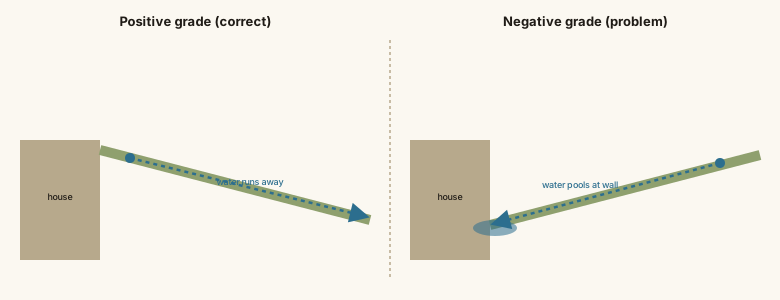
The foundation and the rainfall are identical in both panels — the only difference is the direction of the slope, and that single variable decides whether the water ends up in the yard or against the wall.
Common mistakes
Common Mistakes
Building up flower beds, mulch, or topsoil against the foundation without checking whether it reverses the original slope.
→ Keep landscaping material sloped away from the foundation, and periodically confirm the grade still falls away from the house, not just that it looks tidy.
Assuming a wet basement means the foundation itself is failing.
→ Check grading and gutter discharge points first — they're the cheapest, most common causes, and ruling them out first can save an unnecessary structural repair.
Letting downspouts discharge water directly at the base of the foundation instead of extending them away from the house.
→ Add downspout extensions that carry water at least several feet from the foundation, onto ground that's actually sloped away.
Common misconception
“A wet basement almost always means the foundation itself is cracked or failing.”
Far more often, the foundation is structurally fine and the actual cause is that water is being directed toward it instead of away from it — usually a negative grade, a downspout dumping water too close to the house, or both. Grading is a passive, gravity-driven system that's supposed to carry surface water away from the foundation before it can pool and build hydrostatic pressure against the wall. Because grade changes gradually through soil settling and landscaping additions, a house that was dry for years can develop a real water problem with the foundation itself never having changed at all. Professionals typically check and correct grading first — it's the cheapest fix, and it's frequently the entire solution, often making more expensive interior drainage work unnecessary.
Try it yourself
Estimate how many total inches of drop a given slope produces over a set distance — compare against the common code-minimum of about 1/4 inch per foot.
What to do next
What to do next
- Walk the perimeter of the house after the next rain and check whether water is pooling against the foundation anywhere, rather than running off.
- Confirm the ground slopes away from the foundation for at least the first several feet — roughly 1/4 inch of drop per foot is a common minimum target.
- Extend downspouts so they discharge well away from the foundation, onto ground that's actually sloped away from the house.
- Re-grade any area where landscaping, mulch, or settled soil has flattened or reversed the original slope, before assuming a bigger drainage system is needed.