 KnowThis
Key Takeaways
Key Takeaways
- 1A sump pump doesn't block groundwater from approaching the house — it collects water that's already draining toward a low pit and pumps it out before it can rise past the basement floor.
- 2The system is entirely active and powered: a float switch triggers the pump automatically as water rises, which means the whole setup stops working the moment power is lost.
- 3Because heavy storms are both the time flooding risk is highest and a common cause of power outages, a battery or water-powered backup pump is what actually closes the system's biggest failure point.
The concept
This power dependency is exactly why battery-backup and water-powered backup sump pumps exist as a distinct product category — they exist specifically to cover the single most common real-world failure mode of an otherwise well-designed system.
Why is a power outage during a heavy storm the scenario that most directly defeats a standard sump pump?
Worked examples
Example 1: Normal operation during a rainstorm (baseline case)
During a heavy rainstorm, groundwater around the foundation rises and drains toward the sump pit as designed. The float switch detects the rising water level, triggers the pump, and the pump discharges the water well away from the house through its discharge line. The cycle repeats every few minutes for the duration of the storm as more water continues draining in, and the basement floor stays dry throughout — this is the system functioning exactly as intended, actively keeping pace with incoming water rather than passively blocking it.
During normal operation in a storm, why does a sump pump cycle on and off repeatedly rather than running continuously or staying off?
Example 2: A power outage during the same storm (edge case / variation)
During a power outage, why does a standard sump pump system stop protecting the basement even though groundwater is still draining into the pit normally?
Example 3: A battery-backup pump saving a basement during an outage (real-world / applied case)
A homeowner with a battery-backup sump pump system experiences the same storm-related power outage. When the primary pump loses power, a secondary pump wired to a dedicated backup battery automatically takes over, continuing to remove water from the pit for as long as the battery holds a charge, typically several hours to a day depending on the battery and pump load. This real-world case shows the practical payoff of understanding the system's actual failure point: rather than adding a generic emergency measure, the backup specifically targets the one step (electrically powered pumping) that a standard system can't perform without power.
Why does a battery-backup sump pump specifically address the main vulnerability of a standard sump pump system, rather than being a general-purpose improvement?
How it works (visual)
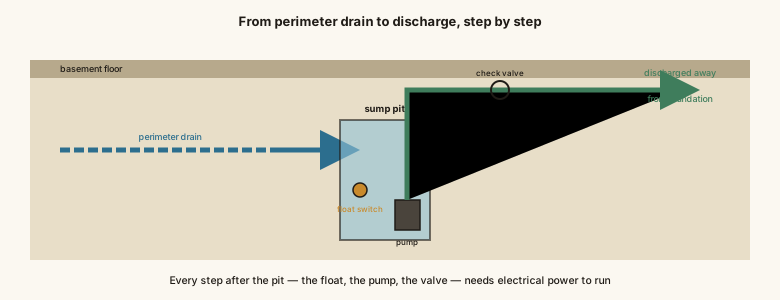
Follow the water's path from the perimeter drain to the discharge point outside — the pump only enters the picture once water has already collected in the pit.
Common mistakes
Common Mistakes
Assuming a sump pump alone is sufficient protection with no backup power plan.
→ Add a battery-backup or water-powered backup pump, since standard sump pumps stop working entirely during a power outage — exactly when storm flooding risk is highest.
Routing the discharge line to drain right back near the foundation.
→ Extend the discharge line far enough from the house that pumped water doesn't simply re-saturate the same soil near the footing.
Ignoring a sump pump that cycles frequently during dry weather.
→ Investigate promptly — this often points to a stuck float switch, a failed check valve, or a rising water table, not normal behavior.
Common misconception
“A sump pump acts like a barrier or seal that keeps groundwater from ever reaching the basement.”
A sump pump is an active, powered removal system, not a passive barrier. Groundwater is designed to drain toward a low collection pit built into the basement floor, and the pump's job is removing that collected water fast enough that it never rises high enough to spread across the floor. Because every step of the actual removal — the float switch trigger, the pump motor — depends on electricity, the system provides no protection at all during a power outage unless a battery or water-powered backup is also in place. This is precisely why storm-related power outages are the scenario most associated with basement flooding even in homes with a working sump pump.
Try it yourself
A rough way to see how fast a sump pit refills based on steady groundwater inflow — a shorter refill time means more frequent pump cycling during heavy inflow conditions like a storm.
What to do next
What to do next
- Install a battery-backup or water-powered backup sump pump so protection continues through a power outage, not just normal operation.
- Test the primary pump periodically by pouring water into the sump pit and confirming the float switch triggers it correctly.
- Route the discharge line to release water well away from the foundation, not back toward the same soil near the footing.
- Investigate promptly if the pump cycles frequently during dry weather, or doesn't cycle at all during a heavy rain — both indicate something needs attention before the next real storm.