 KnowThis
Key Takeaways
Key Takeaways
- 1Water expands by about 9% in volume when it freezes solid, and inside a sealed pipe that extra volume has nowhere to go.
- 2A frozen pipe usually doesn't burst at the ice itself — it bursts wherever pressure trapped between the ice plug and a closed faucet finds the weakest point in the pipe wall.
- 3Letting a faucet drip during a hard freeze works by keeping the system open, not by keeping the water moving fast enough to avoid freezing.
The concept
Once the failure is understood as a two-step process — freeze first, then trapped pressure builds separately — the specific advice around frozen pipes (leave a faucet open, don't assume the leak is at the frozen spot) stops being a list of unrelated tips and starts following directly from the mechanism. Cold air infiltrating around an exterior wall — the same kind of gap addressed by weatherstripping — is also a common reason a supply line in an outer wall or cabinet drops below freezing in the first place.
A pipe running through an exterior wall freezes solid during a cold snap, but both the faucet it feeds and the shutoff valve behind it are closed. What determines whether this pipe actually bursts?
Worked examples
Example 1: An exterior hose bib freezing solid (baseline case)
An outdoor hose spigot left connected to a garden hose over winter freezes solid on a cold night. The hose creates a closed system — the ice plug forms inside the spigot or the short section of pipe just behind it, with the attached hose sealing off the far end. As the ice plug grows, it compresses the trapped water between itself and the sealed hose connection, and that pressure has no path to escape. This is one of the most common and most preventable frozen-pipe failures, largely because the fix is simple: disconnecting the hose before winter removes the seal that turns an ordinary freeze into a closed, pressurized system.
Why does leaving a garden hose connected to an outdoor spigot over winter increase the risk of a burst, compared to disconnecting it?
Example 2: A supply line inside an uninsulated cabinet (edge case / variation)
A pipe inside a closed, uninsulated exterior-wall cabinet freezes even though the room around it stays warm. What does this reveal about which factor actually matters?
Example 3: A burst discovered far from any obviously cold pipe section (real-world / applied case)
After a multi-day cold snap, a homeowner finds water damage near a pipe joint in a heated basement, nowhere near an exterior wall or any section that seemed at risk of freezing. Tracing the system reveals the actual ice plug had formed upstream, in an unheated crawlspace section of the same continuous pipe run, and the trapped pressure from that freeze traveled through the water and ruptured the joint at its weakest point — the basement fitting — rather than the frozen crawlspace section itself. This is the practical payoff of understanding the two-stage mechanism: a burst pipe's location doesn't reliably point to where the freeze happened, so tracing the whole closed section of pipe matters more than focusing only on the visible damage.
A pipe bursts at a joint in a heated basement, but the actual ice plug is later found in an unheated crawlspace section of the same pipe run. What does this illustrate?
How it works (visual)
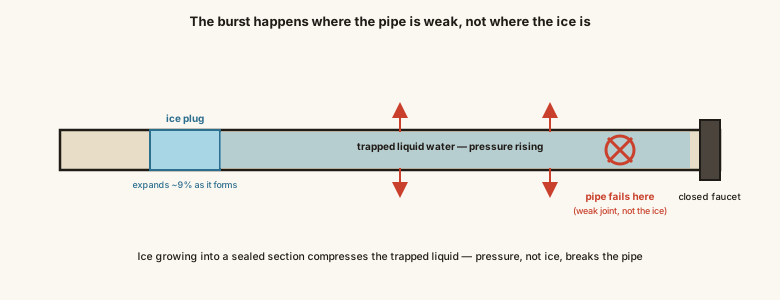
Follow the pressure, not the ice, along the pipe in the diagram — the rupture happens at the weakest point in the whole closed section, which is rarely the same spot as the ice plug itself.
Common mistakes
Common Mistakes
Assuming a burst pipe must be located right at the frozen section.
→ Check the entire closed run of pipe for the actual rupture point — pressure damage often shows up at a joint or weak spot some distance from the ice itself.
Believing a dripping faucet prevents freezing by keeping the water moving fast.
→ Understand that a drip works mainly by keeping the system open rather than sealed, relieving pressure buildup even if a section still freezes.
Leaving a garden hose attached to an outdoor spigot through winter.
→ Disconnect and drain hoses before the first hard freeze — an attached hose seals the pipe into a closed system that's far more prone to a pressure-driven burst.
Common misconception
“A frozen pipe bursts because the ice cracks it open.”
The ice plug itself usually isn't what ruptures the pipe. Water expands by roughly 9% in volume as it freezes, and in a sealed section of pipe — trapped between the growing ice plug and a closed valve or faucet — that expansion has nowhere to go. The resulting pressure builds in the still-liquid water on either side of the ice, and the pipe fails wherever its wall is weakest, which is very often a joint, bend, or corroded spot some distance from the ice plug itself rather than the frozen section. This is why a burst is sometimes discovered in a heated part of the house even when the actual freeze happened somewhere colder, upstream on the same closed run.
Try it yourself
Water expands by about 9% in volume when it freezes solid — this estimates the added volume a section of pipe has to accommodate, illustrating why a fully sealed section has nowhere for that extra volume to go.
What to do next
What to do next
- Disconnect and drain garden hoses from outdoor spigots before the first hard freeze of the season.
- Let faucets fed by exposed or exterior-wall pipes drip slightly during a hard freeze, to keep the system open rather than sealed.
- Open cabinet doors under exterior-wall sinks during cold snaps so warmer room air can reach the supply pipes inside.
- Consider heat trace cable or added insulation for any pipe run through an unheated crawlspace, attic, or garage.