 KnowThis
Key Takeaways
Key Takeaways
- 1Radon is a naturally occurring radioactive gas, produced continuously by decaying uranium and radium in soil and rock, and it has no smell, color, or taste to warn anyone of its presence.
- 2Radon concentration is measured in pCi/L (picocuries per liter), and the EPA recommends taking action to reduce levels at or above 4 pCi/L, though even lower levels still carry some risk.
- 3A simple test kit, not intuition or the home's age or location alone, is the only reliable way to know a specific home's radon level — nearby homes can have very different readings even on the same street.
The concept
Because radon is undetectable without instrumentation and its concentration can vary by floor and season, a single informal impression of a house — "it's new construction" or "the neighbors never mentioned it" — tells you nothing reliable about its actual radon level.
Why can't a homeowner simply tell whether radon is present in their house without testing?
Worked examples
Example 1: A basement short-term test result of 2.1 pCi/L (baseline case)
A homeowner runs a short-term radon test kit in their basement for 48 hours and gets a result of 2.1 pCi/L. This falls below the EPA's 4 pCi/L action-recommended threshold, so immediate mitigation isn't required, but it's not zero risk either — the EPA notes that risk decreases with concentration but doesn't disappear entirely below the action level. A reasonable response here is simply retesting periodically, since levels can shift with seasonal changes in ventilation and ground moisture, rather than assuming a single low reading is permanent.
A short-term radon test comes back at 2.1 pCi/L, below the EPA's 4 pCi/L action level. What does this result mean?
Example 2: A neighboring home testing very differently (edge case / variation)
Why might two neighboring, similarly built homes have very different radon test results?
Example 3: Installing a mitigation system after a high reading (real-world / applied case)
A homeowner gets a confirmed result of 8.4 pCi/L and has a sub-slab depressurization system installed — a fan and pipe network that draws radon gas from beneath the foundation and vents it above the roofline before it can seep indoors. After installation, a follow-up test typically shows a dramatic reduction, often into the range below the 4 pCi/L action level, confirming the system is working as intended. This mirrors standard EPA guidance: mitigation systems are a well-established, generally effective response to a confirmed elevated reading, not an experimental or last-resort measure, and the same basic principle — managing air pressure and pathways rather than trying to "filter" radon out of already-indoor air — is why proper ventilation design matters throughout a house, not just in the basement. It's a genuinely different job from the one a home's regular air filter does: a filter captures particles already circulating through the central air system, while a radon mitigation fan intercepts a gas before it ever reaches that indoor air loop.
How does a sub-slab depressurization mitigation system actually reduce indoor radon levels?
How it works (visual)
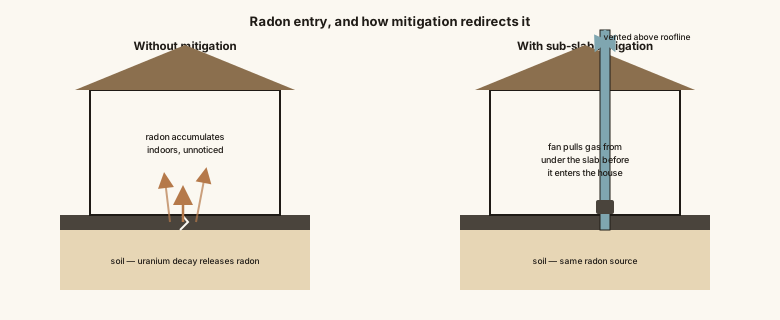
The soil below both houses is producing the same radon — the only real difference is whether that gas has an easy path into the living space or a redirected path venting it above the roof.
Common mistakes
Common Mistakes
Assuming a home doesn't need testing because it's new construction, or because a neighboring house tested low.
→ Test every home regardless of age or a neighbor's result — radon entry depends on very local soil and foundation conditions specific to that structure.
Treating a single short-term test result as a permanent, unchanging fact about the home.
→ Retest periodically, especially after any foundation work, and consider a longer-term test kit for a more representative seasonal average.
Sealing up a home more tightly for energy efficiency without addressing radon, assuming better insulation alone reduces radon risk.
→ Address radon specifically through testing and, if needed, a mitigation system — general air-sealing and insulation work targets heat loss, not the soil-gas pathway radon actually uses.
Common misconception
“Radon is only a problem in certain regions or in old, poorly built homes.”
Radon comes from uranium naturally present in soil and rock nearly everywhere, and elevated levels have been documented in homes across virtually every U.S. state, in new and old construction alike, and in well-built as well as poorly built homes. Regional radon-potential maps exist and can suggest likelihood, but they describe an average tendency across an area, not a guarantee for any individual property — a single home's actual level depends on its own specific soil conditions, foundation, and construction details, which is exactly why the EPA and CDC recommend testing every home rather than relying on general location or age as a substitute.
Try it yourself
Radon results in the U.S. are reported in pCi/L, while many other countries use Bq/m³ (becquerels per cubic meter). Enter a pCi/L reading to see its Bq/m³ equivalent.
Based on the standard unit conversion: 1 pCi/L = 37 Bq/m³. The EPA's 4 pCi/L action-recommended level is equivalent to about 148 Bq/m³.
What to do next
What to do next
- Test your home for radon with an EPA-approved test kit, regardless of its age, construction type, or a neighboring home's result.
- If a short-term test comes back at or above 4 pCi/L, follow up with a second test to confirm before deciding on mitigation.
- Have a qualified radon mitigation professional install a sub-slab depressurization system if a confirmed reading warrants it.
- Retest periodically, especially after foundation repairs, renovations, or significant changes to the home's heating and cooling system.