When to See a Doctor vs Self-Care (General Framework)
Deciding between self-care, a doctor's visit, and emergency care generally comes down to three general signals — how severe symptoms are, whether they're changing over time (worsening, unchanged, or improving), and whether any recognized warning signs are present — rather than a single fixed severity threshold, and this entry provides that general framework, not a diagnosis for any specific symptom.
Reading time
— 4 min
Updated
— Aug 21, 2026
Fact-reviewed
— Aug 21, 2026
This entry is a general decision framework, not medical advice or a diagnostic tool. It cannot evaluate your specific symptoms. When in doubt, or for any symptom that feels severe, sudden, or unusual, contact a doctor or emergency services rather than relying on general guidance alone.
Key Takeaways
Key Takeaways
1The self-care-versus-doctor decision isn't binary — there's a real middle tier (urgent care) for symptoms that need prompt but not emergency attention.
2Trajectory (is it getting better, staying the same, or getting worse) is often as informative as severity at a single moment for deciding whether to wait or seek care.
3A defined set of recognized warning signs (severe pain, difficulty breathing, sudden severe symptoms, among others published by health authorities) generally overrides a 'wait and see' approach regardless of how mild things seemed initially.
The concept
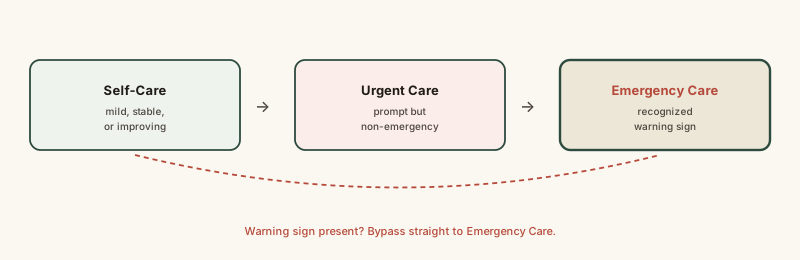
Deciding whether to handle something at home, see a doctor, or seek emergency care generally comes down to three things: how severe it is right now, whether it's getting better or worse, and whether any recognized warning sign is present. Mild, stable, or improving symptoms often fit a self-care threshold; symptoms that are worsening or persisting longer than expected usually warrant a doctor's visit, possibly through urgent care; and any recognized warning sign generally means emergency care regardless of how things looked before.
This three-tier framework — not a single severity line — is why "it's probably nothing, I'll just wait" and "call an ambulance for everything" are both oversimplifications of how the actual decision generally works.
Quick check
A symptom starts out mild but has been steadily worsening over several days. According to this general framework, does 'it started out mild' mean self-care is still the right approach?
Worked examples
Example 1: A mild, stable symptom fitting self-care (baseline case)
A mild sore throat with no fever, present for one day and not worsening, generally fits the self-care tier — rest, fluids, and over-the-counter options as appropriate, with re-evaluation if it changes rather than an immediate visit.
Example 2: A middle-tier case suited to urgent care (edge case / variation)
A minor but clearly displaced finger injury after a fall — painful, swollen, limited mobility, but the person is otherwise stable with no other warning signs — is a common example of the middle tier: it needs prompt professional evaluation (possible imaging, splinting) that shouldn't wait for a routine scheduled appointment, but doesn't require an emergency room visit, making urgent care the framework-consistent choice.
Example 3: A recognized warning sign overriding a mild-seeming start (real-world / applied case)
Someone with what seemed like ordinary heartburn develops sudden chest pressure radiating to the arm along with shortness of breath — a combination that maps onto recognized cardiac warning signs published by health authorities. Per the framework, this overrides any "it's probably just heartburn, I'll wait" reasoning: recognized warning signs call for immediate emergency care regardless of how mild the starting symptom seemed.
Quick check
Why does this general framework treat recognized warning signs (like sudden chest pressure with shortness of breath) as overriding the usual severity/trajectory reasoning?
How it works (visual)
Three-tier decision framework: self-care, urgent care, emergency care
The bypass arrow from "warning sign present" straight to Emergency Care is the framework's key structural feature — it's not a gradual escalation, it's a direct override.
Common mistakes
Common Mistakes
✕
Treating the decision as strictly binary — either self-care or the emergency room.
→ Remember urgent care exists as a real middle tier for symptoms needing prompt but non-emergency attention.
✕
Focusing only on how a symptom started, ignoring whether it's worsening over time.
→ Track trajectory (better, same, worse) alongside initial severity — a worsening pattern can shift the appropriate response even from a mild start.
✕
Rationalizing away a recognized warning sign because the overall situation still seems mild.
→ Treat any recognized warning sign (per CDC/ACEP guidance) as an override to seek emergency care immediately, independent of how mild things otherwise seem.
Common misconception
“If something started out mild, it's safe to just wait and see indefinitely.”
Initial severity is only one input in this framework. A genuinely worsening trajectory over time, or the appearance of a recognized warning sign, both warrant reassessing the decision regardless of how things looked at the start. Health authorities specifically publish warning-sign lists because certain symptom combinations are associated with time-sensitive conditions where "wait and see" carries real, documented risk.
What to do next
What to do next
Track whether a symptom is improving, staying the same, or worsening over time, not just its severity at one moment.
Learn your local urgent care options in advance, so you have a real middle-tier choice ready if needed.
Familiarize yourself with published warning-sign lists (like stroke's F.A.S.T. signs) from a source like the CDC or Mayo Clinic.
When in doubt, or if a recognized warning sign appears, contact a doctor or emergency services rather than continuing to self-manage.
FAQ
FAQ
Related terms
Related terms
Self-care threshold
The general point at which a symptom is judged mild, stable, or improving enough that home management is reasonable, without a specific diagnosis or professional evaluation.
Urgent care
A tier of medical care for conditions that need prompt attention but aren't immediately life-threatening — a middle ground between a scheduled doctor's appointment and an emergency room visit.
This entry was researched from public sources and drafted with AI-assisted tools, then edited — errors are still possible. Spot one, or want a topic covered? Read our disclaimer.
 KnowThis