Basic First Response for Minor Poisoning or Exposure
Poison Control is a real, free, 24/7 hotline (1-800-222-1222 in the US) staffed by specialists who give exposure-specific guidance in real time — for any actual poisoning or chemical exposure the correct first action is always to call Poison Control or emergency services immediately, not to look up general safety information, and this entry exists only to explain what that call does and why general principles like 'don't induce vomiting unless instructed' exist, never as a substitute for making the call.
Reading time
— 5 min
Updated
— Aug 22, 2026
Fact-reviewed
— Aug 22, 2026
If you suspect a real poisoning or chemical exposure, stop reading and call Poison Control at 1-800-222-1222 (US) or emergency services (911) immediately. This entry explains general concepts only — it is never a substitute for that call, and it does not give treatment steps for any specific substance. Poison Control is free, confidential, available 24/7, and is the correct first call even if you're only unsure whether something is a real exposure.
Key Takeaways
Key Takeaways
1Poison Control (1-800-222-1222 in the US) is a real, free, 24/7 hotline staffed by pharmacists, nurses, and toxicologists — call it immediately for any suspected poisoning or exposure, even if unsure it's serious.
2Treatment for poisoning depends entirely on the specific substance involved — there is no single safe universal home response that applies across different poisons, which is why generic advice can't substitute for a specialist on the phone who asks about the exact substance.
3A widely repeated but outdated piece of advice — inducing vomiting after swallowing something harmful — is no longer generally recommended by health authorities and can make some exposures worse; only a poison specialist or medical professional should give exposure-specific instructions.
The concept
Poison Control is a real phone service, not a last resort — specialists answer calls around the clock and ask specific questions about what was involved, how much, and who's affected, then give guidance tailored to that exact situation. For any real suspected poisoning or exposure, calling 1-800-222-1222 (in the US) or emergency services is always the correct first step, faster and safer than searching for general advice online.
Everything below explains general concepts about what the call itself involves — it does not, and cannot responsibly, tell you what to do for any specific real exposure. That decision belongs to Poison Control or emergency services.
Quick check
Someone is unsure whether a small amount of a cleaning product a child touched counts as a 'real' exposure worth calling about. What's the appropriate action?
Worked examples
Example 1: What a Poison Control call actually involves (baseline case)
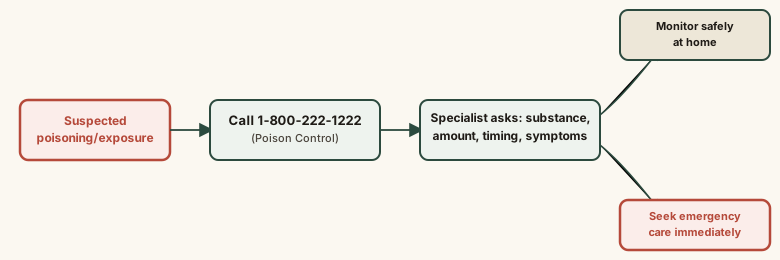
A caller reaches 1-800-222-1222 and is asked several structured questions: what substance was involved (ideally reading directly from a product label or container), roughly how much, when it happened, the age and weight of the person affected, and any symptoms so far. Based on those specific answers, the specialist gives guidance tailored to that exact case — sometimes reassurance that monitoring at home is sufficient, sometimes clear direction to seek emergency care immediately. The call is free, confidential, and available 24/7.
Example 2: Why outdated general advice can actually be harmful (edge case / variation)
Decades ago, many households kept syrup of ipecac specifically to induce vomiting after a child swallowed something harmful. Health authorities have since reversed that general guidance, because for some substances — particularly corrosive or petroleum-based ones — vomiting can cause additional damage on the way back up, and delaying a call to get real specific advice while attempting an outdated home remedy can cost valuable time. This is a concrete, documented case of well-meaning general advice becoming actively counterproductive once more was learned about specific substances.
Quick check
Why did major health authorities reverse their previous general advice to induce vomiting after most poisonings?
Example 3: Preparing information before calling, in a real household scenario (real-world / applied case)
A parent finds an open container near a child and suspects a possible exposure. Before or while calling 1-800-222-1222, gathering the actual product container (to read the exact name and ingredients directly to the specialist), noting the approximate time, and observing the child for any symptoms all make the call faster and the guidance more precise — none of this replaces making the call immediately, it simply makes that call as effective as possible once connected.
How it works (visual)
What happens when you call Poison Control
Every branch in this flow depends on the specific answers given to a trained specialist — which is exactly why no general article, including this one, can substitute for making the actual call.
Common mistakes
Common Mistakes
✕
Waiting to see if symptoms appear before calling Poison Control.
→ Call immediately, even if unsure whether it's a real exposure — specialists are trained to quickly assess uncertain situations, and early guidance can matter for time-sensitive exposures.
✕
Relying on outdated remembered advice, like inducing vomiting, without checking current guidance.
→ Call Poison Control or emergency services for exposure-specific direction rather than acting on an old rule of thumb, since some past general advice has since been reversed.
✕
Searching online for general information instead of calling immediately for a real exposure.
→ Call 1-800-222-1222 first — a live specialist who can ask follow-up questions gives faster, more reliable, and more specific guidance than a general search result.
Common misconception
“There's a single safe home remedy (like inducing vomiting or a 'universal antidote') that works for any poisoning.”
There is no single safe universal response, since the right action depends entirely on the specific substance, amount, and person involved. What's appropriate for one exposure can be actively harmful for another — for example, inducing vomiting is no longer generally recommended by major health authorities for most poisonings, since it can cause additional injury with certain substances. This is exactly why Poison Control exists: to give guidance specific to the real situation, not a remembered general rule.
Quick check
What is the single most important takeaway from how Poison Control actually works?
What to do next
What to do next
Save 1-800-222-1222 (US Poison Control) in your phone now, before you ever need it.
For any real or suspected poisoning or exposure, call Poison Control or emergency services immediately — do not wait for symptoms or search online first.
If safe to do so, gather the product container or substance information to read directly to the specialist when you call.
Do not rely on remembered home remedies like inducing vomiting — let the specialist or a doctor give exposure-specific guidance.
FAQ
FAQ
Related terms
Related terms
Poison Control
A real, free, 24/7 hotline (1-800-222-1222 in the US) staffed by pharmacists, nurses, and toxicologists who give real-time, exposure-specific guidance for any suspected poisoning or chemical exposure.
Universal antidote myth
The false, long-debunked idea that a single home remedy (like activated charcoal mixed with common household items) can safely treat any poisoning — real treatment is always specific to the exact substance involved, which is exactly why Poison Control or emergency services must be contacted rather than guessed at.
This entry was researched from public sources and drafted with AI-assisted tools, then edited — errors are still possible. Spot one, or want a topic covered? Read our disclaimer.
 KnowThis