 KnowThis
Key Takeaways
Key Takeaways
- 1Food provides energy measured in calories, and the body draws that energy mainly from three macronutrients — carbohydrates and protein at about 4 calories per gram, fat at about 9 calories per gram.
- 2Digestion breaks food down into absorbable molecules — glucose, amino acids, fatty acids — that cells use for energy, growth, and repair; food isn't generic 'fuel,' it's raw material for specific chemical processes.
- 3Body Mass Index (BMI) is a simple screening ratio of weight to height used at a population level — it is not a diagnostic measurement of body fat or individual health on its own, per CDC and NIH guidance.
The concept
The energy numbers above aren't just trivia — they're the actual arithmetic behind how a meal's calorie content is calculated, and running real numbers through it makes the mechanism concrete.
Gram for gram, which macronutrient provides the most energy (calories)?
Worked examples
Example 1: Calculating a meal's total calories from its macronutrients (baseline case)
Example 2: Alcohol as an "empty calorie" source (edge case / variation)
Alcohol provides about 7 kilocalories per gram of usable energy but is not classified as one of the three core macronutrients. Why?
Example 3: Calculating BMI and understanding its limits (real-world / applied case)
BMI is calculated as weight in kilograms divided by height in meters squared. For someone weighing 70 kg and standing 1.75 m tall: 70 ÷ (1.75 × 1.75) = 70 ÷ 3.0625 ≈ 22.9, which falls within the commonly cited "normal weight" range of 18.5-24.9 used by the CDC and WHO. BMI is useful as a quick, low-cost population-level screening tool, but per NIH and CDC guidance it does not directly measure body fat percentage or account for individual differences like muscle mass — a muscular athlete can register a high BMI despite having low body fat, because the formula can't distinguish muscle weight from fat weight. This is why BMI is treated as one screening indicator among several, not a standalone diagnosis, and why any individual health concern is best discussed with a healthcare provider who can consider the full picture.
How it works (visual)
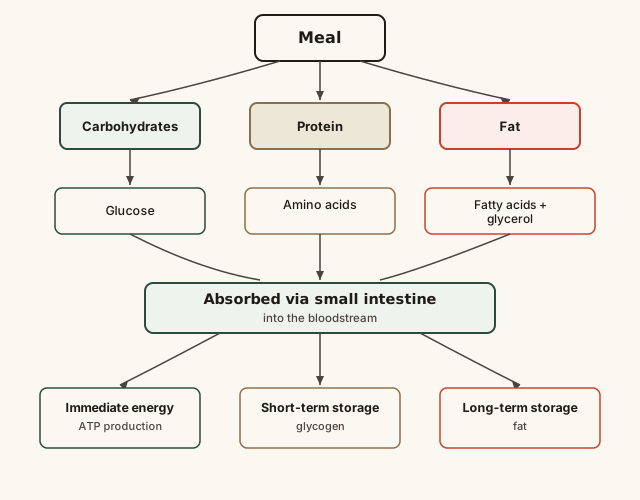
Follow any one of the three streams and notice it ends at the same fork: cells either use the absorbed molecules for energy right away, store a limited amount nearby as glycogen for the next few hours, or — once those stores are full — convert the surplus into fat for longer-term storage. This is the same basic pathway regardless of which macronutrient the energy originally came from, which is why "eating too much fat" and "eating too much of anything beyond what the body uses" both lead to the same storage outcome.
Common mistakes
Common Mistakes
Treating all calories as nutritionally equal regardless of source.
→ Total calories determine energy balance, but the source matters for everything else — a 200-calorie serving of vegetables and a 200-calorie serving of candy deliver very different amounts of protein, fiber, vitamins, and minerals alongside that energy.
Assuming 'fat-free' or 'low-fat' automatically means low-calorie or healthy.
→ Manufacturers often replace removed fat with added sugar or refined carbohydrates to preserve taste and texture, which can leave a 'fat-free' product with a similar or even higher calorie count than the original.
Treating BMI as a precise, standalone diagnosis of an individual's health.
→ Per CDC and NIH guidance, use BMI only as one general screening indicator — it doesn't distinguish muscle from fat and doesn't account for factors like age, sex, or body composition on its own.
Common misconception
“Eating dietary fat directly makes you gain body fat.”
Body weight change is governed primarily by total calorie balance across all macronutrients combined — calories consumed versus calories used — not by dietary fat intake specifically. Dietary fat is also an essential nutrient: it's needed to absorb certain vitamins (A, D, E, and K), build cell membranes, and produce hormones. A diet can lead to weight gain from excess calories sourced entirely from carbohydrates or protein, just as it can from excess fat. The relevant number for weight change is total energy balance, not which single macronutrient the calories came from.
Someone gains weight after several weeks of eating significantly more bread and sugary snacks, without increasing fat intake at all. What does this best illustrate?
Try it yourself
BMI is a general screening ratio, not an individual diagnosis — per CDC and NIH guidance, it doesn't account for muscle mass, age, or body composition. Discuss what your results mean for you personally with a healthcare provider rather than using this calculator alone to draw conclusions.
What to do next
What to do next
- Check a food label and practice the calorie-from-macronutrients math yourself using the 4/4/9 kcal-per-gram values from Example 1.
- Next time you see a 'fat-free' or 'low-fat' label, check the total calorie and sugar content rather than assuming fat-free means low-calorie.
- Try the BMI calculator above, and read the result as one general screening indicator, not a full picture of your individual health.
- For personalized nutrition guidance — especially around weight management or a medical condition — consult a healthcare provider or registered dietitian rather than relying on general reference numbers alone.