 KnowThis
Key Takeaways
Key Takeaways
- 1A fitness tracker counts steps by recognizing the repeating bounce pattern an accelerometer detects during walking, not by sensing an actual footfall.
- 2Heart rate is estimated using photoplethysmography (PPG): a light shone into the skin is absorbed slightly more with each pulse of blood, and a photodiode detects that tiny dip.
- 3Both measurements are indirect estimates smoothed by an algorithm, which is why they can drift from a true count during atypical movement or in some skin/lighting conditions.
The concept
Once you see both measurements as pattern recognition on an indirect signal rather than a direct physical count, the situations where a tracker gets confused make a lot more sense.
How does a wrist-worn fitness tracker actually estimate heart rate?
Worked examples
Example 1: A normal walk across a room (baseline case)
During a slow, steady walk, why does a tracker's step count usually stay close to accurate?
Example 2: Pushing a stroller or vigorous arm-pumping exercise (edge case / variation)
Why might a wrist-worn tracker undercount steps while someone is pushing a stroller?
Example 3: Choosing chest-strap vs. wrist-based monitoring for interval training (real-world / applied case)
Someone training for a race wants accurate heart rate data during short, intense sprint intervals. A wrist-based PPG tracker can struggle here because rapid arm motion during sprinting creates movement artifacts in the light signal that look similar to a genuine pulse, and sweat or a loosening band can further reduce contact quality. A chest-strap monitor, which reads the heart's own electrical signal directly (the same underlying principle as a medical EKG, though not to clinical certification standards) rather than relying on light reflection, is far less affected by arm motion and is the more reliable choice for this specific use case. This is a practical, not theoretical, distinction: understanding which sensing method a device actually uses tells you when to trust the wrist reading and when to reach for something more accurate. One reading that isn't a sensor error: on a long, hot session your real heart rate drifts upward at the same pace as you lose fluid (see how hydration affects physical performance).
Why would a chest-strap heart rate monitor typically outperform a wrist-based tracker during high-intensity interval sprints?
How it works (visual)
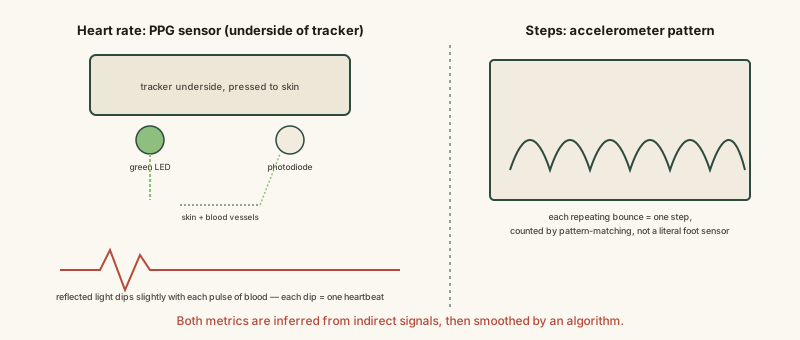
Neither measurement in this diagram is a direct count — both are inferred from an indirect physical signal and cleaned up by software before you ever see a number.
A rough estimate of distance covered, based on step count and an average stride length.
A rough estimate only — actual stride length varies by height, pace, and terrain, and most trackers use a fixed or roughly calibrated stride assumption rather than measuring each individual step's true length.
Common mistakes
Common Mistakes
Assuming a fitness tracker measures heart rate the same way a medical device does.
→ Understand it's an optical estimate (PPG) built for general fitness tracking, not a clinically certified diagnostic tool — treat unusual readings as a prompt to check with a real medical device or professional, not a diagnosis.
Expecting a wrist tracker's step count to be exact.
→ Treat it as a consistent, useful trend indicator rather than a precise count — activities that don't swing the wrist with the legs (pushing a cart, cycling) will undercount, and repetitive arm motion can overcount.
Assuming a low battery or a loose band has no effect on accuracy.
→ A loose-fitting band reduces skin contact and light-sensor accuracy directly — a snug, correctly positioned band is one of the simplest ways to improve reading quality.
Common misconception
“A fitness tracker measures your heart rate and step count exactly, the same way a medical device would.”
Both measurements are estimates inferred from indirect signals — light reflection for heart rate, motion-pattern matching for steps — and then smoothed by an algorithm. They're useful for spotting trends over time (is your resting heart rate trending down, are you generally more active this week than last), but they are not built or certified to the same accuracy standard as a clinical EKG or a direct step-by-step count, and both can be thrown off by loose fit, skin tone contrast, cold hands, or motion that doesn't match the expected pattern.
What to do next
What to do next
- Wear the band snug and positioned slightly above the wrist bone for the most consistent PPG heart rate contact.
- Treat step and heart rate numbers as trends to track over weeks, not exact counts to trust down to the last digit.
- For high-intensity interval training where accuracy matters most, consider a chest-strap monitor instead of relying on wrist-based PPG alone.
- Read what makes a device smart next to see how a fitness tracker's sensor, processor, and connectivity combination fits the broader smart-device definition.