 KnowThis
Key Takeaways
Key Takeaways
- 1A device counts as "smart" when it combines four things: a sensor or data source, a processor, network connectivity, and software that can be updated after purchase.
- 2Adding an app or a remote on/off switch to a device doesn't automatically make it smart — a Bluetooth-controlled light that only turns on or off, with no sensing or logic, is barely more capable than a mechanical switch.
- 3"Internet of Things" (IoT) is the umbrella term for the whole category of everyday physical objects built this way — a smart device is a single member of that category.
The concept
Once you have this checklist, it gets much easier to tell genuinely capable smart devices apart from products that borrow the label mostly for marketing.
A lamp can be turned on and off from a phone app over Bluetooth, but has no sensors and never receives software updates. By the fuller definition of a smart device, what is it missing?
Worked examples
Example 1: A smart plug vs. a mechanical timer (baseline case)
What is the core functional difference between a mechanical outlet timer and a smart plug, beyond the smart plug simply being app-controlled?
Example 2: A \"smart\" water bottle that only tracks taps (edge case / variation)
A device has a sensor and a Bluetooth connection to an app, but its manufacturer has never issued a single software update and the app does nothing but display a raw count. How should this be judged against the four-ingredient definition?
Example 3: Choosing between two similar smart thermostats while shopping (real-world / applied case)
Two thermostats both advertise "smart learning." One has a temperature and occupancy sensor, connects to Wi-Fi, and has received several firmware updates adding new scheduling logic since launch. The other has a temperature sensor only, connects over Bluetooth to a phone in the same room (no home network access), and has never been updated. Applying the four-ingredient checklist quickly separates real capability from label alone: the first genuinely senses more (occupancy, not just temperature), can be reached and improved remotely, and has a track record of active updates — the second is closer to a basic connected thermostat wearing the same marketing language.
When comparing two 'smart' thermostats where one has more sensors, home-network connectivity, and a history of firmware updates, and the other lacks all three, what does the four-ingredient framework suggest?
How it works (visual)
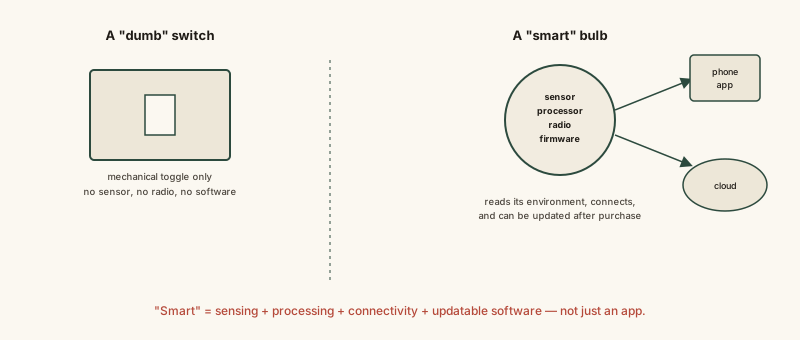
The mechanical switch has exactly one job and cannot change. The smart bulb has the same basic function — turning light on or off — but wraps it in a loop of sensing, processing, and connectivity that can be reprogrammed long after purchase.
Common mistakes
Common Mistakes
Assuming any device with an app is automatically a 'smart' device in the fuller sense.
→ Check whether it actually senses conditions and can be updated after purchase — an app that only sends on/off commands is remote control, not the full smart-device ingredient set.
Treating 'smart' and 'Internet of Things' as two unrelated terms.
→ Internet of Things is the umbrella category; a smart device is one member of that category — the terms describe the same underlying idea at different scopes.
Assuming a higher price automatically means more genuine smart capability.
→ Check the specific ingredients — sensor type, processing depth, connectivity range, and update history — rather than relying on price or marketing copy alone.
Common misconception
“If a device has an app and can be turned on or off remotely, it's automatically a smart device.”
Remote on/off control is only the connectivity piece of a bigger picture. A genuinely smart device also senses something about its environment and can be improved or patched with new software after it's already in your home — a device with only an app and a toggle, no sensing, and no update history is closer to a remote-controlled gadget than a fully smart one, even if the packaging uses the word "smart."
What to do next
What to do next
- Before buying a 'smart' product, check whether it actually senses something (not just relays a command) and whether the manufacturer has a track record of software updates.
- Distinguish 'Internet of Things' (the category) from 'smart device' (a specific member of that category) so you can talk about either accurately.
- When two similar products both use the word 'smart,' compare their sensors, connectivity type, and update history side by side rather than trusting the label alone.
- Read what a smart home hub actually does next to see how multiple smart devices connect and coordinate once you have more than one.