 KnowThis
Key Takeaways
Key Takeaways
- 1Water-saving habits split into two very different categories: behavioral habits that only save water while you're actively doing them, and fixture-level flow rate reductions that save water automatically on every single use, forever.
- 2A standard showerhead flows at roughly 2.5 gallons per minute (gpm); a WaterSense-certified showerhead flows at 2.0 gpm or less — the savings compound with every shower, with zero ongoing behavior change required.
- 3The single biggest lever in most homes is usually the highest-frequency, highest-flow fixture — for most households, that's the shower, not the faucet used for brushing teeth.
The concept
None of this means behavioral habits are worthless — a leaking faucet left unfixed, or a garden hose left running, can waste more water than any fixture swap saves. The point is that fixture-level changes and behavior changes solve different parts of the problem, and mixing up which lever actually produces the bigger number is a common mistake.
A household wants to reduce water use with the least ongoing effort. Should they focus first on remembering to turn off the tap while brushing teeth, or on swapping their showerhead for a WaterSense-certified model?
Worked examples
Example 1: Calculating daily savings from a showerhead swap (baseline case)
Example 2: Annualizing the savings across a household (edge case / variation)
Why does the annualized savings in Example 2 not depend on the household remembering to do anything differently day to day?
Example 3: Comparing a fixture swap against a leaking faucet (real-world / applied case)
How it works (visual)
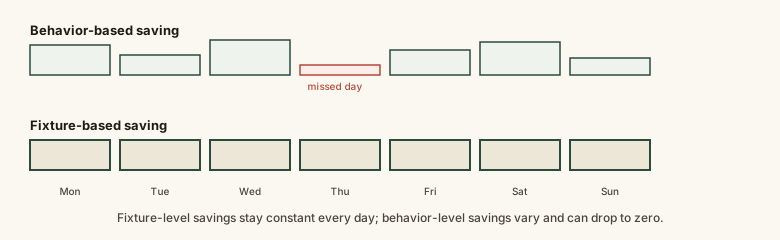
The visual point is consistency, not just total volume — a behavior-based habit can be perfectly saving water on Monday and completely forgotten by Thursday, while a fixture-level change produces the same reduction every single day without requiring anyone to remember it.
Common mistakes
Common Mistakes
Focusing conservation effort entirely on faucet-off habits while ignoring high-flow fixtures like showerheads and toilets.
→ Check the flow rate or WaterSense certification of your highest-frequency fixtures first — the largest, most reliable savings usually live there, not at the bathroom sink.
Assuming a home has no leaks just because no water is visibly pooling anywhere.
→ Check your water meter with all fixtures off for an hour, or watch for a slowly moving toilet flapper — many leaks are silent and can waste thousands of gallons a year unnoticed.
Believing a low-flow fixture means noticeably weaker water pressure.
→ WaterSense-certified fixtures are specifically tested for performance, not just flow reduction — many use aeration or spray-pattern redesign to maintain a comparable felt pressure at a lower flow rate.
Common misconception
“The biggest way to save household water is being more careful and mindful about water use day to day.”
Mindful daily behavior helps, but the EPA's own WaterSense data shows that fixture-level upgrades — low-flow showerheads, faucet aerators, and efficient toilets — typically produce larger and far more consistent water savings than behavior alone, precisely because they don't depend on remembering to do anything differently each day. Fixing leaks, which requires no behavior change at all, often outweighs both.
Someone argues that fixing a small, slow faucet leak isn't worth the effort compared to a fixture upgrade. What does the real math in Example 3 suggest about this claim?
Try it yourself
What to do next
What to do next
- Check your showerheads and faucet aerators for a WaterSense label, or look up their rated flow rate — this is usually the highest-leverage single upgrade in a home.
- Test for hidden leaks by checking your water meter with everything off for an hour, or watching for a running toilet — leak repair is often a bigger win than any single fixture upgrade.
- Use the calculator above with your own fixture's flow-rate reduction and household usage minutes to estimate your specific savings.
- Keep behavioral habits (shorter showers, turning off taps) as a genuine secondary layer, not a replacement for fixing flow rates and leaks.