 KnowThis
Key Takeaways
Key Takeaways
- 1Fast fashion's central environmental problem is garment lifespan, not fabric type alone — the same manufacturing footprint gets divided across far fewer wears when a garment is discarded quickly.
- 2The Ellen MacArthur Foundation's clothing utilization research documents a real, measurable decline in how many times an average garment is worn before disposal, compared to a few decades earlier.
- 3Extending a garment's useful life by wearing it more times, or buying it secondhand, reduces its environmental footprint per wear more reliably than switching to a specific 'eco' fabric while keeping the same low-utilization buying pattern.
The concept
This doesn't mean fabric choice is irrelevant — different fibers do have genuinely different water, land, and chemical footprints at the production stage. But fabric choice alone can't offset a buying pattern built around very low garment utilization, which is the larger lever most discussions of "sustainable fashion" undersell.
A shopper switches to buying only clothes made from a specific 'sustainable' fabric, but continues buying and discarding clothing at the same fast pace as before. Does this fully solve fast fashion's core environmental problem?
Worked examples
Example 1: Footprint-per-wear at two different utilization levels (baseline case)
Example 2: Secondhand purchase extending total utilization (edge case / variation)
Does buying a garment secondhand instead of new reduce that specific garment's manufacturing footprint?
Example 3: A brand's repair program as an industry response (real-world / applied case)
How it works (visual)
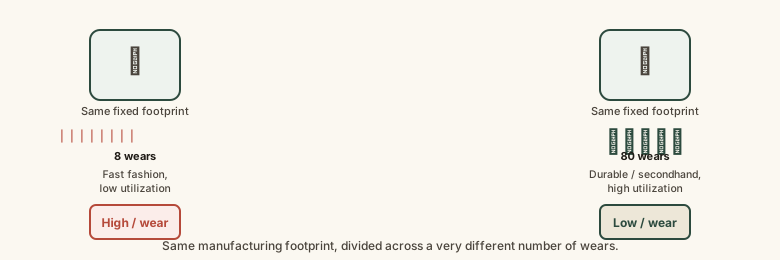
Both shirts start with an identical bar representing the same fixed manufacturing footprint — the diagram's whole point is that the footprint itself doesn't shrink or grow based on how the garment is used afterward; only the number of wears it gets divided across changes, and that's the number a buying pattern can actually influence.
Common mistakes
Common Mistakes
Assuming that buying 'eco-friendly' labeled fabric alone solves fast fashion's environmental impact.
→ Pair fabric choice with attention to how many times you'll realistically wear the item — utilization is the larger, often-overlooked lever.
Treating clothing donation as equivalent to keeping a garment in active use.
→ Understand that donated clothing only extends utilization if it's actually resold and worn again — a large share of donated clothing in high-income countries is exported or ends up unsold, per industry waste-flow research, so donation isn't automatically equivalent to a garment getting more real wears.
Believing secondhand or repaired clothing is inherently 'lower quality' than buying new.
→ Evaluate individual condition and craftsmanship on its own merits — a well-made secondhand garment with years of wear left in it delivers more utilization value than a poorly made new one bought to be quickly discarded.
Common misconception
“The most sustainable choice is always whichever specific fabric or material has the lowest publicized water or carbon footprint per kilogram.”
Per-kilogram fabric footprint numbers only capture the production stage. The Ellen MacArthur Foundation's actual textile-economy framework emphasizes garment utilization — how many times an item is worn before disposal — as at least as significant a factor, since a low-footprint fabric worn only a handful of times can still have a higher footprint-per-wear than a higher-footprint fabric worn for years.
If a shopper genuinely wants to reduce their fashion footprint, which choice does the utilization framework suggest matters most, all else equal?
What to do next
What to do next
- Before buying a new garment, estimate honestly how many times you'll realistically wear it — utilization is the biggest lever you personally control.
- Check whether a brand offers a repair program before discarding a garment with a fixable issue like a torn seam or broken zipper.
- Consider secondhand purchase for items you'll wear regularly — it extends an existing garment's utilization without adding new manufacturing footprint.
- Treat fabric-type sustainability claims as one input, not the whole picture — pair them with attention to how long you'll actually keep and wear the item.