How Cities Are Going Green: Urban Sustainability Case Studies
Cities that are widely cited as sustainability leaders got there through distinct, deliberately chosen strategies matched to their own geography and constraints, not a single universal green-city template.
Reading time
— 4 min
Updated
— Aug 22, 2026
Fact-reviewed
— Aug 22, 2026
Key Takeaways
Key Takeaways
1There's no single template for a "green city" — Copenhagen, Curitiba, and Singapore each built their sustainability reputation around a different core strategy suited to their own geography and constraints.
2Curitiba, Brazil pioneered bus rapid transit (BRT) in the 1970s specifically because it delivered rail-like capacity at a fraction of the construction cost and timeline of a subway system.
3A city's transportation modal share — the percentage of trips taken by walking, cycling, transit, or car — is a concrete, trackable metric that shows whether sustainability policy is actually changing behavior, not just intentions.
The concept
Cities frequently cited as sustainability leaders didn't all follow the same playbook. Copenhagen invested for decades in cycling infrastructure until bikes became a normal, safe way to commute. Curitiba, Brazil built an entire bus rapid transit network instead of a subway, because it could be built faster and cheaper while carrying comparable passenger volumes. Singapore, a small, dense island nation, focused on integrating greenery vertically into buildings since it has little available land for traditional parks. Each city solved the same broad problem — reducing car dependence and environmental impact — with a strategy matched to its own starting conditions.
Looking at how these strategies were chosen — not just what they are — is what makes them useful examples for other cities, rather than a checklist to copy without adaptation.
Quick check
Why did Curitiba build a bus rapid transit system in the 1970s instead of a subway, given that subways generally carry more passengers per hour?
Worked examples
Example 1: Copenhagen's decades-long cycling investment (baseline case)
Copenhagen built physically protected bike lanes (separated from car traffic, not just painted lines) as a sustained, decades-long infrastructure priority, alongside bike-specific traffic signals and dedicated bicycle bridges. The city has tracked its cycling modal share as a standing metric for years, using it to guide continued infrastructure investment — a concrete, measurable feedback loop between the policy and its outcome, rather than a one-time initiative.
Example 2: Curitiba's bus rapid transit as a capital-cost solution (edge case / variation)
Curitiba's BRT system used dedicated bus-only lanes, articulated (accordion-style) high-capacity buses, and tube-shaped stations with pre-paid, level boarding to eliminate the slow fare-collection bottleneck typical of ordinary bus stops. The result approached subway-level passenger throughput at a fraction of subway construction cost and timeline — a solution shaped directly by the city's specific 1970s financial constraint, since it couldn't have afforded a metro system on the same timeline.
Example 3: Singapore's land-constrained vertical greening (real-world / applied case)
Singapore is a small, densely populated island with little available land for traditional large parks. Rather than treating this as a hard limit on urban greenery, the city built vertical planting requirements directly into its building codes and public infrastructure — green walls, rooftop gardens, and elevated planted walkways connecting buildings — expanding green coverage without expanding land use. This strategy is specifically shaped by land scarcity, and would be a less obvious first choice for a city with abundant open land, illustrating why constraint-matched strategy, not a single "best" intervention, is the real transferable lesson.
Quick check
Would Singapore's vertical-greenery strategy necessarily be the best approach for a sprawling, land-abundant city to adopt?
How it works (visual)
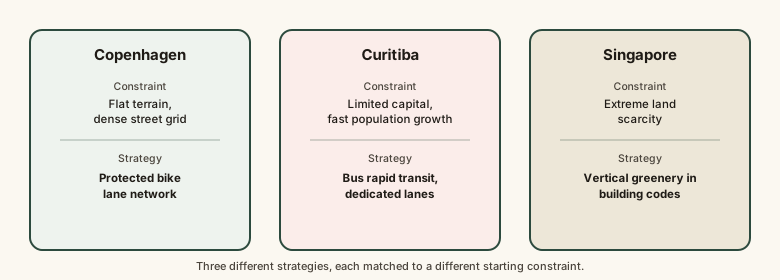
Three cities, three constraint-matched sustainability strategies
Each column pairs a real starting constraint with the strategy it produced — the pattern worth learning from these cities is that pairing, not any single strategy in isolation.
Common mistakes
Common Mistakes
✕
Assuming a strategy that worked in one famous case study city will automatically work identically anywhere else.
→ Look at what constraint or condition made that strategy the right fit in its original city, and check whether a similar condition actually exists locally before assuming transferability.
✕
Treating "green city" rankings as if they measure one single, universal standard.
→ Different rankings weight different metrics (transit modal share, green space per capita, emissions per capita) — check what a specific ranking actually measures before treating it as a complete picture.
✕
Assuming urban sustainability progress requires enormous capital investment.
→ Curitiba's BRT system specifically demonstrates that a well-designed, lower-cost intervention can rival the impact of a far more expensive one when matched well to the actual problem.
Common misconception
“A city either is or isn't a 'green city' — it's a fixed, permanent label rather than an ongoing set of policy tradeoffs and measurable outcomes.”
Every city profiled as a sustainability leader continues to face real tradeoffs and setbacks, and the cities themselves track ongoing metrics (modal share, emissions, green coverage) precisely because sustainability performance is a continuous, measurable process, not a one-time achievement that gets permanently checked off.
What to do next
What to do next
When comparing your own city to a sustainability case study, identify the specific constraint that shaped that city's strategy before assuming the same solution applies locally.
Look up your city's own tracked sustainability metrics (transit modal share, tree canopy coverage, per-capita emissions) if published — concrete numbers matter more than general reputation.
Support local infrastructure investments (protected bike lanes, dedicated transit lanes) that are matched to your city's actual geography and density, not just imported wholesale from another city's playbook.
Follow C40 Cities or similar city-sustainability networks for ongoing, updated case study data rather than relying on older, frequently-repeated examples alone.
FAQ
FAQ
Related terms
Related terms
Bus rapid transit (BRT)
A public transportation system that uses dedicated bus-only lanes and pre-boarding fare collection to move passengers at speeds and volumes closer to rail transit, at a much lower construction cost.
Modal share
The percentage of total trips in a city taken by a given mode of transportation (walking, cycling, transit, or private car), used to measure a city's transportation sustainability over time.
This entry was researched from public sources and drafted with AI-assisted tools, then edited — errors are still possible. Spot one, or want a topic covered? Read our disclaimer.
 KnowThis