A keystone species is one whose impact on its ecosystem is disproportionately large relative to its population size, meaning its removal or reintroduction can trigger a trophic cascade — a chain reaction of changes through multiple levels of the food web.
Reading time
— 4 min
Updated
— Aug 22, 2026
Fact-reviewed
— Aug 22, 2026
Key Takeaways
Key Takeaways
1A keystone species' importance is defined by its ecological effect, not its population size — some keystone species (like top predators) are naturally rare relative to the species they influence.
2Removing a keystone species can trigger a trophic cascade — a multi-level chain reaction through the food web — even when the keystone species itself was never numerous enough to seem obviously important.
3Yellowstone's wolf reintroduction is the most thoroughly documented real-world trophic cascade, showing measurable downstream effects on elk behavior, vegetation, and even river geomorphology.
The concept
A keystone species is one whose role in its ecosystem matters far more than its numbers would suggest. Sea otters are a classic example: by eating sea urchins, they keep urchin populations from exploding and devouring entire kelp forests, which countless other species depend on for habitat. Remove the otters, and urchin populations can boom unchecked, turning a lush kelp forest into a barren "urchin barren" within a few years — a huge ecosystem-wide change triggered by the loss of one relatively uncommon predator.
Understanding trophic cascades is what turns keystone species from an interesting biology fact into an actual conservation strategy — reintroducing or protecting one species can sometimes restore an entire ecosystem's function more effectively than managing dozens of species individually.
Quick check
Sea otters aren't especially numerous compared to sea urchins in a kelp forest ecosystem. Why does removing otters still cause such large ecosystem-wide change?
Worked examples
Example 1: Sea otters and kelp forests (baseline case)
Sea otters prey heavily on sea urchins, which graze on kelp holdfasts (the root-like structures anchoring kelp to the seafloor). Where otter populations were hunted to near-extinction for the fur trade in the 18th and 19th centuries, urchin populations exploded and grazed large kelp forests down to bare rock — a state ecologists call an urchin barren. Where otter populations have since recovered under protection, kelp forests have measurably regenerated, restoring habitat for fish, invertebrates, and other species that depend on kelp structure.
Example 2: Wolves, elk, and willows in Yellowstone (edge case / variation)
Wolves were eliminated from Yellowstone National Park by the 1920s and reintroduced in 1995. Without wolf predation pressure, elk populations had grown large and grazed streamside willow and aspen saplings heavily, preventing young trees from maturing. After wolf reintroduction, elk numbers declined and — notably — elk behavior changed as much as their numbers did: elk began avoiding exposed streamside areas where wolves could more easily hunt them, a phenomenon researchers call the "ecology of fear." Reduced grazing pressure allowed willow and aspen regeneration in some areas, which in turn supported beaver population recovery, since beavers depend on that same vegetation for food and dam construction.
Example 3: Why the Yellowstone story is often oversimplified (real-world / applied case)
A widely circulated narrative claims wolves single-handedly "changed the course of rivers" in Yellowstone by reducing elk grazing enough to stabilize streambank vegetation and reduce erosion. The trophic cascade mechanism is real and well-documented, but subsequent research has shown the actual outcome is more complex and geographically uneven than the popular version suggests — vegetation recovery varies significantly by location, and other factors (changing precipitation, other predator and prey dynamics) also play a role. This doesn't invalidate the trophic cascade concept, but it's a useful caution against treating any single, dramatic case study as a universally clean, simple story.
Quick check
What's the accurate way to describe the popular claim that reintroducing wolves to Yellowstone directly and simply 'changed the course of rivers'?
How it works (visual)
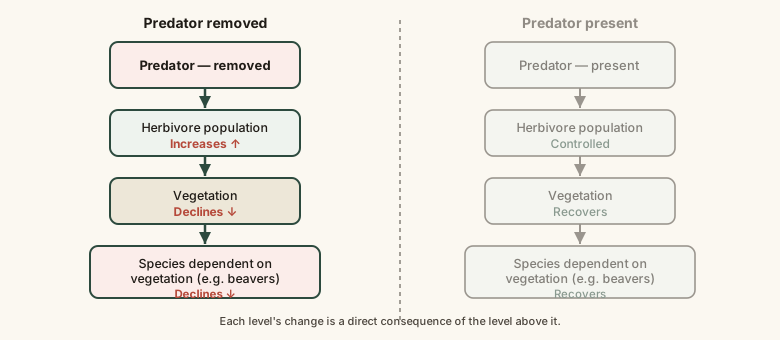
Trophic cascade: how removing a top predator ripples through a food web
Each level's change is a direct consequence of the level above it — the cascade isn't four independent effects, it's one control point (the predator) whose presence or absence propagates downward through every subsequent link in the chain.
Common mistakes
Common Mistakes
✕
Assuming keystone species must be large or numerically dominant.
→ Remember that keystone status is about disproportionate ecological effect, not population size — some keystone species (sea stars, in Paine's original research) are quite small and were never numerically dominant.
✕
Treating a single viral trophic-cascade story as a universally simple, clean example without checking for the nuance in the actual research.
→ Look for the peer-reviewed follow-up research on famous cases like Yellowstone wolves — real ecological outcomes are usually more geographically variable and multi-causal than the popularized version.
✕
Assuming keystone species are only predators.
→ Ecosystem engineers like beavers, and even some plant species, can function as keystone species through habitat creation or structural effects rather than predation.
Common misconception
“The Yellowstone wolf reintroduction proves that reintroducing any single predator will reliably and simply fix a damaged ecosystem.”
Trophic cascades are real, but their strength and outcome depend heavily on the specific ecosystem, the other species present, and factors like climate and land use — conservation biologists treat keystone species reintroduction as one powerful tool among several, not a guaranteed universal fix that works identically in every ecosystem it's applied to.
What to do next
What to do next
When reading about a species reintroduction program, look for whether researchers describe it as having a keystone or trophic-cascade effect, and check the actual cited evidence rather than assuming it's automatic.
Support conservation programs that protect top predators and ecosystem engineers, since their protection can have outsized positive ecological ripple effects.
Be skeptical of viral single-sentence summaries of complex ecological research (like "wolves changed the rivers") — look for the actual peer-reviewed nuance.
Learn your local ecosystem's keystone species, if any have been identified — many regions have a documented one, whether a predator, an ecosystem engineer, or a foundational plant species.
FAQ
FAQ
Related terms
Related terms
Keystone species
A species whose impact on its ecosystem's structure and function is disproportionately large relative to its population size or biomass, such that removing it triggers outsized ecological change.
Trophic cascade
A chain reaction of population and behavioral changes that ripples through multiple levels of a food web after a predator (or other keystone species) is added to or removed from an ecosystem.
This entry was researched from public sources and drafted with AI-assisted tools, then edited — errors are still possible. Spot one, or want a topic covered? Read our disclaimer.
 KnowThis