Nature-based solutions use living systems — trees, wetlands, soil, vegetation — to manage urban problems like flooding, extreme heat, and air pollution, often delivering the same or better results than traditional gray infrastructure at a lower long-term cost.
Reading time
— 4 min
Updated
— Aug 22, 2026
Fact-reviewed
— Aug 22, 2026
Key Takeaways
Key Takeaways
1Nature-based solutions use living systems — trees, soil, wetlands, vegetation — to perform functions that cities traditionally handled with concrete and pipes, like absorbing stormwater or cooling air.
2Urban heat islands exist because pavement and buildings absorb and re-radiate solar heat that vegetation would otherwise reflect, shade, or evaporate away — tree canopy directly counters this mechanism.
3Green infrastructure often costs less over its lifetime than equivalent gray infrastructure, because a bioswale or wetland doesn't need the same pipe replacement and pumping-station maintenance a purely engineered stormwater system does.
The concept
A nature-based solution uses living or natural systems to solve a problem cities usually handle with concrete, pipes, or machinery. A tree-lined street cools nearby sidewalks through shade and evaporation; a constructed wetland can filter polluted runoff the way a water treatment plant would; a green roof absorbs rainwater that would otherwise overwhelm a storm drain. These aren't decorative add-ons — they're functional infrastructure that happens to be alive.
The reason cities are adopting these approaches at scale isn't sentimentality about greenery — it's that the underlying physical mechanisms genuinely address real engineering problems, often at a lower long-term cost.
Quick check
Why does a tree-lined street tend to be several degrees cooler than a street with no trees, even at the same time of day and under the same sun?
Worked examples
Example 1: A green roof reducing stormwater runoff (baseline case)
A conventional flat roof sends nearly all rainfall directly into the storm drain system within minutes. A green roof — a shallow layer of soil and drought-tolerant vegetation over a waterproof membrane — absorbs a significant share of that rainfall into the growing medium and releases the rest slowly through evapotranspiration and delayed drainage, meaning less water reaches the drain system at the storm's peak, when overflow and flooding are most likely.
Example 2: Copenhagen's cloudburst streets (edge case / variation)
After a 2011 storm caused severe flooding, Copenhagen redesigned parts of its street network with a nature-based twist: streets and public squares were graded and landscaped so that, during extreme rain, they intentionally flood in a controlled way — functioning as temporary retention basins that direct water toward parks and green channels rather than overwhelming the sewer system. On a normal day, these are ordinary streets and plazas; the "solution" is dormant most of the time and activates only when needed, an unusual design pattern compared to a pipe that's either large enough or isn't.
Several cities have built constructed wetlands to treat polluted stormwater before it reaches a river or bay — water is routed through a shallow, vegetated wetland system where plant roots and microbial activity in the soil filter out sediment, excess nutrients, and some pollutants, mimicking what a natural wetland does, before the cleaner water continues downstream. This approach can handle large water volumes at a fraction of the capital cost of building an equivalent mechanical filtration plant, though it requires more land area than a compact treatment facility.
Quick check
What is a genuine tradeoff of using a constructed wetland instead of a mechanical treatment plant for stormwater filtration?
How it works (visual)
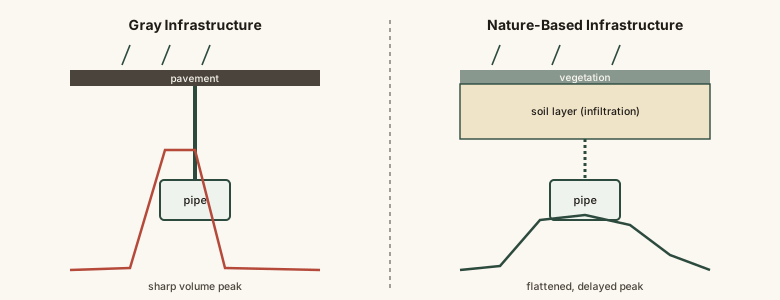
Gray infrastructure vs. nature-based infrastructure: managing the same rainstorm
The pipe on both sides eventually receives water, but the nature-based version spreads that arrival out over a longer period and reduces the peak volume — which is exactly the metric that determines whether a storm drain system overflows during a heavy rain event.
Common mistakes
Common Mistakes
✕
Treating nature-based solutions as purely aesthetic additions rather than functional infrastructure with measurable performance.
→ Recognize that green roofs, bioswales, and urban tree canopy are designed and sized to hit specific stormwater or cooling targets, the same way an engineer sizes a pipe or a chiller.
✕
Assuming nature-based solutions can always fully replace gray infrastructure everywhere.
→ Most real-world implementations are hybrid systems — nature-based elements reduce the load on pipes and pumps, they don't always eliminate the need for them entirely, especially in the densest urban cores.
✕
Underestimating the maintenance a nature-based system needs to keep functioning (soil compaction, plant die-off, clogged inlets).
→ Budget for ongoing maintenance just as you would for mechanical infrastructure — an unmaintained bioswale or green roof loses much of its designed performance over time.
Common misconception
“Nature-based solutions are a modern, unproven trend that hasn't been tested at real city scale.”
Nature-based infrastructure has been implemented at full municipal scale in multiple major cities for over a decade, with measured performance data — Copenhagen's cloudburst plan and Philadelphia's Green City, Clean Waters stormwater program are both large, long-running, and independently evaluated programs, not pilot projects or trends.
What to do next
What to do next
Look up whether your city has a green infrastructure or urban forestry plan, and check if there are tree-planting or rain-garden incentive programs available to residents.
If you have a yard, consider a rain garden or native plantings in a low spot to reduce runoff leaving your property.
Support urban tree canopy preservation in local planning decisions — mature trees provide substantially more cooling and stormwater benefit than newly planted ones.
When evaluating a city's climate resilience plans, look for nature-based solutions alongside traditional infrastructure investment, not as a replacement for basic maintenance.
FAQ
FAQ
Related terms
Related terms
Nature-based solutions
Approaches that use natural systems — vegetation, soil, wetlands — to address human and environmental challenges, such as using tree canopy to cool a city instead of relying solely on air conditioning.
Urban heat island
The effect by which cities are measurably warmer than surrounding rural areas because pavement and buildings absorb and re-radiate heat that vegetation would otherwise reflect or evaporate away.
Green infrastructure
Engineered systems that use vegetation and soil — rain gardens, bioswales, green roofs — to manage stormwater and other urban functions traditionally handled by pipes and concrete (gray infrastructure).
This entry was researched from public sources and drafted with AI-assisted tools, then edited — errors are still possible. Spot one, or want a topic covered? Read our disclaimer.
 KnowThis