An invasive species is a non-native organism that causes measurable ecological or economic harm in its new environment, typically because it lacks the natural checks — predators, competitors, parasites — that regulated its population where it evolved.
Reading time
— 4 min
Updated
— Aug 22, 2026
Fact-reviewed
— Aug 22, 2026
Key Takeaways
Key Takeaways
1Not every non-native species is invasive — the term specifically means a non-native organism causing measurable ecological or economic harm, not just an organism living somewhere new.
2The core mechanism is missing checks: a species introduced without its native predators, competitors, and parasites can undergo explosive population growth, a process called ecological release.
3Invasive species are one of the leading drivers of native species decline and extinction worldwide, alongside habitat loss, precisely because native species haven't evolved defenses against a threat that didn't exist in their shared evolutionary history.
The concept
An invasive species is a plant, animal, or other organism that ends up somewhere it doesn't naturally occur and causes real damage once it's there — outcompeting native species for food and space, spreading disease, or reshaping the whole local ecosystem. The Burmese python in Florida's Everglades is a well-documented example: released or escaped pets established a breeding population with no natural predators, and surveys have since found sharp declines in native mammal populations in areas where pythons are dense.
Understanding why a species becomes invasive — rather than just cataloging which ones are — is what makes the concept useful for thinking about conservation and prevention, not just a list of villains.
Quick check
A species of fish native to Asia is found thriving in a US river. Is it automatically classified as an invasive species?
Worked examples
Example 1: The Burmese python in the Everglades (baseline case)
Burmese pythons, native to Southeast Asia, established a breeding population in Florida's Everglades by the early 2000s, likely from escaped or released exotic pets. With no natural predator able to control an apex-level constrictor of that size, python numbers grew largely unchecked. U.S. Geological Survey road-survey data documented severe declines — in some cases over 90% — in native mammal sightings (raccoons, opossums, bobcats) in python-dense areas compared to areas where pythons hadn't yet spread, a direct predation-pressure effect from a species the native mammals had no evolved defense against.
Example 2: Zebra mussels and an ecosystem's food web (edge case / variation)
Zebra mussels don't prey on other animals directly — their damage works through the food web instead. Each mussel filters roughly a liter of water per day, removing the phytoplankton and zooplankton that native fish larvae depend on for food. Multiplied across a population that can reach tens of thousands of mussels per square meter of lake floor, this filtering can clear water dramatically (increasing sunlight penetration and altering the whole aquatic plant community) while starving out the base of the native food web — an invasive impact that spreads outward from a single species to reshape an entire ecosystem's structure.
Example 3: Why island ecosystems are especially vulnerable (real-world / applied case)
Island species often evolve in the absence of mammalian predators, since few mammals reach isolated islands naturally — which is why introduced rats, cats, and pigs have caused a disproportionate share of the world's recorded bird extinctions. Ground-nesting island birds that never evolved anti-predator behavior against a mammal have no defense once one arrives; conservation programs on islands like New Zealand now invest heavily in predator-eradication programs specifically because removing a single introduced predator species can allow native bird populations to recover in ways that would be impossible while it remained.
Quick check
Why have introduced predators like rats and cats caused disproportionate damage on islands specifically, compared to mainland ecosystems?
How it works (visual)
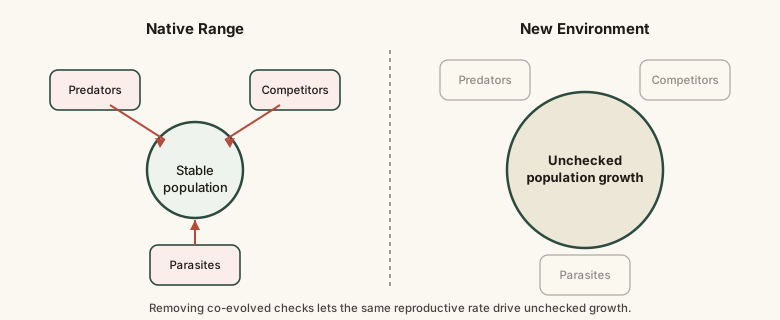
Ecological release: why an introduced species can outgrow its native population
In its native range, a species sits inside a web of pressures that keep its numbers in a rough equilibrium. Remove that species to an environment where none of those pressures exist, and the same reproductive rate that was previously balanced by predation and competition now drives sustained population growth instead.
Common mistakes
Common Mistakes
✕
Treating "non-native" and "invasive" as interchangeable terms.
→ Reserve "invasive" for non-native species with documented ecological or economic harm — many introduced species never reach that threshold.
✕
Assuming invasive species are always animals.
→ Plants (like kudzu or purple loosestrife), fungi, and even microorganisms can be classified as invasive when they cause the same kind of documented harm.
✕
Releasing exotic pets into the wild, assuming a single animal can't cause real damage.
→ Recognize that many major invasions — Burmese pythons in the Everglades among them — trace back to individual pet releases, since it only takes a small founding population to establish if conditions and food are favorable.
Common misconception
“Invasive species are simply nature adapting and spreading, so human efforts to control them are pointless or even harmful interference.”
Invasive species aren't a natural range expansion — they're typically introduced through human activity (shipping, the pet trade, agriculture) at a pace and to destinations that natural dispersal would never achieve. Because native species haven't had evolutionary time to develop defenses, the resulting harm is real and measurable, which is exactly why conservation biologists treat invasive-species management as a legitimate, evidence-based intervention rather than interference with a natural process.
What to do next
What to do next
Never release an aquarium fish, reptile, or plant into a local waterway or wild area — rehome it through a pet store, rescue, or humane surrogacy program instead.
Clean boats, boots, and gear between visits to different bodies of water or natural areas to avoid transporting invasive seeds, larvae, or spores.
Check your region's invasive species watch list (most wildlife agencies publish one) before planting ornamental species in a garden.
Support local invasive-species removal volunteer programs, which are a genuinely effective, low-cost conservation tool in many regions.
FAQ
FAQ
Related terms
Related terms
Invasive species
A non-native organism introduced to a new environment that causes measurable ecological or economic harm, typically by outcompeting native species that lack evolved defenses against it.
Ecological release
The population surge an introduced species can undergo when it arrives in a new environment free of the predators, parasites, and competitors that limited its numbers in its native range.
This entry was researched from public sources and drafted with AI-assisted tools, then edited — errors are still possible. Spot one, or want a topic covered? Read our disclaimer.
 KnowThis