A public petition is a formal request signed by members of the public asking a government body or institution to take (or not take) a specific action; most petitions are advisory with no binding legal effect, though a smaller category of formal petition mechanisms — with fixed signature thresholds set in law — can legally require a government response or trigger a specific process like a ballot initiative.
Reading time
— 4 min
Updated
— Aug 21, 2026
Fact-reviewed
— Aug 21, 2026
Key Takeaways
Key Takeaways
1A public petition is a signed request asking a government body or institution to act — but most petitions are advisory, with no legal power to force any specific outcome.
2A smaller category of formal petition mechanisms, defined in law with a fixed signature threshold, can legally require a government response or trigger a specific process like a ballot initiative.
3The real influence of an advisory petition comes from the public pressure and media attention it generates, not from any binding legal obligation it creates.
The concept
A petition is a request signed by members of the public, asking a government or institution to do (or not do) something specific. Most petitions people encounter — online or on paper — are purely advisory: they show that a lot of people care about an issue, but the recipient isn't legally required to act on them at all.
The most important practical question about any specific petition isn't how many people signed it — it's whether it's attached to a formal legal mechanism at all, since that single fact determines whether a large signature count creates any actual obligation.
Quick check
If an online petition gathers a million signatures asking a government to change a specific policy, is the government legally required to make that change?
Worked examples
Example 1: A formal petition triggering a guaranteed response (baseline case)
Some legislatures maintain an official petition system where reaching a specific, published signature threshold within a set time window legally guarantees the topic gets formally debated by lawmakers, even if the outcome of that debate isn't predetermined. This is a real, legally defined mechanism — distinct from an ordinary advisory petition — precisely because the threshold is set in official rules and crossing it triggers a specific, required procedural step.
Example 2: An advisory petition with real indirect influence (edge case / variation)
An online advocacy petition gathers hundreds of thousands of signatures on a specific issue, receives significant media coverage, and is cited by lawmakers during public debate on related legislation. The petition itself created no legal obligation, but the scale of public attention it generated became a real input into how lawmakers weighed public opinion — illustrating that "advisory" doesn't mean "without any real-world consequence," just without a guaranteed legal one.
Example 3: A ballot-initiative petition (real-world / applied case)
In a jurisdiction with a ballot-initiative process, organizers must first collect a legally specified number of verified signatures from eligible voters within a set time period. Once verified as meeting the threshold, the proposed measure is legally guaranteed a spot on the next election ballot, where voters — not lawmakers — decide its fate directly. This is one of the clearest examples of a formal petition mechanism converting a raw signature count into a legally required, specific procedural outcome.
Quick check
What typically determines whether signatures on a petition are counted as valid toward a formal legal threshold?
How it works (visual)
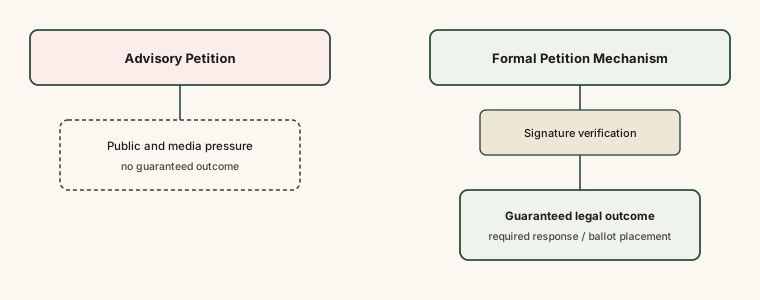
Advisory petitions vs formal petition mechanisms
The visual gap between the two paths is the whole point — one produces a guaranteed procedural outcome once its threshold is met, and the other produces only whatever indirect political pressure the campaign manages to generate.
Common mistakes
Common Mistakes
✕
Assuming a large number of petition signatures automatically creates a legal obligation for a government to act.
→ Check whether the petition is tied to a formal, legally defined mechanism — most large petitions, including online ones, are advisory only.
✕
Assuming an advisory petition has no real-world effect at all.
→ Recognize advisory petitions can still generate genuine public and media pressure, even without any binding legal requirement.
✕
Assuming raw signature counts on formal petitions are automatically valid.
→ Remember formal petition mechanisms typically require signature verification against eligibility records, so raw and certified counts can differ.
Common misconception
“If a petition reaches a certain number of signatures, the government is legally required to grant its request.”
Only formal petition mechanisms — legally defined processes with their own specific signature thresholds and procedures — create a binding legal requirement, and even then the guaranteed outcome is often a required response or debate, not the request itself being automatically granted. The overwhelming majority of petitions, including large online ones, are advisory and create no legal obligation at all.
Quick check
Does reaching a formal petition mechanism's signature threshold always guarantee that the exact requested policy change happens?
What to do next
What to do next
Before signing a petition expecting a guaranteed outcome, check whether it's tied to a formal legal mechanism or is purely advisory.
Look up whether your own jurisdiction has a formal petition or ballot-initiative process, and what its actual signature threshold is.
If you organize or support an advocacy campaign, understand that its real leverage — absent a formal mechanism — comes from sustained public and media attention, not the raw signature count alone.
Read the fine print on any petition platform about how (or whether) signatures get verified before being delivered to the target institution.
FAQ
FAQ
Related terms
Related terms
Petition
A formal, signed request from members of the public asking a government body or institution to take or refrain from a specific action.
Advisory petition
A petition with no binding legal effect — it communicates public opinion but doesn't legally obligate the recipient body to act on it.
Formal petition mechanism
A legally defined petition process, typically with a fixed minimum signature threshold, that triggers a required government response or a specific procedural outcome (such as a ballot measure) once met.
Ballot initiative
A process in some jurisdictions where a sufficiently signed public petition places a proposed law or measure directly on an election ballot for voters to decide, bypassing the ordinary legislative process.
If an online petition gathers a million signatures asking a government to change a specific policy, is the government legally required to make that change?
This entry was researched from public sources and drafted with AI-assisted tools, then edited — errors are still possible. Spot one, or want a topic covered? Read our disclaimer.
 KnowThis