Freedom of information laws give members of the public a legal right to request and receive records held by government bodies, subject to specific, defined exemptions (such as national security, ongoing law enforcement investigations, or personal privacy) that agencies can invoke to withhold particular records or portions of them.
Reading time
— 4 min
Updated
— Aug 21, 2026
Fact-reviewed
— Aug 21, 2026
Key Takeaways
Key Takeaways
1Freedom of information laws give the public a real, legally enforceable right to request records from government bodies — this is a genuine legal mechanism, not just a general democratic ideal.
2That right is not unlimited — nearly every freedom of information law includes specific, defined exemptions (national security, ongoing investigations, personal privacy, and similar categories) that agencies can invoke to withhold certain records.
3Many governments also practice proactive disclosure, publishing categories of records automatically, specifically to reduce the volume of individual requests needed.
The concept
A freedom of information law gives ordinary people the legal right to ask a government agency for its records — reports, emails, data, internal documents — and generally requires the agency to provide them within a set time. It's a real legal tool, not just a general idea about transparency, and a denied request can often be appealed or challenged.
The practical reality of freedom of information requests is less "ask and instantly receive everything" and more "ask, and the agency applies a defined legal process, which may include lawful redactions or full exemptions for specific portions."
Quick check
Can a government agency lawfully withhold every record it doesn't want to release, using its own discretion alone?
Worked examples
Example 1: A straightforward request (baseline case)
A person submits a formal request to a government agency for a specific report on local air quality data. The agency locates the report, finds no applicable exemption, and releases it in full within the legally required response window — a routine outcome for requests involving records with no sensitive content.
Example 2: A partial release with redactions (edge case / variation)
A requester asks for internal agency emails discussing a policy decision. The agency releases the emails but redacts a small number of passages, citing a personal-privacy exemption for portions referencing private individuals' medical information unrelated to the policy discussion itself. The bulk of the requested record is still disclosed — only the specifically exempt portions are withheld, illustrating that exemptions often apply to specific passages, not entire documents.
Example 3: An appealed denial (real-world / applied case)
An agency denies a request entirely, citing an ongoing-investigation exemption. The requester believes the exemption is being applied too broadly and files a formal appeal, as most freedom of information laws provide for. An independent review (sometimes an internal appeals office, sometimes a court) then evaluates whether the exemption was properly applied — a real check on agency discretion, though one that takes additional time and doesn't guarantee the requester ultimately receives the record.
Quick check
If a requester believes a government agency wrongly denied their freedom of information request, do they have any recourse?
How it works (visual)
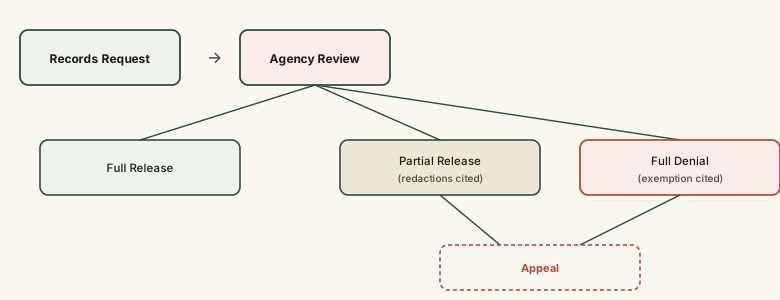
From request to release, denial, or appeal
Both the partial-release and full-denial branches lead to the same appeal option — the law's real safeguard against improper withholding isn't preventing all exemptions, it's guaranteeing a way to challenge how they're applied.
Common mistakes
Common Mistakes
✕
Assuming freedom of information laws guarantee access to absolutely any government record with no exceptions.
→ Check the law's specific exemption categories — nearly every freedom of information law includes defined exemptions like national security or personal privacy.
✕
Assuming freedom of information requests apply to private companies as well as government bodies.
→ Remember these laws generally apply to government bodies specifically, not private company records, unless a separate law independently applies.
✕
Treating a denied request as automatically final.
→ Check for a formal appeal process — most freedom of information laws provide one to contest an improperly applied exemption.
Common misconception
“Freedom of information laws mean any government record can be requested and must be fully released without exception.”
Freedom of information laws create a real, legally enforceable right to request government records, but that right operates within a defined structure of exemptions — categories like national security, ongoing investigations, and personal privacy that agencies can lawfully cite to withhold a record or specific portions of it. The right to request and the right to unconditional full disclosure are not the same thing.
Quick check
Do freedom of information laws generally apply to private company records?
What to do next
What to do next
Look up your own country or region's specific freedom of information law and its published response-time requirements before filing a request.
Check whether the records you want are already proactively published online before filing a formal request — it can save significant time.
If a request is denied or redacted, review the specific exemption cited and check whether the law's appeal process applies.
Read a real, published freedom of information response (many governments post redacted release logs) to see exactly how exemptions get applied in practice.
FAQ
FAQ
Related terms
Related terms
Freedom of information law
Legislation granting members of the public a legal right to request and receive records held by government bodies, subject to specific defined exemptions.
Exemption
A specific, legally defined category (such as national security or personal privacy) that allows a government body to lawfully withhold a requested record or a portion of it.
Proactive disclosure
A government practice of publishing certain categories of records or data automatically, without waiting for an individual request, often to reduce the volume of formal requests needed.
Public records
Documents and data created or held by a government body in the course of conducting official business, generally the subject matter freedom of information requests seek to access.
This entry was researched from public sources and drafted with AI-assisted tools, then edited — errors are still possible. Spot one, or want a topic covered? Read our disclaimer.
 KnowThis