 KnowThis
Key Takeaways
Key Takeaways
- 1An ambassador is a country's top-ranking accredited representative to another country, formally distinct from a consul, whose job focuses on citizen services and trade rather than full political representation.
- 2The Vienna Convention on Diplomatic Relations (1961) formally codifies diplomatic ranks and courtesies, which is why diplomatic protocol looks broadly similar across almost every country in the world.
- 3Order of precedence among ambassadors is typically determined by length of continuous service in that specific posting (the 'dean of the diplomatic corps' principle), not by the relative size or power of the country they represent.
The concept
Because these titles map to specific defined roles rather than being informal honorifics, knowing which one applies tells you concretely what kind of work that official is actually responsible for.
A traveler needs help after losing their passport abroad. Should they contact their country's embassy or its consulate in that region?
Worked examples
Example 1: Identifying the right official for a given need (baseline case)
Example 2: An ambassador's temporary absence (edge case / variation)
Example 3: Determining the dean of the diplomatic corps (real-world / applied case)
At a formal diplomatic event, which ambassador is traditionally recognized as the dean of the diplomatic corps and given precedence among the ambassadors present?
How it works (visual)
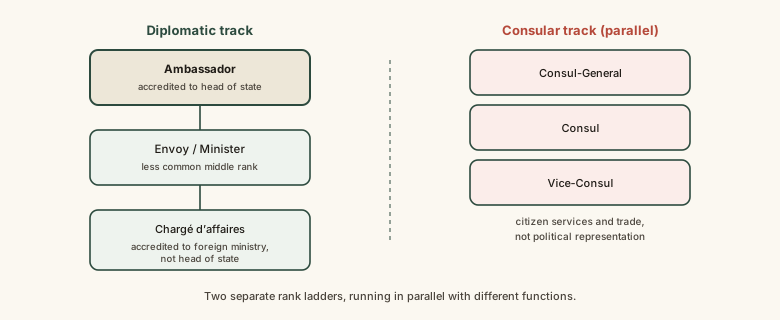
The consular track running alongside the main diplomatic-rank ladder is exactly why a country can simultaneously have an ambassador handling political relations and a separate consul-general handling passports and trade in a different city, without either role overlapping the other's defined function.
Common mistakes
Common Mistakes
Using 'ambassador' and 'consul' as interchangeable titles for any diplomatic official.
→ Check the specific function involved — ambassador for political representation and embassy leadership, consul for citizen services, visas, and trade support.
Assuming diplomatic precedence at events is based on a country's size, wealth, or power.
→ Remember precedence among ambassadors of the same rank is set by seniority of continuous service in that posting, not by the relative standing of the country represented.
Treating a temporary chargé d'affaires (covering for an absent ambassador) as a permanent demotion of that country's diplomatic representation.
→ Recognize the interim chargé d'affaires role is a normal, temporary bridging arrangement, not a downgrade in the underlying diplomatic relationship.
Common misconception
“Diplomatic titles and protocol are largely symbolic formalities with no real practical function.”
Protocol exists specifically to prevent rank and precedence disputes from escalating into genuine diplomatic friction — a seating arrangement or speaking order that appears to slight one country's representative relative to another's has historically caused real diplomatic incidents. A shared, internationally recognized rulebook (largely from the Vienna Convention) is what keeps these situations procedural rather than personal or political.
What to do next
What to do next
- When you need help abroad as a citizen, look for the consulate or consular section, not necessarily the main embassy.
- Remember that diplomatic precedence tracks seniority of service in a posting, not the relative power of the country represented.
- Don't assume a temporary chargé d'affaires signals any downgrade in a diplomatic relationship — it's a routine bridging arrangement.
- When reading about diplomatic events, note which rank (ambassador, envoy, chargé d'affaires) is involved — it tells you the formal level at which that exchange is happening.