 KnowThis
Key Takeaways
Key Takeaways
- 1A sustainable news habit fixes both the number of sources (a small, deliberately chosen set) and the schedule (a set check-in time) — leaving either one open-ended is what produces the fatigue most people associate with 'keeping up with the news.'
- 2Source diversity matters more than source volume — three outlets with genuinely different editorial approaches inform better than ten outlets echoing the same wire-service story.
- 3Algorithmic feeds and push notifications are optimized for engagement time, not for informing you efficiently — a habit built around them will structurally tend toward the doomscrolling pattern rather than away from it.
The concept
The goal isn't to consume less information — it's to make consumption a deliberate, bounded choice instead of a background process running continuously in the background of the day.
Why does relying on an algorithmic social media feed for news tend to produce more anxious, less informative consumption than a scheduled check-in with fixed sources?
Worked examples
Example 1: Building a minimal fixed source list (baseline case)
Example 2: Handling a fast-moving breaking story without falling into continuous refreshing (edge case / variation)
Example 3: Auditing an existing feed-based habit and rebuilding it (real-world / applied case)
A reader wants to stay informed on a fast-moving story without falling into continuous refreshing. What's the better approach?
How it works (visual)
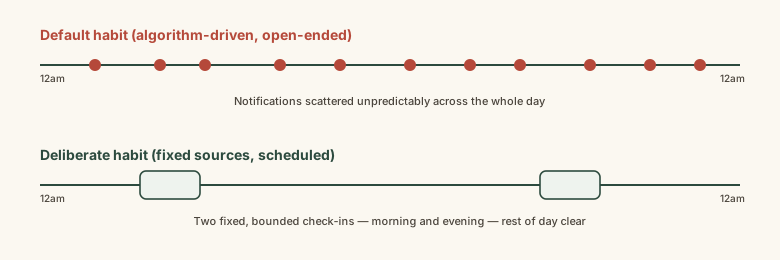
The contrast isn't about total information consumed — it's about whether that consumption is scattered across the whole day at an algorithm's initiative, or concentrated into a couple of bounded, self-initiated sessions.
Common mistakes
Common Mistakes
Leaving push notifications on for news apps and social media, then trying to 'just not check' them.
→ Turn off push notifications for news content entirely — a scheduled habit works far better without a competing always-on trigger.
Following many sources that all repeat the same wire-service story, mistaking volume for diversity.
→ Prioritize a small number of sources with genuinely different editorial approaches or ownership over a large number that mostly overlap.
Treating a fast-moving breaking story as a reason to abandon the scheduled habit and refresh continuously.
→ Add one or two extra scheduled check-ins for the day rather than switching to unbounded refreshing.
Common misconception
“Staying well-informed requires checking the news frequently throughout the day.”
Frequency of checking and quality of being informed aren't the same thing. A small, deliberately diverse set of sources checked on a fixed schedule reliably captures the meaningful developments in most stories, since the bulk of what continuous checking adds is provisional, soon-revised coverage rather than new settled information. Frequent checking is more strongly associated with news fatigue than with being measurably better informed.
What to do next
What to do next
- Pick 3-5 fixed sources with genuinely different editorial perspectives, rather than many sources that mostly overlap.
- Turn off push notifications for news apps and social media entirely.
- Set one or two specific times a day (or a few times a week) to check the news, rather than checking whenever a notification or idle moment appears.
- During a genuinely fast-moving story, add a couple of extra scheduled check-ins rather than switching to unbounded refreshing.