Extended screen use is associated with digital eye strain, a real, well-documented cluster of symptoms (dryness, fatigue, blurred vision) linked partly to reduced blink rate during screen focus — the widely recommended 20-20-20 rule (every 20 minutes, look at something 20 feet away for 20 seconds) is a simple behavioral habit aimed at interrupting sustained near-focus and encouraging blinking.
Reading time
— 4 min
Updated
— Aug 22, 2026
Fact-reviewed
— Aug 22, 2026
This entry explains general eye-health literacy — it is not a substitute for an eye exam. Persistent or worsening eye symptoms should be evaluated by an eye care professional.
Key Takeaways
Key Takeaways
1Digital eye strain (also called computer vision syndrome) is a real, documented cluster of symptoms — dryness, fatigue, blurred vision, headaches — associated with extended screen use, per the American Academy of Ophthalmology.
2One documented mechanism is reduced blink rate: people blink noticeably less often during focused screen tasks, which reduces tear-film replenishment and contributes to dryness.
3The 20-20-20 rule — every 20 minutes, look at something 20 feet away for 20 seconds — is a simple habit designed to interrupt sustained near-focus and encourage natural blinking and refocusing.
The concept
Digital eye strain is a documented set of symptoms linked to extended screen use, per the American Academy of Ophthalmology and NIH's National Eye Institute. A big contributor is that people blink less often while focused on a screen, which lets the eye's tear film dry out faster than usual. The 20-20-20 rule is a simple, widely recommended habit meant to interrupt that pattern.
Because reduced blinking is a specific, identifiable mechanism, habits that either increase conscious blinking or force a break from near-focus directly address the documented cause, not just the symptom.
Quick check
Why does screen use specifically reduce blink rate compared to other activities?
Worked examples
Example 1: Applying the 20-20-20 rule during a workday (baseline case)
During a two-hour work block on a computer, the 20-20-20 rule suggests roughly six breaks (every 20 minutes), each just 20 seconds long, looking at something at least 20 feet away — a window view, a far wall, or a hallway. The total added time is only about 2 minutes across the full two hours, a low-cost habit relative to the documented benefit.
Example 2: Why "20 feet away" specifically matters, not just "looking away" (edge case / variation)
Glancing at a nearby object still just a few feet away doesn't relax the eye's focusing muscles the same way a farther-away object does, since the eye still needs to maintain a relatively near focus. The 20-foot distance is specifically chosen because it approximates optical infinity for the eye's focusing muscles — beyond roughly 20 feet, the eye doesn't need to actively adjust focus further, allowing the near-focus muscles to genuinely relax rather than just shift slightly.
Quick check
Does looking at any object a few feet away provide the same benefit as the 20-20-20 rule's 20-feet guidance?
Example 3: Screen brightness and ambient lighting as an additional factor (real-world / applied case)
The American Academy of Ophthalmology also cites screen brightness relative to ambient room lighting as a contributor to eye strain — a very bright screen in a dark room, or a dim screen in a bright room, both increase the eye's workload to adjust. Matching screen brightness closer to the surrounding room lighting, alongside taking 20-20-20 breaks, addresses a second documented contributor beyond blink rate alone.
How it works (visual)
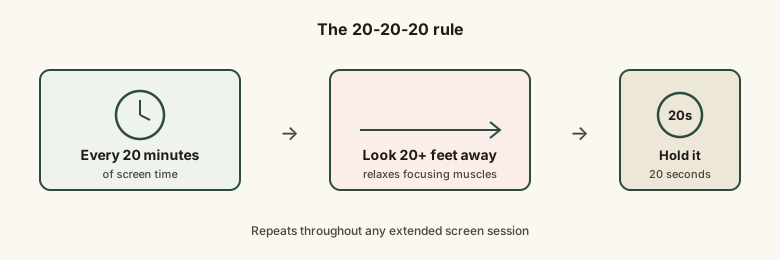
The 20-20-20 rule
The rule's structure — a time trigger (20 minutes), a distance target (20 feet), and a duration (20 seconds) — makes it easy to remember and apply without any special equipment.
Common mistakes
Common Mistakes
✕
Assuming digital eye strain causes permanent eye damage.
→ Per the American Academy of Ophthalmology, symptoms are generally temporary and resolve with breaks and habit changes, not permanent harm.
✕
Looking at a nearby object instead of something genuinely far away during a break.
→ Aim for roughly 20 feet or more, since closer objects still require active near-focus and provide less muscle relaxation.
✕
Ignoring ambient lighting and screen brightness mismatch as a contributing factor.
→ Match screen brightness closer to the surrounding room's lighting level to reduce eye workload.
Common misconception
“Screens themselves emit something that directly damages the eyes over time.”
Major eye-health authorities, including the American Academy of Ophthalmology, describe digital eye strain as a temporary, symptom-based condition tied to how screens are used (sustained near-focus, reduced blinking, brightness mismatch) — not a claim of direct physical damage from the screen or its light output. The documented concern is comfort and temporary strain, not lasting injury.
Quick check
Does the American Academy of Ophthalmology characterize digital eye strain as causing permanent eye damage?
What to do next
What to do next
Apply the 20-20-20 rule during extended screen sessions: every 20 minutes, look 20 feet away for 20 seconds.
Consciously blink more often during focused screen work, since blink rate is documented to drop during near-focus tasks.
Match screen brightness to the surrounding room's ambient lighting rather than leaving it at a fixed setting.
See an eye care professional if symptoms are persistent or worsening, rather than assuming they'll resolve on their own.
FAQ
FAQ
Related terms
Related terms
Digital eye strain
A cluster of symptoms — including dryness, fatigue, and blurred vision — associated with extended screen use, also referred to as computer vision syndrome.
Blink rate
How often the eyes blink per minute; documented to decrease during sustained close-up visual tasks like screen use, reducing tear-film replenishment.
This entry was researched from public sources and drafted with AI-assisted tools, then edited — errors are still possible. Spot one, or want a topic covered? Read our disclaimer.
 KnowThis