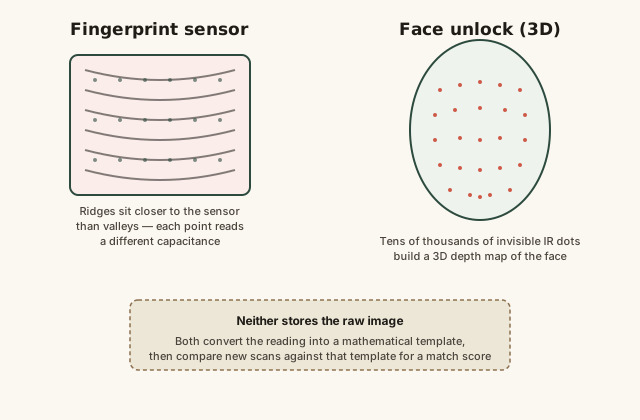
Fingerprint unlock typically uses a capacitive sensor that reads the pattern of ridges and valleys on a finger as tiny differences in electrical capacitance, while 3D face unlock projects thousands of invisible infrared dots to build a depth map of the face — and both convert their reading into a mathematical template rather than storing a raw image.
Reading time
— 5 min
Updated
— Sep 24, 2026
Fact-reviewed
— Aug 28, 2026
Key Takeaways
Key Takeaways
1A capacitive fingerprint sensor reads the ridge-and-valley pattern on a finger electrically, not visually — ridges sit closer to the sensor than valleys, producing a measurable capacitance difference at each point.
2Secure 3D face unlock projects thousands of invisible infrared dots onto the face to build an actual depth map, which is fundamentally more secure than simply comparing a flat 2D photo.
3Neither system stores a raw image or photo for comparison — both convert the scan into a mathematical template, and future unlock attempts are compared against that template, not against a picture.
The concept
A fingerprint sensor doesn't take a photo of your finger — it feels the shape of the ridges electrically, similar to running a fingertip over a texture and noticing the bumps without looking at it. A secure face unlock system doesn't just take a picture either — it shines an invisible pattern of light onto your face and measures how that pattern bends and shifts across the shape of your features, building something closer to a 3D sculpture of your face than a flat photograph. In both cases, the device turns what it senses into a set of numbers — a biometric template — and compares new scans against those numbers, not against a stored picture.
The "template, not image" distinction is the single most important thing to understand about how these systems actually work, and it directly answers one of the most common privacy questions people have about biometric unlock.
Quick check
Does a phone's fingerprint sensor store an actual image or photo of your fingerprint that could theoretically be viewed or extracted as a picture?
Worked examples
Example 1: Setting up a fingerprint unlock for the first time (baseline case)
During setup, the sensor asks for multiple touches of the same finger at slightly different angles and positions, because a single scan rarely captures the full ridge pattern cleanly across the whole sensor area. Each touch produces a capacitance reading across the sensor's grid, and the device combines several of these readings into a single, more complete and reliable template representing that finger's ridge pattern. From then on, each unlock attempt captures a fresh scan, generates a fresh template from it, and compares that fresh template against the one stored during setup — accepting the unlock if the match score is high enough.
Quick check
During fingerprint setup, why does the sensor ask for several touches of the same finger at slightly different angles instead of accepting just one scan?
Example 2: Why a wet or very dry finger can fail to register (edge case / variation)
A finger that's very wet, very dry, or has a fresh cut across the ridge pattern can produce a distorted or incomplete capacitance reading, since the sensor's ability to distinguish ridges from valleys depends on a clean, consistent electrical contrast between the two. Excess moisture can create a more uniform electrical layer across the sensor that masks the ridge-and-valley difference, while very dry skin can reduce the finger's overall conductivity, both making the resulting scan noisier and more likely to fall below the match-score threshold even for the finger's genuinely correct owner. This is a physical sensing limitation, not a security malfunction — the correct finger, under different moisture conditions, simply doesn't always produce a clean enough electrical signal to match reliably.
Quick check
Why might a fingerprint sensor occasionally fail to recognize the correct owner's finger right after they've been swimming, even though it works fine normally?
Example 3: Face unlock being fooled by a photo, and why 3D systems resist this (real-world / applied case)
A simple 2D face recognition system, relying only on a standard camera image, can potentially be tricked by a sufficiently good printed photo or a photo displayed on another screen, since it's comparing flat image features rather than genuine physical depth. A 3D face unlock system using structured light largely resists this specific attack, because a flat photo — printed or on a screen — doesn't have real depth for the infrared dot pattern to map; the projected dots land on a flat surface rather than distorting around the contours of an actual nose, cheekbones, and eye sockets, producing a depth map that clearly fails to match the genuine stored 3D template. This is precisely why device manufacturers implementing face unlock for actual security purposes (rather than casual convenience) specifically emphasize 3D depth sensing rather than a simple camera comparison.
Quick check
A printed photo of a phone's owner is held up to the phone's 3D face unlock system, which uses infrared dot projection. Why does this typically fail to unlock the phone?
How it works (visual)
Capacitive fingerprint sensing vs. 3D infrared face mapping
The shared bottom box is the most important part of this diagram — regardless of which sensing method is used, what actually gets stored and compared later is a set of numbers, never a picture.
Common mistakes
Common Mistakes
✕
Believing a fingerprint or face scan is stored as a viewable image somewhere on the device.
→ Modern biometric systems store a mathematical template derived from the scan, not the original image — this is a deliberate privacy and security design choice, not an accident of how the sensors happen to work.
✕
Assuming all 'face unlock' features offer the same level of security.
→ A basic 2D camera-based face unlock is meaningfully less secure than a 3D depth-sensing system, since a flat photo can potentially fool the former but not the latter — check which type a specific device actually uses if security matters to you.
✕
Assuming a failed fingerprint scan always means a sensor problem or security flag.
→ Wet, very dry, or injured fingers commonly produce lower-quality scans that fail to clear the match threshold — this is usually a scan-quality issue, not a device malfunction.
Common misconception
“Your device keeps an actual picture of your fingerprint or face on file, which could theoretically be leaked or viewed as an image.”
Modern fingerprint and face unlock systems convert the scan into a biometric template — a mathematical representation of distinguishing features — rather than storing the raw scan itself. This template is generally not designed to be reversible back into a usable image, and reputable implementations keep it stored within dedicated secure hardware on the device rather than as an ordinary accessible file, specifically to limit what could be exposed even in a broader device compromise.
What to do next
What to do next
If a device offers both a basic camera-based face unlock and a proper 3D depth-based option, prefer the 3D option when security matters more than casual convenience.
Don't assume an occasional failed fingerprint or face scan means something is broken — wet or dry skin, poor lighting, and minor injuries can all reduce scan quality temporarily.
Register more than one finger during fingerprint setup if your device allows it, to reduce failed unlock attempts from minor everyday variation.
Still set a strong backup PIN or passcode — every biometric system falls back to one, and it deserves the same care as the biometric method itself.
FAQ
FAQ
Related terms
Related terms
Capacitive fingerprint sensor
A fingerprint sensor that detects the ridge-and-valley pattern of a finger by measuring tiny differences in electrical capacitance at each point on a small grid, since ridges sit closer to the sensor than valleys.
Biometric template
A mathematical representation derived from a fingerprint or face scan, used for comparison during future unlock attempts — not a stored photograph or raw image of the original scan.
Structured light / IR dot projection
A depth-sensing technique that projects a large number of invisible infrared dots onto a surface (such as a face) and measures how the pattern distorts to calculate a detailed 3D shape.
Match score
A calculated measure of how closely a new scan's template matches a previously stored template, which the system compares against a threshold to decide whether to unlock.
2D face recognition
A less secure face-matching approach based on a standard flat photo or camera image, which can potentially be fooled by a photograph, unlike a 3D depth-based system.
False accept rate
The statistical rate at which a biometric system incorrectly matches a different person's scan as a positive match, one of the key metrics used to judge a biometric system's security.
This entry was researched from public sources and drafted with AI-assisted tools, then edited — errors are still possible. Spot one, or want a topic covered? Read our disclaimer.
 KnowThis