 KnowThis
Key Takeaways
Key Takeaways
- 1Recipes worldwide specify oven temperature in one of three systems: Celsius (most of the world), Fahrenheit (US), or UK gas marks (1 through 9).
- 2Gas mark to Celsius is only an approximation — roughly °C ≈ (gas mark × 14) + 121 — because gas marks were never a precise linear temperature scale to begin with.
- 3A fan (convection) oven typically runs about 20°C hotter than the same dial number on a conventional oven, so recipes often list both a conventional and a fan temperature.
The concept
With the base formulas established, the practical skill is reading a recipe correctly regardless of which of the three systems it was written in.
A US recipe calls for baking at 375°F. Roughly what Celsius temperature should you set on an oven that only displays Celsius?
Worked examples
Example 1: Converting a common baking temperature (baseline case)
Example 2: Adjusting for a fan oven (edge case / variation)
Example 3: Reading an old UK recipe with only a gas mark listed (real-world / applied case)
Why is the gas-mark-to-Celsius formula described as an approximation rather than an exact conversion, unlike Celsius-to-Fahrenheit?
How it works (visual)
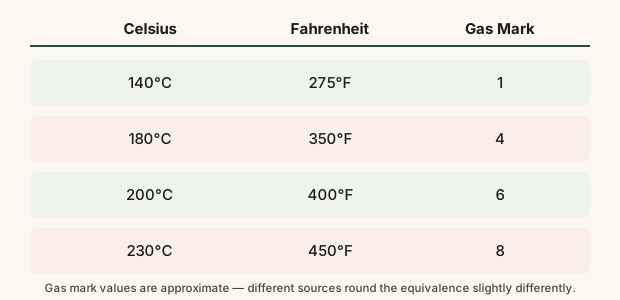
Reading across any row gives roughly the same oven heat in all three systems — useful as a quick lookup when a recipe uses a system your oven doesn't display, without doing the arithmetic each time.
Common mistakes
Common Mistakes
Treating gas mark as if it converts to Celsius with the same precision as Fahrenheit does.
→ Use the gas mark equivalence as a reasonable starting point, but expect minor variation between sources — it was never a precisely calibrated scale.
Forgetting to adjust for a fan (convection) oven when a recipe was written for a conventional oven, or vice versa.
→ Apply the roughly 20°C fan-oven offset (lower for fan, higher for conventional), and check your oven manufacturer's specific guidance since offsets vary.
Rounding an oven temperature conversion so aggressively that it changes the cooking outcome (e.g. rounding 190°C down to 175°C).
→ Round to the nearest 5 or 10 degrees on the target scale, not further — ovens have enough thermostat variance already without adding avoidable rounding error.
Common misconception
“Gas mark, Celsius, and Fahrenheit all convert to each other with the same mathematical precision.”
Celsius and Fahrenheit have an exact, continuous mathematical relationship (°F = °C × 9/5 + 32). Gas mark is a coarser, historically derived scale from early UK gas oven regulators, so its relationship to Celsius is only ever an approximation — useful for cooking, but not exact the way the Celsius-Fahrenheit formula is.
A recipe from the UK lists both a conventional oven temperature and a lower fan oven temperature. Why does it list two numbers instead of one?
Try it yourself
What to do next
What to do next
- Keep a quick reference table of the three oven systems (Celsius, Fahrenheit, gas mark) near your oven if you regularly cook recipes from different regions.
- When a recipe specifies "fan" or "conventional," match it to your actual oven type, or apply the roughly 20°C adjustment if it doesn't.
- Use the standard Celsius-Fahrenheit formula for precision, and treat gas mark conversions as approximate — round sensibly, don't over-calculate.
- Trust your oven thermometer over the dial label when precision really matters — domestic oven dials are commonly off by 10-15°C from the true internal temperature.