 KnowThis
Key Takeaways
Key Takeaways
- 1The 24-hour clock and 12-hour clock measure the exact same 24 hours in a day — the only difference is how each hour is labeled, not how time itself works.
- 2The 12-hour clock reuses the numbers 1 through 12 twice per day and depends entirely on an AM/PM label to say which half is meant; the 24-hour clock gives every hour a single number from 0 to 23, so the label becomes unnecessary.
- 312:00 AM and 12:00 PM are the single most error-prone moments in the 12-hour system, because 12 doesn't intuitively feel like it comes 'before' 1 the way 0 obviously does — this is precisely the ambiguity the 24-hour clock was designed to eliminate.
The concept
The two formats aren't measuring different things — a flight that departs at 15:15 and one that departs at 3:15 PM leave at the identical instant. What changes is how much interpretation is required to read that instant correctly.
Why is 24-hour time considered less error-prone than 12-hour time for things like flight schedules and hospital records?
Worked examples
Example 1: Converting a straightforward PM time (baseline case)
Example 2: The noon/midnight edge case (edge case / variation)
Someone converts 12:00 AM to 24-hour time and writes 12:00. What went wrong?
Example 3: Decimal hours for payroll and scheduling (real-world / applied case)
How it works (visual)
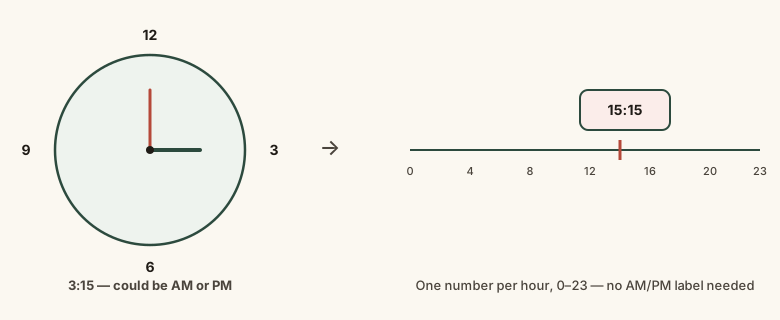
The analog clock face physically can't tell you whether it's AM or PM — the hands land in the same place either way. The 24-hour number line has no such gap: every position from 0 to 23 corresponds to exactly one hour of the day, with nothing left for a label to disambiguate.
Common mistakes
Common Mistakes
Converting 12:00 AM to 24-hour time as 12:00 instead of 00:00.
→ Remember midnight always converts to 00:00 — 12:00 in 24-hour time exclusively means noon.
Adding 12 to 12:00 PM, producing an incorrect '24:00' or wrapping to '00:00'.
→ 12:00 PM (noon) is the one PM hour that stays as 12:00 — the 'add 12' rule only applies to PM hours 1 through 11.
Writing 24-hour time with a colon-free four-digit format (e.g. 1530) and reading it as a decimal number for math.
→ 1530 is not the number fifteen-hundred-thirty — it's 15 hours and 30 minutes. Convert to decimal hours (15.5) explicitly before doing arithmetic, using the minutes/60 approach.
Common misconception
“24-hour time is a more 'precise' or scientifically different measurement of time than 12-hour time.”
Both formats describe the exact same 24-hour day at the exact same precision — a flight leaving at 15:15 and one leaving at 3:15 PM depart at the identical instant. The only difference is notation: 24-hour time assigns each hour a unique number so no AM/PM label is needed, while 12-hour time reuses 1–12 twice per day and relies on that label to disambiguate.
A digital clock displays '00:45'. What time is this in 12-hour format?
Try it yourself
What to do next
What to do next
- When converting PM hours to 24-hour time, add 12 to every hour except 12 PM itself, which stays as 12:00.
- When converting AM hours, keep the number the same except 12 AM, which becomes 00:00.
- For payroll or duration math, convert clock times to decimal hours (hour + minutes/60) before subtracting, rather than trying to subtract hours and minutes separately.
- Default to 24-hour time for anything scheduling-critical (travel, medication, shift handoffs) where an AM/PM misread would actually matter.